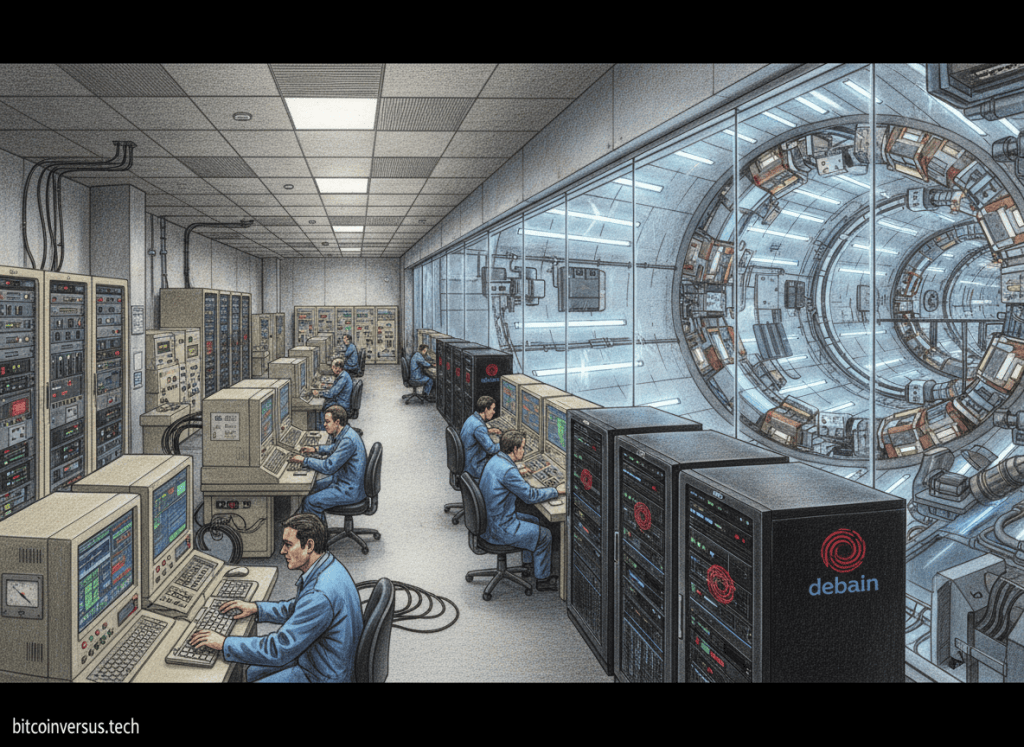
CERN plans to have more than 2,200 industrial computers and embedded systems in its accelerator-control infrastructure running Debian 13 by the end of 2026. The migration puts one of the world’s most demanding scientific control environments behind a mainstream community Linux distribution—and highlights how CPU support policy can determine the operating system used by physical infrastructure.
The Debian Project announced the 2,200-plus-system target on September 1 and linked directly to CERN’s MiniDebConf technical presentation on controlling its accelerators with Debian. Phoronix independently reported the migration and its connection to newer Red Hat Enterprise Linux x86-64-v3 requirements. Linux publisher nixCraft also highlighted the CERN migration on X.
Why 2,200 control computers matter
These are not ordinary office desktops. CERN’s accelerator complex depends on industrial computers and embedded systems connected to equipment that must be controlled predictably for long operating lifetimes. Hardware replacement cycles in that environment can be very different from consumer or cloud computing, making long-lived CPU compatibility a practical infrastructure requirement.
That makes the migration a useful counterpoint to the rapid hardware cadence elsewhere in Linux. BitcoinVersus.Tech recently covered Qualcomm opening Snapdragon X2 to Linux developers, where the challenge is enabling brand-new silicon. CERN faces the opposite problem: keeping mature industrial hardware useful and supportable.
The x86-64-v3 compatibility problem
According to the technical reporting around the transition, a central issue is the move by newer Enterprise Linux releases toward an x86-64-v3 CPU baseline. That baseline enables newer processor instructions but excludes older x86-64 hardware that does not implement the required feature set. For a research facility with specialized machines still performing their intended job, replacing functioning hardware simply to satisfy an operating-system baseline can be expensive and operationally disruptive.
Debian 13 gives CERN a path to newer userspace and security maintenance while retaining compatibility with a broader hardware fleet. It is the same reason Linux hardware support matters outside laboratories: the operating system can extend the useful life of servers, appliances and embedded controllers long after a consumer-oriented replacement cycle would have retired them.
Linux is part of the machine, not just the server room
CERN’s move is a reminder that Linux increasingly sits inside operational technology. The distribution choice affects drivers, package maintenance, remote administration, security updates and the ability to keep specialized equipment working over long service lives.
Firmware maintenance is another layer of that lifecycle. The site recently examined fwupd’s expanding Linux firmware support, while FortiOS shows how Linux also underpins dedicated network-security appliances. CERN extends the same theme into accelerator control: Linux is increasingly embedded in the infrastructure that makes physical systems operate.
Debian wins by supporting the hardware CERN already owns
The notable part of CERN’s decision is not a benchmark victory. It is lifecycle economics and engineering compatibility. A Linux distribution that continues to support the processors inside working industrial machines can be more valuable than one optimized around a newer baseline those machines cannot meet.
For data centers, mines, factories, laboratories and other infrastructure operators, the lesson is straightforward: operating-system roadmaps and CPU roadmaps are now part of equipment-lifecycle planning. CERN’s 2,200-machine migration shows what happens when those roadmaps diverge.
BitcoinVersus.Tech
Advertisement
Editor’s Note:
We volunteer daily to ensure the credibility of the information on this platform is Verifiably True. If you would like to support our research initiatives, please donate here: 3C9o19EH5HSiwEPyCTmEKzxhNCbo2X6TTb
BitcoinVersus.tech is not a financial advisor. This media platform reports on financial subjects purely for informational purposes.


Leave a Reply