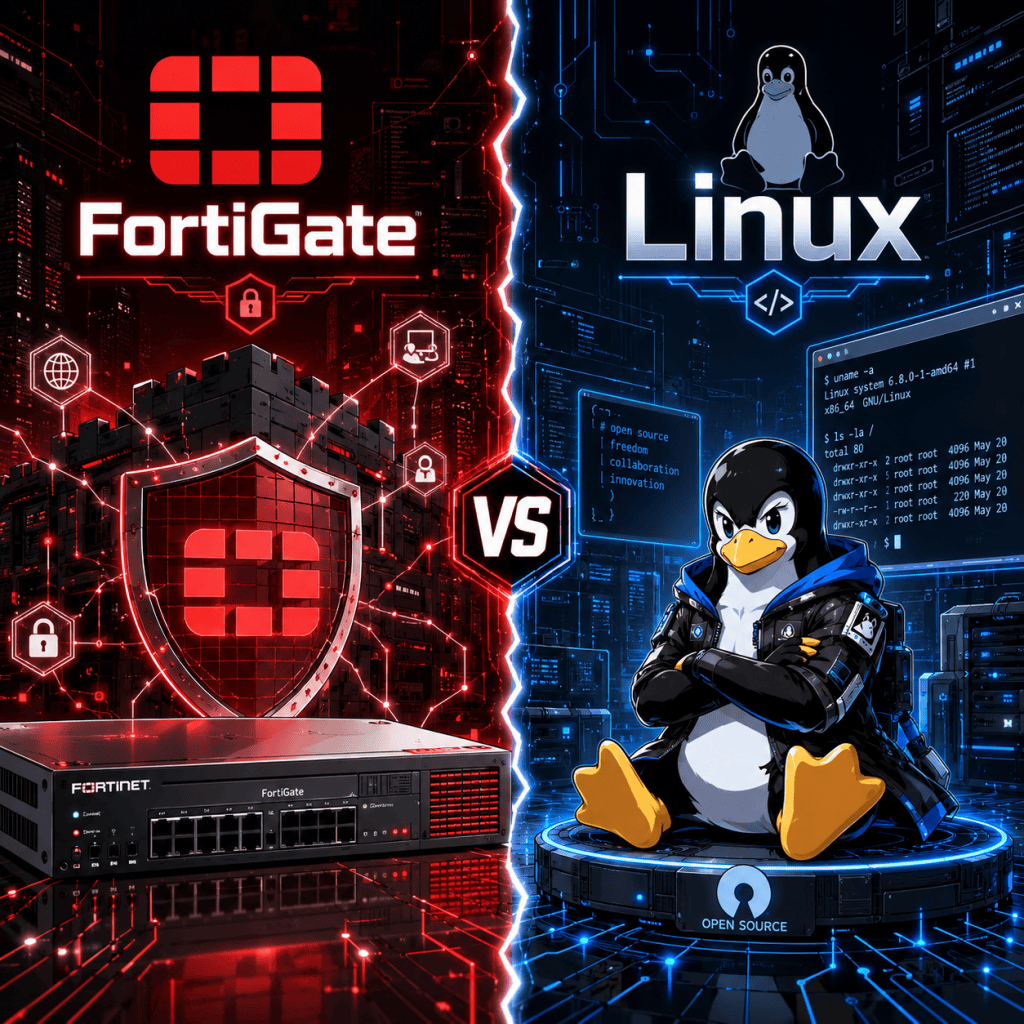
FortiOS, the operating system used across FortiGate firewall appliances, is built on a heavily modified Linux kernel.
This means the underlying operating system shares important architectural roots with Linux, including concepts related to networking, processes, interfaces, system resources, logging, and kernel-level traffic handling.
Fortinet then builds its own proprietary networking, security, management, and firewall technologies on top of that foundation.
It is important to distinguish FortiGate from FortiOS. FortiGate refers to Fortinet’s physical and virtual firewall platform, while FortiOS is the operating system running on those systems.
The relationship can be simplified as Linux kernel to FortiOS to FortiGate, with Fortinet modifying and hardening the underlying Linux technology for dedicated enterprise networking and cybersecurity workloads.
FortiOS should not be considered a traditional Linux distribution like Ubuntu, Fedora, or Red Hat Enterprise Linux.
Administrators typically interact with FortiGate systems through Fortinet’s own command line interface, graphical management tools, configuration structure, firewall policies, routing controls, VPN features, and security services rather than through a standard Linux environment.
Still, Linux knowledge translates well into FortiGate administration.
Understanding network interfaces, routing, processes, system resources, logs, permissions, services, and troubleshooting concepts gives administrators a useful foundation for learning FortiOS.
The commands and management model may be different, but many of the underlying computing and networking concepts remain closely related.
For network engineers and security professionals, this makes FortiGate an interesting example of how Linux can serve as the foundation for a specialized commercial network operating system.
Fortinet takes that Linux-based foundation and turns it into a purpose-built platform focused on firewalling, VPNs, intrusion prevention, application control, threat detection, routing, centralized management, and enterprise network security.
BitcoinVersus.Tech Editor’s Note:
We volunteer daily to ensure the credibility of the information on this platform is Verifiably True. If you would like to support to help further secure the integrity of our research initiatives, please donate here: 3C9o19EH5HSiwEPyCTmEKzxhNCbo2X6TTb
BitcoinVersus.tech is not a financial advisor. This media platform reports on financial subjects purely for informational purposes.


Leave a Reply