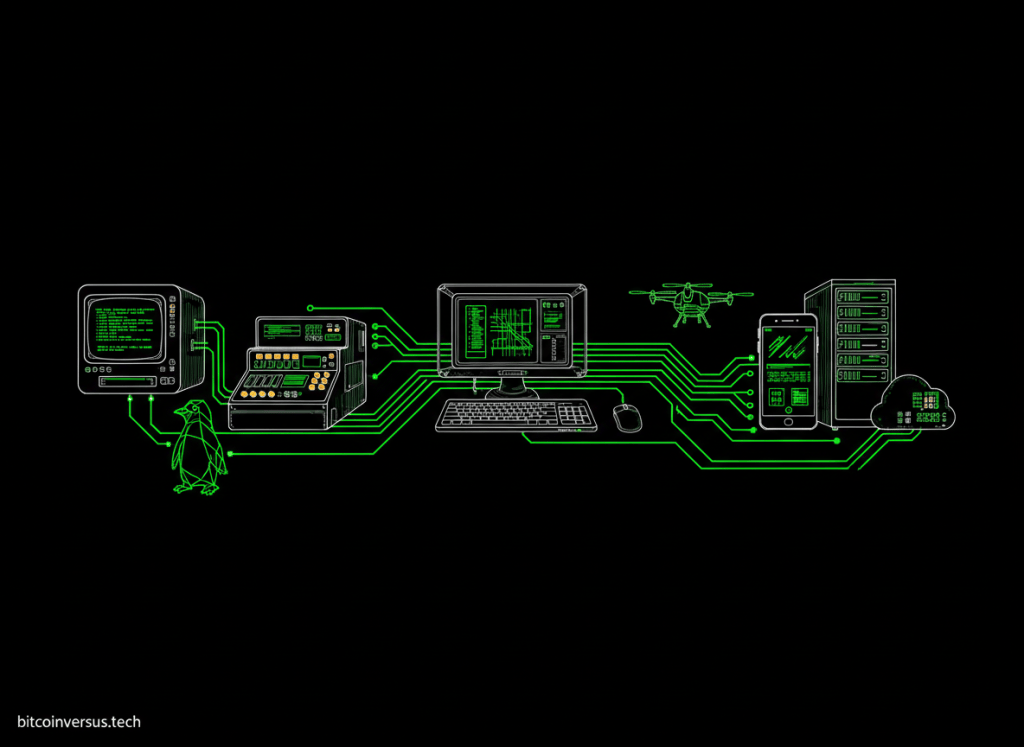
Linux turned 35 in August 2026, marking a milestone in the longer operating-system story that moved computing from batch-processed mainframes to Unix, personal computers, smartphones, cloud servers, containers and embedded devices.
The anniversary arrived alongside a fresh operating-systems history explainer from The Night Shift Professor. The larger lesson is that an operating system is not simply the screen a user sees. It is the privileged software layer that decides which programs run, how memory is isolated, how files are organized and how hardware is shared.
In an August 25 anniversary post, the Linux Foundation traced Linux back to Linus Torvalds’ 1991 announcement of a free operating-system project that he initially described as a hobby.
Operating systems began as resource managers
Early computers were too expensive to sit idle while one user slowly entered commands. Batch-processing systems grouped jobs together so the machine could execute work with less human intervention. Time-sharing later pushed the idea further by allowing multiple users and programs to share one computer interactively.
That resource-sharing problem still defines modern operating systems. The kernel schedules processor time, controls access to memory, mediates devices and provides the mechanisms that keep one process from casually overwriting another.
BitcoinVersus.tech’s overview of the kernel covers that central role directly: the kernel is the privileged layer between applications and hardware, not merely another background program.
Unix made portability a defining operating-system idea
Unix changed the direction of operating-system design because it combined multi-user time-sharing with a small set of composable tools and, critically, became portable across different hardware.
The Computer History Museum’s profile of Ken Thompson records how Thompson and Dennis Ritchie created Unix at Bell Labs in 1969 and how rewriting Unix in C helped it move across hardware platforms.
That portability mattered because software no longer had to remain tightly bound to one specific machine family. Unix and Unix-like systems then spread through universities, engineering environments, workstations, servers and eventually consumer devices.
Linux inherited the Unix model and opened development
Linux is technically a kernel rather than a complete operating system by itself, but it became the core of countless operating-system distributions. Its Unix-like process model, permissions, files, networking and device abstractions made it familiar to existing Unix users while its open development model allowed thousands of contributors and companies to extend it.
The Linux Foundation’s 35-year anniversary material describes Linux as infrastructure spanning cloud systems, AI, smartphones, supercomputers and embedded devices.
The command line still exposes the operating system underneath
Modern desktops and phones hide most kernel activity behind graphical interfaces, but command-line tools still expose the operating system’s internal state directly.
BitcoinVersus.tech’s recent journalctl lesson shows one example. System logs reveal services starting and stopping, hardware events, kernel messages and failures that a graphical application may never display.
That visibility is one reason Linux remains central to infrastructure work. Operators can inspect processes, logs, sockets, storage and permissions through stable interfaces instead of depending entirely on a vendor-specific graphical control panel.
Linux moved far beyond traditional servers
The 35-year story is also about scale in both directions. Linux can run enormous cloud systems, but it can also sit inside routers, industrial controllers, vehicles, appliances and specialized devices where users may never know it is present.
BitcoinVersus.tech recently examined another invisible deployment layer in FortiOS and FortiGate network security, where Linux underpins appliance software that many administrators interact with primarily through a web interface or command shell.
Containers changed what an operating system boundary means
Virtual machines made it possible to run multiple guest operating systems on one physical server. Containers took a different approach: they share the host kernel while isolating processes, filesystems and networking into separate environments.
That architecture made the Linux kernel even more central to modern cloud infrastructure. A container image may feel like a tiny standalone system, but its processes still depend on the host kernel for CPU scheduling, memory management, networking and device access.
Thirty-five years later, the operating system is less visible and more important
The operating system has gradually disappeared from the user’s attention. Mainframe operators once interacted directly with job queues. PC users chose operating systems as major consumer products. Smartphone users now mostly think about apps and services while the kernel, drivers, scheduler and filesystem remain hidden underneath.
That invisibility is a sign of maturity. Operating systems became successful by turning processor time, memory, storage, networks and devices into predictable abstractions that software can use without constantly negotiating with the hardware.
Linux at 35 demonstrates how durable those abstractions can become. The project began on a personal 386 PC and now spans servers, phones, network appliances, embedded systems and space hardware. The interface keeps changing, but the operating system’s core job remains the same: make one machine safely usable by many programs at once.
Editor’s Note
We volunteer daily to ensure the credibility of the information on this platform is Verifiably True. If you would like to support our research initiatives, please donate here: 3C9o19EH5HSiwEPyCTmEKzxhNCbo2X6TTb
BitcoinVersus.tech is not a financial advisor. This media platform reports on financial subjects purely for informational purposes.


Leave a Reply