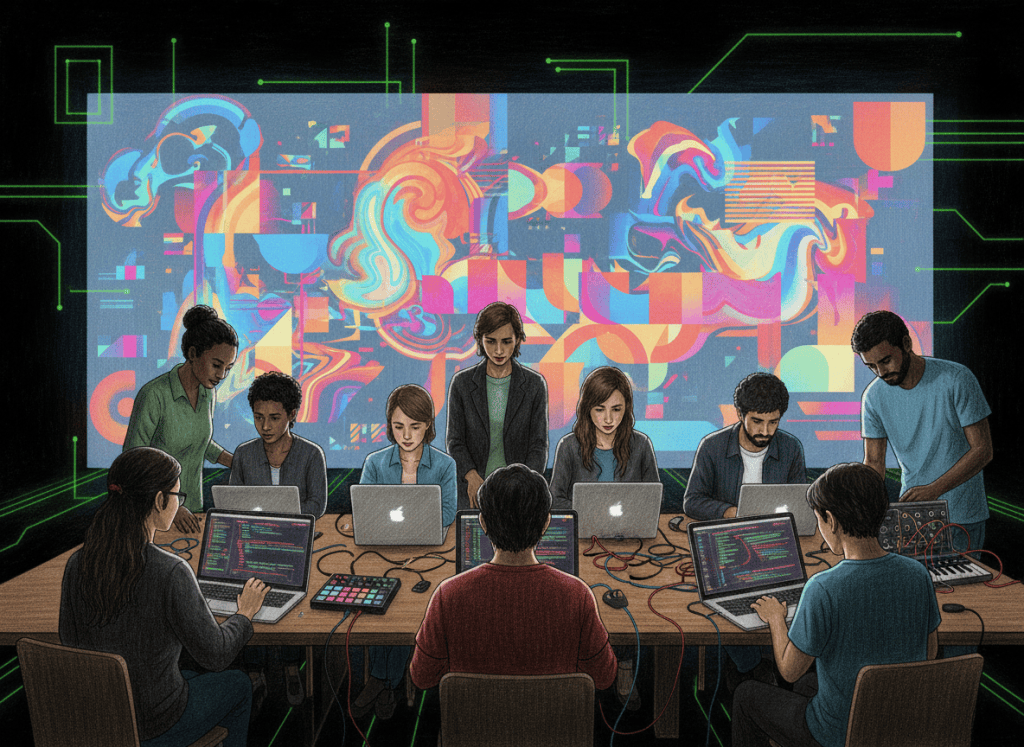
Code is not only infrastructure or business logic. In the creative-coding world, JavaScript, shaders, sensors and live software can be the paint, instrument and stage—and a new fellowship partnership is putting money behind the people who build those cultural tools.
On September 30, the Processing Foundation announced that Jerome Foundation has joined its Fellowship Program as a Gold Tier institutional supporter. The two-year commitment will support the program through 2027 and 2028, backing two early-career artists each year to build open-source tools alongside New York City communities.
When programming becomes an artistic medium
Processing has spent a quarter-century lowering the barrier between programming and visual culture. Its ecosystem lets artists, designers, students and programmers treat software as a medium for generative graphics, interactive installations, data-driven storytelling and performance rather than only as a product-development tool.
That makes the fellowship culturally interesting as well as technically interesting. The funded output is not simply artwork produced with existing software. Fellows are expected to build open-source tools that other artists can use, modify and extend. In that model, software itself becomes part of the cultural artifact.
Open source can function like cultural infrastructure
The distinction matters because creative software can outlive a single exhibition or performance. A reusable library, editor, accessibility tool or new interaction technique can become infrastructure for hundreds of future projects. Processing says its fellowship program has operated since 2013 and has helped incubate tools including p5.js and the p5.js Editor.
Jerome Foundation’s own artist roster illustrates how closely software and culture already overlap. Its 2025–2028 fellows include artists working with live coding, electronics, multichannel audio, digital sampling and other technology-centered practices. Live coding is particularly literal: performers write and execute software in real time as part of the performance itself.
Creative coding sits between art and computer science
The broader history of computing makes this convergence feel less unusual. BitcoinVersus.tech recently traced how operating systems moved from specialized machines into everyday cultural devices. Creative-coding frameworks perform a similar abstraction at a smaller scale: they hide enough low-level complexity that an artist can think about motion, color, interaction and sound while still working directly with programmable systems.
At the same time, entertainment technology is moving toward increasingly software-defined experiences. Digital concerts now combine real-time graphics, avatars and music technology, while new creation platforms are experimenting with natural-language interfaces for building interactive games.
AI makes human-built creative tools more important
Generative AI can now produce images, music and interactive content with minimal technical input. Creative coding represents a different relationship with automation: the artist can define the rules, manipulate the system, inspect the logic and deliberately make the software behave in unexpected ways.
That does not make creative coding anti-AI. It makes authorship and control more visible. An artist can use models, shaders, procedural systems or machine-learning components while still deciding how those systems connect and what they express.
Culture needs programmers too
The Jerome–Processing partnership is a reminder that some of the most culturally significant software may never look like conventional enterprise technology. It can be a sketchbook, an instrument, a projection system, a choreography tool or a new way for a community to tell stories with data.
Funding artists to build those tools keeps coding connected to experimentation. Instead of treating programmers only as engineers who implement somebody else’s product requirements, creative coding treats programming itself as a form of cultural practice.
BitcoinVersus.Tech
Advertisement
Editor’s Note
We volunteer daily to ensure the credibility of the information on this platform is Verifiably True. If you would like to support to help further secure the integrity of our research initiatives, please donate here: 3C9o19EH5HSiwEPyCTmEKzxhNCbo2X6TTb
BitcoinVersus.tech is not a financial advisor. This media platform reports on financial subjects purely for informational purposes.


Leave a Reply