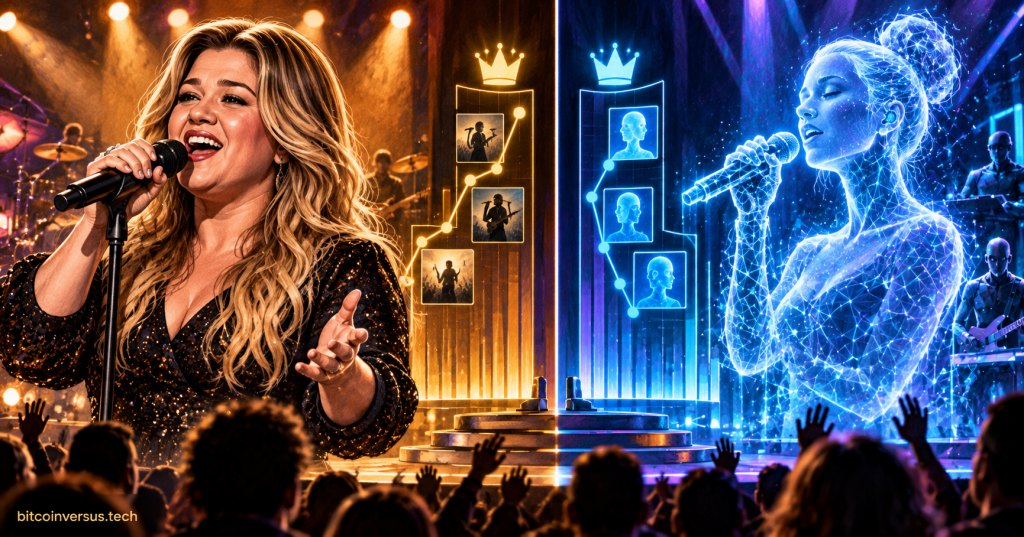
Kelly Clarkson has landed on a surprisingly specific middle ground in the fight over artificial intelligence and music: use the technology, experiment with it, even welcome AI-created performers—but do not make machine-generated artists compete against human musicians on the same chart.
During the September 30 episode of Las Culturistas, Clarkson said she enjoys AI creatively and sees real possibilities in what it can let people make. Her line in the sand is competition. If an AI act and a human singer are measured on the same leaderboard, she argues, the categories are no longer measuring the same kind of creative work.
Clarkson wants AI music at the table—just at a different chart
The full argument appears near the end of the original Las Culturistas episode. Clarkson’s position is not anti-AI. She describes herself as enthusiastic about the technology and says she is interested in it artistically, but she compares direct chart competition between AI and human performers to putting robots and people into the same athletic event.
Pop Crave’s widely circulated post captured the central distinction: Clarkson thinks there can be an audience for both human and AI-created music without forcing them into one competitive category.
The original conversation is more nuanced than “Kelly loves AI”
The headline-friendly part is that Clarkson likes AI. The more interesting part is why she still wants a boundary. She argues that new creative tools can expand who gets to make things, including people who may not have traditional musical capabilities, while still preserving a category where human performance is evaluated against human performance.
People’s report on the interview similarly describes Clarkson as supportive of AI as a creative tool while emphasizing her concern about AI acts competing directly against humans.
Music is already becoming a software problem
The debate fits a much larger transition in culture. BitcoinVersus.Tech previously covered AI systems transforming modern hip-hop into old-school R&B, an early example of machine tools altering not just production but the apparent era, texture and identity of recorded music.
Once generative systems can produce convincing vocals, instrumentation, arrangements and virtual performers, a chart is no longer merely ranking songs. It can also end up comparing radically different production pipelines: a human performer recording a song, a human directing an AI system, or a largely synthetic act whose public identity may itself be generated.
Virtual performers make the boundary even harder
The problem gets stranger when AI-generated sound is paired with a visual identity. BitcoinVersus.Tech recently reported on Unit1 raising $20 million to build hyper-realistic music avatars. A virtual performer can now become a concert product, a social-media personality and a persistent visual brand—not merely an audio file.
That makes Clarkson’s proposed separation less about banning a tool and more about defining what a music chart is supposed to measure. Is it measuring listening activity? Human artistic achievement? Commercial popularity? A song regardless of how it was produced? Those questions become unavoidable as synthetic performers improve.
Creative tools and creative competition are different questions
There is also a useful distinction between using AI inside a human creative process and presenting an AI-generated identity as the artist itself. BitcoinVersus.Tech’s coverage of the Processing Foundation’s fellowship for artists building open-source creative tools shows the other side of this transition: software can expand human expression rather than substitute for the person receiving artistic credit.
Clarkson is not announcing a new chart or industry rule. She is proposing a way to organize a category that is becoming increasingly difficult to define. Her argument is essentially that AI music can be legitimate creative output while still being different enough from human performance to deserve its own competitive lane.
That distinction may become more important as synthetic voices, AI songwriting systems and digital performers become ordinary parts of music culture. The technology does not have to disappear for human-made music to remain identifiable. But the industry may have to get much better at telling listeners which is which.
BitcoinVersus.Tech
Advertisement
Editor’s Note
We volunteer daily to ensure the credibility of the information on this platform is Verifiably True. If you would like to support to help further secure the integrity of our research initiatives, please donate here: 3C9o19EH5HSiwEPyCTmEKzxhNCbo2X6TTb
BitcoinVersus.tech is not a financial advisor. This media platform reports on financial subjects purely for informational purposes.


Leave a Reply