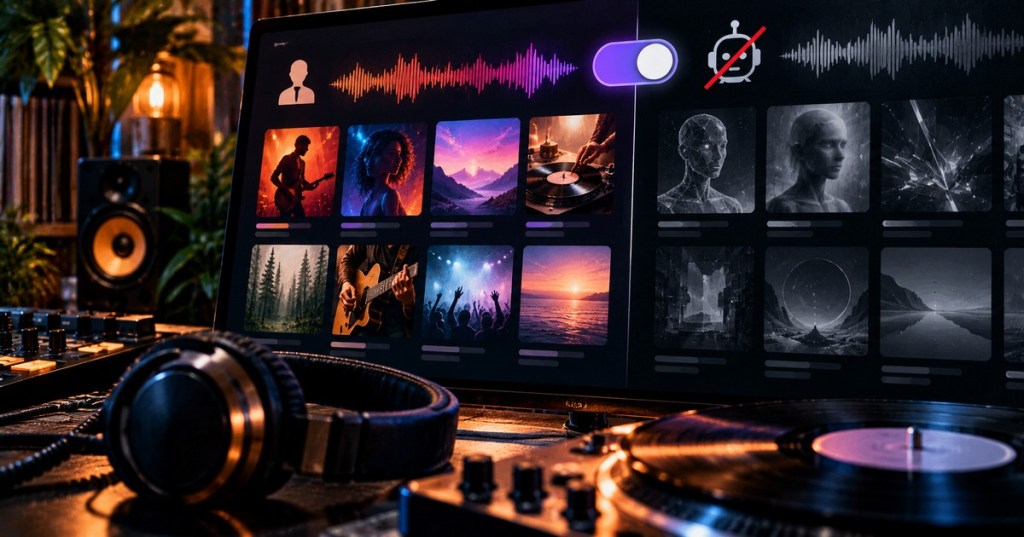
Deezer is giving listeners a new way to decide whether fully AI-generated music appears in their streaming experience.
Deezer announced on October 13 that it will roll out a global on/off switch before the end of 2026. When enabled, the setting will remove fully AI-generated tracks, albums and related artists from search results. Users who want access to that music can turn the filter back off.
Deezer’s official Reddit account announced the new listener-controlled AI music filter.
The filter builds on controls Deezer already uses behind the scenes. The company says it has detected and excluded more than 42 million fully AI-generated tracks from algorithmic recommendations and editorial playlists since January 2025, while more than 14 million albums have been tagged. Deezer says it now receives nearly 90,000 fully AI-generated tracks per day, representing more than half of daily deliveries on peak days.
Soundkey explains how streaming platforms are attempting to identify AI-generated music and where detection can become complicated.
This is not a blanket ban on AI-assisted music. Deezer says the toggle targets music created entirely through generative systems. Music made by people who use limited AI tools inside a larger human production process is treated differently. That distinction matters as labels, distributors and artists try to define where assistance ends and fully synthetic creation begins. BitcoinVersus.Tech recently covered Symphonic tightening its rules for AI music as distributors face the same problem.
The announcement also triggered debate among AI-music creators over the difference between fully generated tracks and human work that uses AI-assisted tools.
Listener demand is part of Deezer’s argument. A Deezer/Ipsos survey from November 2025 found that 45% of music-streaming users wanted the ability to filter out music generated entirely by AI. The same study found that 97% of participants could not reliably distinguish two AI-generated tracks from one human-made track in a blind test.
The wider music industry is moving in several directions at once. BitcoinVersus.Tech has covered Suno rebuilding its AI-music platform around licensed catalogs, while artists and platforms are also debating whether synthetic performers should be separated from human acts. Kelly Clarkson recently argued that AI artists should have their own chart.
Produce Like a Boss examines how the growing volume of synthetic music affects artists, royalties and trust on streaming services.
The feature also has an economic angle. Deezer says fully AI-generated tracks currently make up only about 1% to 3% of streams on its service, but the company found that up to 85% of streams generated by fully synthetic tracks in 2025 were fraudulent. When Deezer identifies stream manipulation, those plays are excluded from royalty payments.
Music Business Worldwide separately reported that the setting will apply globally before year-end. The important change is user control: Deezer is moving beyond labels and recommendation rules by allowing listeners to decide whether fully AI-generated music appears in search at all.
That makes the filter a cultural choice as much as a technical feature. Generative music is not disappearing, but listeners will increasingly be asked whether they want it mixed into the same discovery systems as human-made music—or placed behind a switch.
BitcoinVersus.Tech Editor’s Note:
We volunteer daily to ensure the credibility of the information on this platform is Verifiably True. If you would like to support to help further secure the integrity of our research initiatives, please donate using the QR code provided

For best QR-code scanning results, please scan this donation code from a desktop or larger screen. Mobile screens may prevent camera recognition.


Leave a Reply