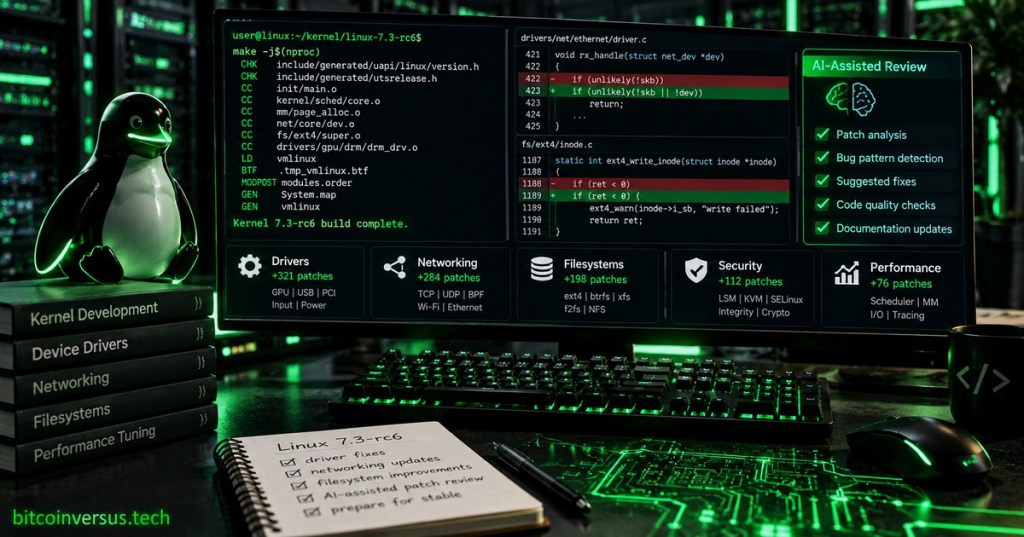
Linux 7.3-rc6 arrived on October 4 with Linus Torvalds describing the current level of AI-assisted bug finding and patch churn as the new “AI normal.” The release candidate is not unusually unstable by his assessment, but the phrase captures a major change in how much machine-generated analysis is now flowing through Linux development.
Torvalds’ October 4 release announcement says roughly half of the rc6 diff is once again driver fixes, with updates spread across GPU, networking, USB, TTY, IIO and sound. He also notes architecture work, KVM changes, core networking fixes, SMB client work, BPF changes and new self-tests.
The key line is not about a single subsystem. Torvalds says the commit count itself now looks normal for the new “AI normal,” meaning a continued stream of small error-path fixes and related cleanups is becoming an ordinary part of a release-candidate cycle rather than an exceptional event.
Linux 7.3 is still moving toward a normal stable release
Linux 7.3-rc6 is a test kernel, not the stable 7.3 release. The important signal from rc6 is that Torvalds did not flag a broad regression crisis: the mix of fixes has returned to a familiar shape after rc5 had a slightly unusual diffstat.
Phoronix’s rc6 coverage highlights continued fixes across networking and drivers, including a revert of Logitech Bolt receiver HID++ support after user-reported problems. It also points to the continuing flood of AI- and LLM-assisted reports and patches around the kernel tree.
This is the next step after BitcoinVersus covered Linux 7.2.9 and 7.3-rc5 entering final stabilization. Rc6 is adjacent news, but materially different: the release has advanced another week and Torvalds is now explicitly describing the AI-driven patch baseline as normal.
What “AI normal” actually means
AI-assisted kernel work is not one thing. Some tools are being used to scan for suspicious error paths, missing checks, lifetime bugs and cleanup mistakes; other submissions are low-value or poorly reviewed. The result is that maintainers have more potential defects to inspect, but also more noise to filter before code can be trusted.
That distinction matters because Linux does not merge a patch simply because an AI system suggested it. A patch still has to survive human review, subsystem expectations, testing and the normal maintainer chain. AI can increase the number of candidate fixes without removing the engineering work required to decide whether a fix is correct.
Drivers remain the largest moving surface
Torvalds says about half of the rc6 diff is driver fixes. That is a useful reminder that the Linux kernel is not only a scheduler and memory manager; it is also the compatibility layer for an enormous range of GPUs, network adapters, USB devices, storage controllers, sound hardware, sensors and embedded systems.
That broad hardware surface is one reason each release candidate still finds real-world regressions after the merge window closes. A change that is logically correct in isolation can still expose a device quirk, timing issue or old firmware assumption once it reaches more test machines.
Linux 7.3 is already landing in distribution testing
The kernel is not developing in isolation. Ubuntu 26.10 Beta is already testing the Linux 7.3 line alongside GNOME 51 and Rust Coreutils, giving the release candidate wider exposure to desktop and hardware combinations before stable distributions adopt the final kernel.
For administrators and technicians, that is why release candidates belong in labs, test VMs and noncritical systems rather than production by default. They are intended to surface regressions while there is still time to fix them before the stable tag.
The bigger Linux story is process, not just version numbers
Linux has reached a point where code scale, hardware diversity and AI-assisted analysis are all increasing together. The project still relies on the same core principle that carried it through decades of growth: patches are useful only when maintainers can review, test and reason about them.
That makes the “AI normal” phrase more important than it first sounds. Linux is not merely adding AI-generated fixes; it is learning how to absorb a new source of engineering input without allowing volume to replace judgment.
The shift also fits the longer arc described in BitcoinVersus’ look at Linux at 35. The operating system has repeatedly adapted to new hardware eras and development models; now it is adapting its maintenance process to machine-assisted software engineering.
BitcoinVersus.Tech
Advertisement
Editor’s Note:
We volunteer daily to ensure the credibility of the information on this platform is Verifiably True. If you would like to support our research initiatives, please donate here: 3C9o19EH5HSiwEPyCTmEKzxhNCbo2X6TTb
BitcoinVersus.tech is not a financial advisor. This media platform reports on financial subjects purely for informational purposes.


Leave a comment