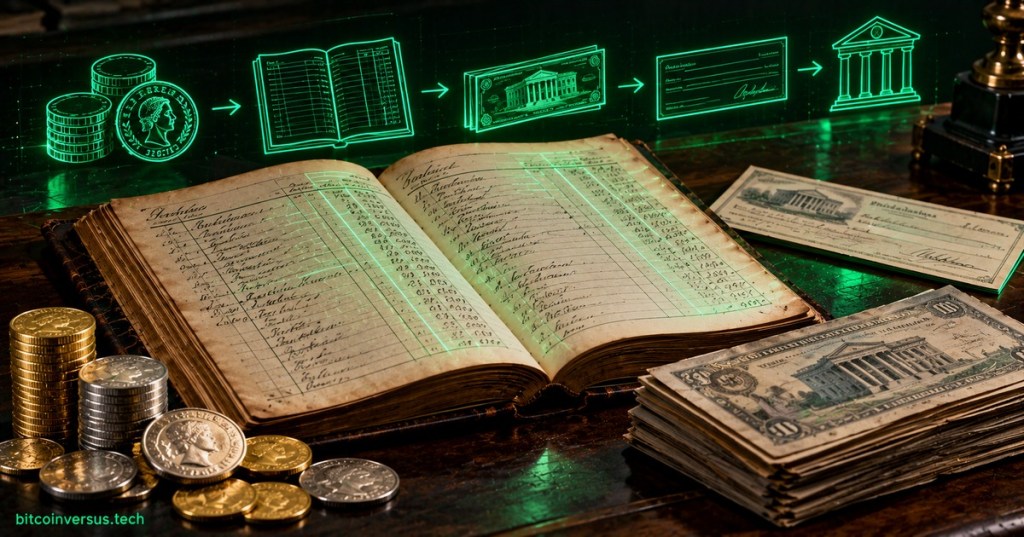
OSHistory.004 follows standardized coinage by asking what happens when money no longer has to move physically for every payment. Banks, merchants, and account keepers learned to store valuable assets in one place while transferring claims through receipts and written records. That change created a bridge from coin money to ledger money.
From coins to deposits
A deposit bank changes the location of money without necessarily changing who owns the economic claim. If a customer deposits 100 units of coin, the bank receives an asset—cash or metal—and records a 100-unit liability because it owes that amount back to the depositor. The customer can then hold a bank balance instead of holding the physical coins directly.
Simple deposit example
Bank assets:      +100 units of cash
Bank liabilities: +100 units of customer deposits
Ledger money and checks
A ledger allows value to move by changing records rather than moving metal. If one customer pays another customer at the same bank, the bank can reduce one account balance and increase the other by the same amount. Checks later formalized this instruction: the payer authorized the bank to transfer part of a recorded deposit to another person or institution.
Double-entry bookkeeping made large ledgers auditable
As banking and trade expanded, record systems needed a way to detect incomplete or inconsistent entries. Double-entry bookkeeping records every transaction through at least two linked entries and preserves the accounting identity Assets = Liabilities + Equity. The system does not guarantee that every entry is honest, but it gives accountants a structured method for checking whether the books remain internally balanced.
Accounting identity
Assets = Liabilities + Equity
Bank credit created transferable claims
A bank can also create a deposit when it makes a loan. The loan becomes an asset of the bank because the borrower owes repayment, while the newly credited deposit becomes a liability because the bank owes the account holder usable funds. This is a major step in monetary history because payment claims can expand through credit even when the same quantity of physical coin or gold does not move with every loan.
Reserves limit settlement risk
Deposits are useful as money only if banks can meet withdrawals and settle payments to other banks. A reserve ratio compares immediately available reserves with deposit liabilities; in a simplified example, 20 units of reserves against 100 units of deposits produces a 20% reserve ratio. Real banking systems use more complex liquidity, capital, and settlement rules, but the basic idea is that a bank needs assets that can satisfy payment obligations when deposit claims leave the bank.
Reserve ratio = Reserves ÷ Deposits × 100%
Example: 20 ÷ 100 × 100% = 20%
Liquidity risk and bank runs
A bank can be solvent on paper and still face a liquidity crisis if too many depositors demand settlement at once. Loans and other assets may be valuable but difficult to convert into cash immediately, while deposit liabilities can be payable on demand. This mismatch is one reason historical banking systems developed reserve practices, clearing arrangements, lender-of-last-resort institutions, and deposit insurance.
Why ledgers matter to the history of Bitcoin
The move from coins to bank ledgers separated the monetary record from the physical object and made trusted recordkeepers central to payment systems. Bitcoin keeps the ledger concept but changes the trust architecture: transaction history is replicated across a network and validated through protocol rules rather than maintained only by one bank. Understanding bank ledgers therefore provides historical context for why a decentralized ledger was such a significant design change.
Prior lessons
- OSHistory.001: The Coincidence of Wants
- OSHistory.002: Commodity Money — Why Some Goods Work Better as Money
- OSHistory.003: Standardized Coinage — Weights, Mints, Seigniorage, and Trust
Exercises
- Draw a two-column bank balance sheet after a customer deposits 500 units of coin. Identify the bank asset and the matching liability.
- Customer A pays Customer B 75 units and both use the same bank. Write the two ledger changes needed to settle the payment without moving physical coin.
- A bank has 250 units of reserves and 1,000 units of deposits. Calculate the simplified reserve ratio.
- A bank issues a 300-unit loan and credits the borrower’s deposit account by 300 units. Identify the new bank asset and the new bank liability.
- Explain in two sentences how Bitcoin changes the recordkeeper model without eliminating the need for a ledger.
Knowledge check
- Why is a customer deposit recorded as a bank liability?
- What is the main operational difference between moving coins and changing ledger balances?
- What accounting identity must remain balanced in double-entry bookkeeping?
- What happens to a bank’s balance sheet when it creates a loan-funded deposit?
- Why can a solvent bank still face a liquidity problem?
- What is the simplified reserve ratio when reserves are 40 and deposits are 200?
- What ledger property does Bitcoin retain from banking systems, and what trust property does it change?
Answers
- Because the bank owes the depositor the recorded amount and must honor permitted withdrawals or transfers.
- Ledger settlement changes ownership records; physical settlement requires the monetary object itself to move.
- Assets = Liabilities + Equity.
- The loan becomes an asset and the credited deposit becomes a liability.
- Its assets may be valuable but not immediately convertible into settlement money while withdrawals are due now.
- 20%.
- Bitcoin retains a transaction ledger but distributes verification across a protocol-driven network rather than relying on one bank as the sole recordkeeper.


Leave a Reply