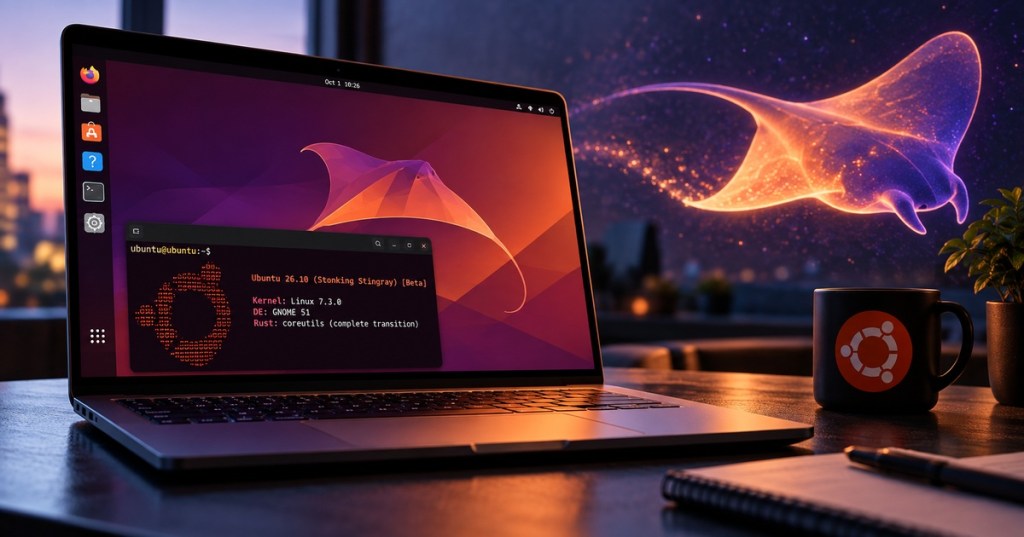
Ubuntu 26.10 has reached beta with one of the more aggressive Linux desktop stacks Canonical has shipped in years: a Linux 7.3 release-candidate kernel, GNOME 51, and a completed move of Ubuntu’s core command-line utilities to Rust.
The Ubuntu Release Team announced the “Stonking Stingray” beta on October 1 for Desktop, Server, WSL and Cloud images, along with the official Ubuntu flavors. The final Ubuntu 26.10 release remains scheduled for October 15, 2026.
Linux 7.3 puts the beta on the newest hardware track
Ubuntu’s jump to Linux 7.3 matters because this kernel cycle is carrying a large wave of new hardware enablement and performance work. That includes continued AMD Zen 6 preparation, Intel hybrid-CPU scheduling improvements, newer graphics support, Btrfs performance work, early Apple M3 Pro/Max/Ultra support, and initial kernel support for Valve’s 2026 Steam Controller.
It is another reminder of how quickly the kernel keeps moving. BitcoinVersus.Tech recently looked at the platform’s broader arc in Linux Turns 35 as Operating Systems Move From Mainframes to Smartphones. Ubuntu 26.10 is effectively taking that upstream pace and packaging it into a mainstream desktop and server release on a very short timeline.
Phoronix’s beta report confirms that Ubuntu 26.10 is testing Linux 7.3 alongside GNOME 51 and the completed Rust Coreutils transition. The outlet also highlighted the Snapdragon-focused concept builds that are evolving in parallel with the main release.
Phoronix also posted the release milestone in a specific X status, tying the beta directly to Linux 7.3 and GNOME 51.
Rust Coreutils moves from experiment to default plumbing
The most consequential change may be less visible than the desktop. Ubuntu 26.10 completes its transition to Rust-based coreutils, meaning foundational commands such as file-copying, moving and removal utilities are now coming from the Rust implementation rather than the traditional GNU C implementation across the new release.
That does not make Linux “a Rust operating system,” but it is a major production test for memory-safe systems software in everyday administration paths. The same language is spreading across other infrastructure projects as teams look for stronger memory-safety guarantees without giving up native performance. BitcoinVersus.Tech’s recent report on GitHub moving a 430,000-line Copilot runtime to Rust shows how quickly the language is expanding beyond low-level experimentation.
GNOME 51 gives the desktop side its own major refresh
GNOME 51 supplies the desktop layer for Ubuntu 26.10, bringing the distribution onto the newest GNOME generation at the same time the kernel and low-level userland are changing underneath it. That combination makes this beta especially useful for hardware testers, application developers and desktop integrators who want to find regressions before the stable release.
Snapdragon support is becoming part of the Ubuntu story too
The main beta is arriving as Canonical also pushes Linux farther onto Arm laptops. The latest Ubuntu 26.10 concept images add early Snapdragon X2 laptop enablement while expanding support for existing Snapdragon X1 systems.
That work connects directly with the upstream hardware push in Linux 7.3. BitcoinVersus.Tech previously covered how Qualcomm opened Snapdragon X2 to Linux developers, and Ubuntu is now turning part of that enablement into testable desktop images ahead of broader certified support.
Linux 7.3 is bigger than one distribution
Ubuntu is only one downstream consumer of Linux 7.3, but its beta gives ordinary users a practical way to see the kernel’s direction. New CPU scheduling, storage work, graphics-driver changes, device support and Rust integration all become much easier to evaluate when they are packaged into a complete operating system rather than scattered across upstream trees.
Beta means test first, deploy later
Ubuntu’s beta images are intended for testing, not for systems where downtime or data loss would be costly. The value of this stage is exactly the opposite: get the near-final stack onto diverse hardware, find the rough edges, and give developers time to fix release-blocking problems before October 15.
For Linux enthusiasts, Ubuntu 26.10 is shaping up as an unusually dense release. Linux 7.3 pushes hardware support forward, GNOME 51 refreshes the desktop, Rust Coreutils changes foundational user-space plumbing, and Snapdragon development broadens the architectures Canonical is actively targeting. The next two weeks will show how much of that ambition survives the final stabilization pass intact.
BitcoinVersus.Tech
Advertisement
Editor’s Note
We volunteer daily to ensure the credibility of the information on this platform is Verifiably True. If you would like to support to help further secure the integrity of our research initiatives, please donate here: 3C9o19EH5HSiwEPyCTmEKzxhNCbo2X6TTb
BitcoinVersus.tech is not a financial advisor. This media platform reports on financial subjects purely for informational purposes.


Leave a Reply