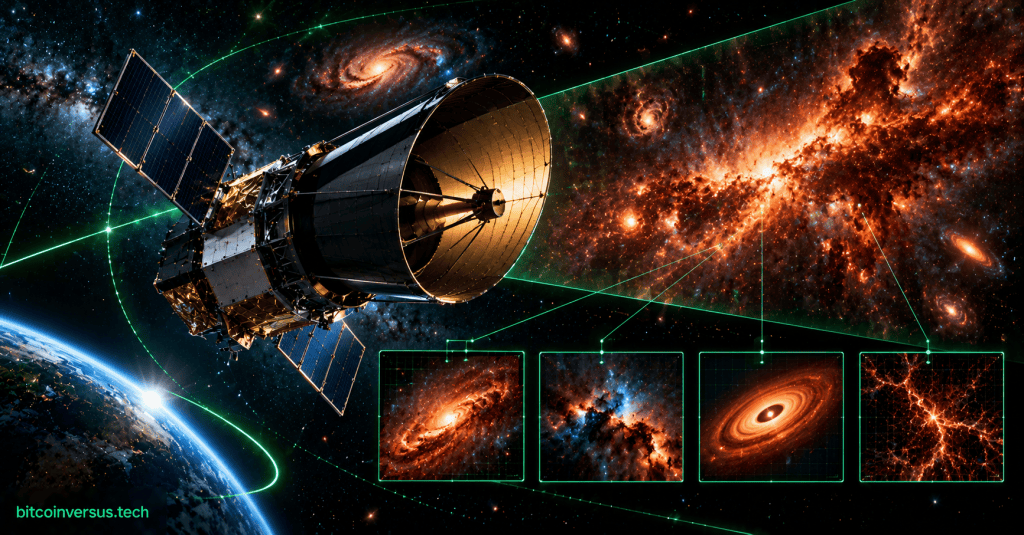
NASA has selected PRIMA, the PRobe far-Infrared Mission for Astrophysics, to advance as the first mission in a new class of space observatories called Probe Explorers.
The selection matters because PRIMA is being built to observe a part of the electromagnetic spectrum that sits beyond the reach of the James Webb Space Telescope and before the wavelengths typically studied by radio observatories. In its September 23 announcement, NASA’s Jet Propulsion Laboratory said the mission is moving into Phase B, where teams advance preliminary design and technology development before a later confirmation review.
PRIMA fills a gap Webb cannot
Webb has transformed infrared astronomy, but it does not cover the entire infrared spectrum. PRIMA is designed around a 5.9-foot, or 1.8-meter, telescope optimized for far-infrared light—radiation associated with colder material such as dusty star-forming regions, planet-forming disks and obscured galaxies.
Sky & Telescope notes that PRIMA is intended to bridge the observational gap between space-based infrared instruments and ground-based radio facilities such as ALMA. That gives astronomers access to signals that cannot be captured cleanly by Webb alone.
NASA JPL highlighted that role in a September 23 public post, saying PRIMA will conduct deep far-infrared surveys and help connect the capabilities of existing infrared and radio observatories.
A colder telescope can see a colder universe
Far-infrared astronomy has a practical problem: the telescope itself can glow strongly enough in infrared to hide the faint objects it is trying to study. PRIMA’s design addresses that by cooling its primary mirror to about 4.5 kelvin, only a few degrees above absolute zero.
That thermal control, paired with more sensitive detectors, is intended to let PRIMA detect emission from cold dust and gas that previous far-infrared missions could not survey as deeply or as quickly.
This kind of engineering sits alongside other recent NASA hardware work BitcoinVersus.Tech has been tracking, including a two-engine CubeSat that recently cleared ground testing. The scale is different, but the pattern is the same: new science increasingly depends on spacecraft that combine specialized sensors with tightly optimized thermal, propulsion and communications systems.
Two instruments will divide the science workload
PRIMA is expected to carry two primary instruments: the Far Infrared Enhanced Survey Spectrometer, known as FIRESS, and the PRIMA Imager, or PRIMAger. Together they are designed to map and analyze far-infrared emissions across wide regions of the sky.
That opens several major science targets. Astronomers want to trace how galaxies and their black holes evolved together, examine how dust and heavier elements accumulated through cosmic history, and probe the environments where new planets form.
Planet formation may be especially interesting because far-infrared wavelengths can reveal molecular transitions associated with water, carbon, oxygen and the cold regions of protoplanetary disks where material freezes out. Those environments help determine what kinds of planets can form and what raw materials are available to them.
The new Probe Explorers class changes NASA’s mission ladder
PRIMA is also notable because of where it fits inside NASA’s mission portfolio. Probe Explorers are intended to sit between smaller Explorer-class missions and the agency’s largest flagship observatories, giving NASA another way to field ambitious astrophysics missions without waiting for the next once-in-a-generation telescope.
The model complements a broader expansion of autonomous and distributed space systems. BitcoinVersus.Tech recently covered NASA’s ASTRA spacecraft fleet experimenting with autonomous science decisions. PRIMA approaches the future from another direction: one highly specialized observatory built to open an entire wavelength regime.
JPL will manage a large international team
NASA JPL will manage PRIMA, while other NASA centers and international agencies are expected to contribute hardware and technical support. Partners listed by NASA include organizations in France, Italy, Germany, Canada, South Korea, Japan and the United Kingdom.
If the mission passes its later confirmation review, NASA is targeting a 2033 launch and a planned five-year primary mission. PRIMA is expected to operate near the Sun-Earth L2 region, the same broad gravitational neighborhood used by Webb and other deep-space observatories.
That location keeps the observatory far from Earth’s immediate thermal and orbital environment while providing the stable geometry needed for a cryogenic telescope.
From the Moon to the coldest parts of the cosmos
NASA’s current science portfolio is spreading across very different scales. BitcoinVersus.Tech recently reported on three Moon-base experiments aimed at lava tubes, ice and surface hazards. PRIMA pushes in the opposite direction, looking billions of light-years outward to understand how galaxies, stars and planetary systems assembled.
The common thread is instrumentation. Better sensors, colder detectors, more capable onboard computing and increasingly autonomous spacecraft are allowing missions to collect information that older observatories could not reach.
PRIMA is not launched yet
The most important qualification is that PRIMA remains in development. Phase B is a serious milestone, but it is not the same as a completed flight observatory. NASA still has to mature the design, manage schedule and technical risk, complete later reviews and deliver the spacecraft and instruments.
If those steps hold, PRIMA could become the first major observatory designed specifically to give astronomers a modern, sensitive far-infrared survey capability. Webb showed how much hidden structure appears when astronomy moves beyond visible light. PRIMA’s bet is that an entire cold universe is still waiting beyond Webb’s wavelength limit.
BitcoinVersus.Tech
Advertisement
Editor’s Note
We volunteer daily to ensure the credibility of the information on this platform is Verifiably True. If you would like to support to help further secure the integrity of our research initiatives, please donate here: 3C9o19EH5HSiwEPyCTmEKzxhNCbo2X6TTb
BitcoinVersus.tech is not a financial advisor. This media platform reports on financial subjects purely for informational purposes.


Leave a Reply