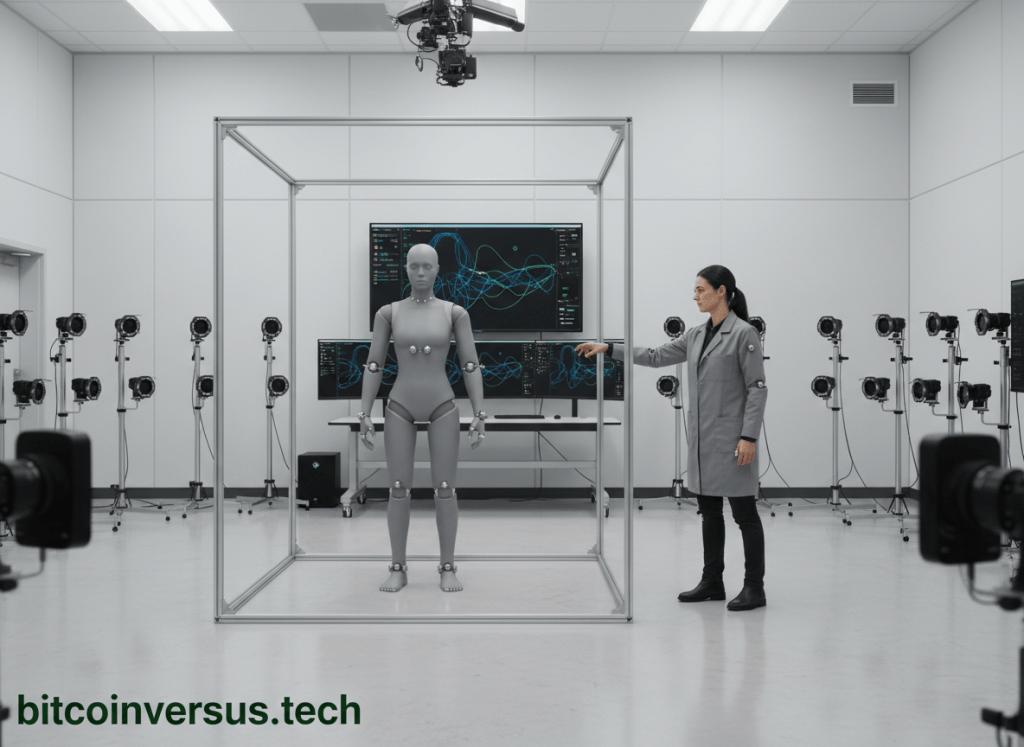
Innodata has opened a new robotics R&D lab in New Jersey built around a deceptively hard problem in physical AI: measuring exactly how humans and robots move in the real world, rather than asking a vision model to reconstruct that motion from ordinary video.
According to the company’s September 30 announcement, the facility uses high-precision, low-latency infrared optical tracking cameras developed with Vicon to capture movement at sub-millimeter resolution. The company says the resulting data can train humanoids and industrial robots, validate their performance, and provide an external reference against the telemetry generated inside the machines themselves.
Direct 3D measurement instead of guessing from pixels
The technical distinction matters. A monocular camera sees a two-dimensional grid of pixels and a model must infer depth, joint position and motion from it. Innodata’s new lab instead measures three-dimensional motion directly from humans, robots and the objects they manipulate. The Robot Report’s detailed look at the facility says Vicon’s optical system can capture those subjects in the same space with sub-millimeter accuracy and millisecond latency.
That makes the lab useful for more than producing training examples. A robot developer can compare the machine’s internal, or egocentric, telemetry with an independently observed exocentric measurement. If a joint encoder, onboard camera or other sensor reports motion inaccurately, the external capture system can expose the difference.
Innodata’s launch post emphasizes the same point: the facility is intended both to train and evaluate the next generation of humanoid robots, with Vicon providing the motion-capture foundation.
Training data becomes a robotics infrastructure problem
Large language models could ingest enormous existing text corpora. Physical AI has no equivalent archive of every useful human interaction with tools, machines and environments. Robots need examples that preserve geometry, timing, contact and context. That bottleneck has already created a market around teleoperation, wearable capture, simulation and carefully curated robot demonstrations.
Innodata says its physical-AI pipeline spans humanoids, human-operated hardware, wearables, sensor rigs, Universal Manipulator Interface grippers and other multimodal systems. Customers can buy packaged motion data, commission custom capture projects, or send robots into the lab for scripted evaluation. Motion can also be retargeted from one platform to another.
Real-to-sim can multiply expensive demonstrations
One practical path is to use high-quality real-world motion as a seed for simulation. A precise physical demonstration can anchor a digital twin, while simulation varies object positions, poses and edge cases that would be expensive to capture one at a time. That complements the massive simulated-training approach already visible in Skild AI’s humanoid soccer work.
The lab also fits a wider shift toward full physical-agent systems rather than isolated robot actions. Dyna’s Taku platform, for example, targets long nonlinear workflows, while Innodata is attacking the data and measurement layer needed to train and test systems that must recover from real-world variation.
And as humanoid developers push from demonstrations toward factories and field deployments, measurement quality becomes part of the hardware problem. Boston Dynamics’ Atlas factory training center reflects the same broader transition: robots increasingly need structured environments where their behavior can be taught, measured and validated before deployment.
Why the external ground truth matters
The most interesting part of Innodata’s lab may be evaluation rather than data volume. A robot can report that it reached a commanded pose or followed a trajectory, but an independently calibrated camera system can test that claim from outside the machine. For safety-critical or high-precision work, that separation between internal telemetry and external measurement can become a useful benchmark layer.
There is still a large gap between precise motion capture and a robot that understands intent, contact forces and consequences. Sub-millimeter trajectories do not by themselves teach a humanoid why grabbing a hot mug by its body is different from grabbing the handle. But better ground-truth motion data can remove one source of uncertainty from the training stack and make the remaining perception, planning and control errors easier to isolate.
BitcoinVersus.Tech
Advertisement
BitcoinVersus.Tech Editor’s Note:
We volunteer daily to ensure the credibility of the information on this platform is Verifiably True. If you would like to support to help further secure the integrity of our research initiatives, please donate here: 3C9o19EH5HSiwEPyCTmEKzxhNCbo2X6TTb
BitcoinVersus.tech is not a financial advisor. This media platform reports on financial subjects purely for informational purposes.


Leave a Reply