
MIT engineers have built a soft sheet that can reconstruct its own three-dimensional shape as it bends, folds, and twists by measuring how light changes inside embedded optical fibers.
The work, published in Advanced Intelligent Systems, replaces rigid motion sensors with flexible optical waveguides embedded throughout a stretchable silicone sheet. MIT says the sheet can rebuild its shape almost in real time and still works when some fibers are cut or disconnected.
The Sheet Uses Soft Optical Fibers
Ordinary optical fibers guide light through a transparent core surrounded by cladding. The MIT team used the same basic principle, but built the fibers from soft rubber instead of glass so they could stretch and bend with the surrounding sheet.
The researchers also intentionally roughened one side of each fiber. When the fiber bends toward the rough side, more light scatters away. When it bends toward the smooth side, a different amount of light reaches the detector. That turns the fiber into a bidirectional bend sensor rather than a simple cable.
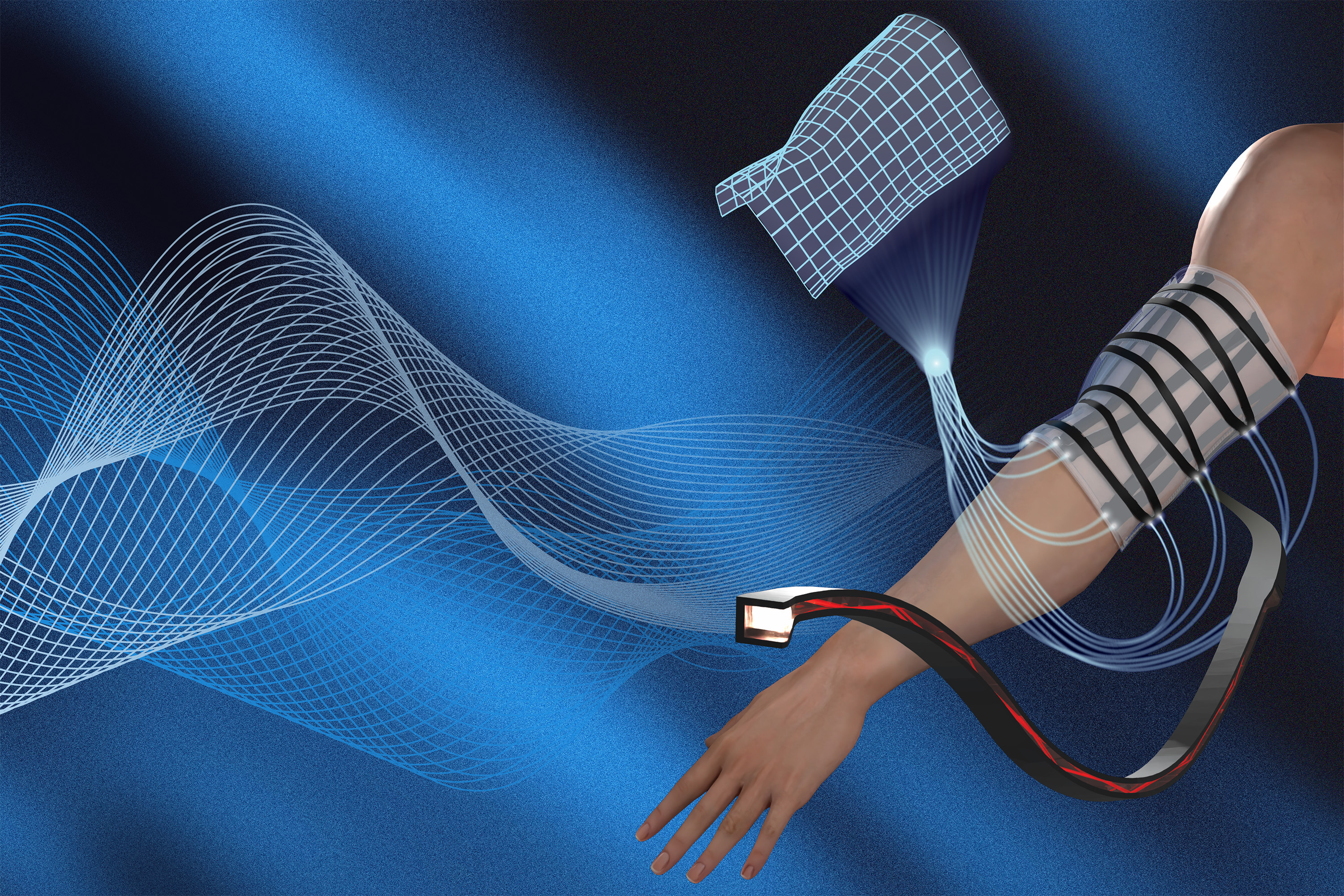
A Zig-Zag Fiber Pattern Reconstructs The Surface
The team tested several fiber layouts before settling on a zig-zag pattern spread across the silicone sheet. LEDs send light into the fibers, photodetectors measure how much light reaches the other end, and an algorithm converts those measurements into estimates of how each section is bending.
Those local bend measurements are then combined into a full 3D reconstruction of the sheet. In experiments, the virtual copy followed diagonal folds, reverse folds, and other deformations almost in real time.
The Error Was Less Than 0.4 Centimeters
To measure accuracy, the researchers laid the sheet across 3D-printed forms with known geometry and compared the physical shape with the reconstructed one. MIT reports an average surface error of less than 0.4 centimeters.
The researchers compared that with rigid-sensor approaches that typically showed errors around 1 to 2 centimeters. The point is not that the soft sheet has solved motion capture completely, but that a compliant sensor surface can now reach useful reconstruction accuracy without being built from hard modules attached at a few fixed points.
It Keeps Working After Some Fibers Fail
Because the reconstruction uses information from multiple fibers spread across the surface, the sheet is not dependent on every sensing path remaining perfect. MIT says the system could still reconstruct its overall shape even when several fibers were cut or disconnected.
That kind of redundancy matters for wearables and soft robots. Flexible systems are supposed to bend, rub, stretch, and experience repeated loading, so a sensing architecture that fails completely after one damaged element would have limited value outside the lab.
Physical Therapy Is One Of The Clearest Uses
The researchers wrapped the sensing sheet around an upper arm to show how it could track joint movement and surface deformation. A future garment could record how far a patient bends an elbow, rotates a shoulder, or stretches during rehabilitation without relying on a camera system in the room.
That complements other assistive technology BitcoinVersus.Tech has covered, including the tongue-controlled hand exoskeleton that combines robotics with functional electrical stimulation. One system helps restore motion; the MIT sheet could help measure motion continuously and quantify progress over time.
The Same Sensor Could Control Robots Or Games
A soft motion-sensing garment could also act as an input device. If the sheet knows its own shape, body movement can be mapped onto a virtual character or sent to a tele-operated robot without using external cameras.
That connects with BitcoinVersus.Tech’s coverage of sub-millimeter motion capture for humanoid robot training and wearable computing moving into augmented-reality hardware. The difference here is that the body itself becomes the sensing surface.
Optical Fibers Are Doing More Than Carrying Data
Most people encounter fiber optics as communications infrastructure. BitcoinVersus.Tech has covered fiber fusion splicing and the use of optical links inside high-speed computing systems. In this sheet, the same physics becomes a mechanical sensor: bending changes light transmission, and the light becomes a measurement of shape.
The published paper also shows that the waveguides can respond to local pressure, suggesting the sheet could eventually sense both its own shape and external contact. That would make it useful not only as wearable motion capture but also as a soft robotic skin.
What Comes Next
The current optical fibers are about 1 millimeter thick. The team says other fabrication methods could shrink them to tens of micrometers, potentially thinner than a human hair. Smaller fibers would allow many more sensing paths to fit into a garment or robot surface.
The next step is therefore not simply making the same sheet larger. It is making the sensing network thinner, denser, and easier to wear while preserving the ability to reconstruct complex 3D motion after repeated bending and damage.
Editor’s Note
The featured image is original photorealistic editorial artwork created specifically for this story and is not reused in the body. The body image is a separate MIT research image credited to the researchers and MIT News. The YouTube video is embedded as a responsive native Gutenberg player, and the Reddit discussion is embedded directly in the article. No normal story text is placed inside cards, panels, callouts, or text boxes.
BitcoinVersus.Tech content is provided for informational and educational purposes.


Leave a Reply