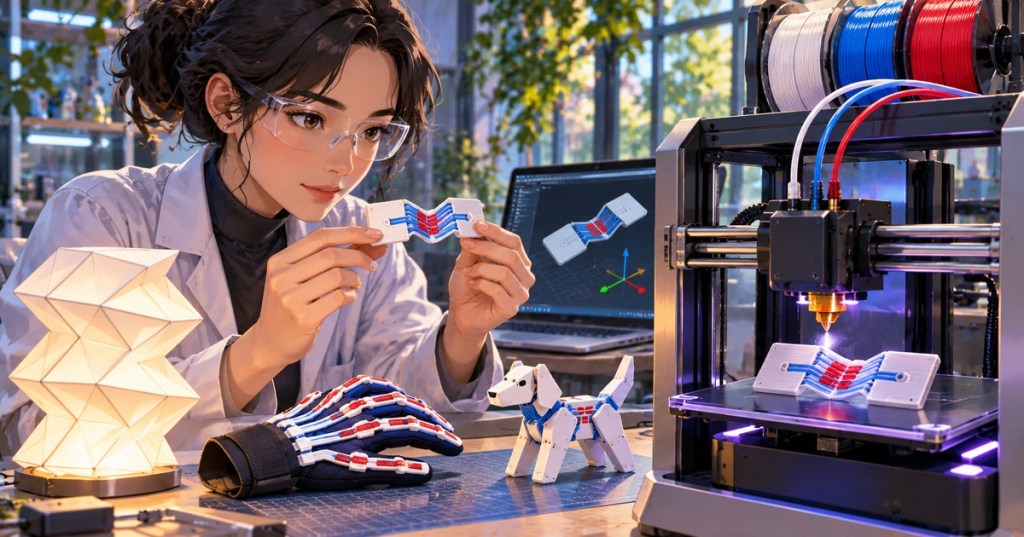
Researchers at MIT’s Computer Science and Artificial Intelligence Laboratory and Tianjin University have developed X-Hinges, software that designs flexible 3D-printed objects with motion sensors built into their structure. Highlighted by MIT on October 22, 2026, the research demonstrates a glove that controls a robotic hand, a foldable lamp, and a game controller. The team is presenting its work at the November 2–5 ACM UIST conference.
MIT CSAIL researchers demonstrate X-Hinges prototypes, including the sensing glove, lamp and flexible controls. Official research video.
Sensors emerge from the printer
Ordinary 3D printing produces shapes; interactive objects often require separate sensors and wiring afterward. X-Hinges instead prints three materials together: a flexible structural body, a higher-resistance sensing filament and a lower-resistance conductive trace. Electrical resistance changes as the printed hinge bends, allowing electronics and software to estimate movement.
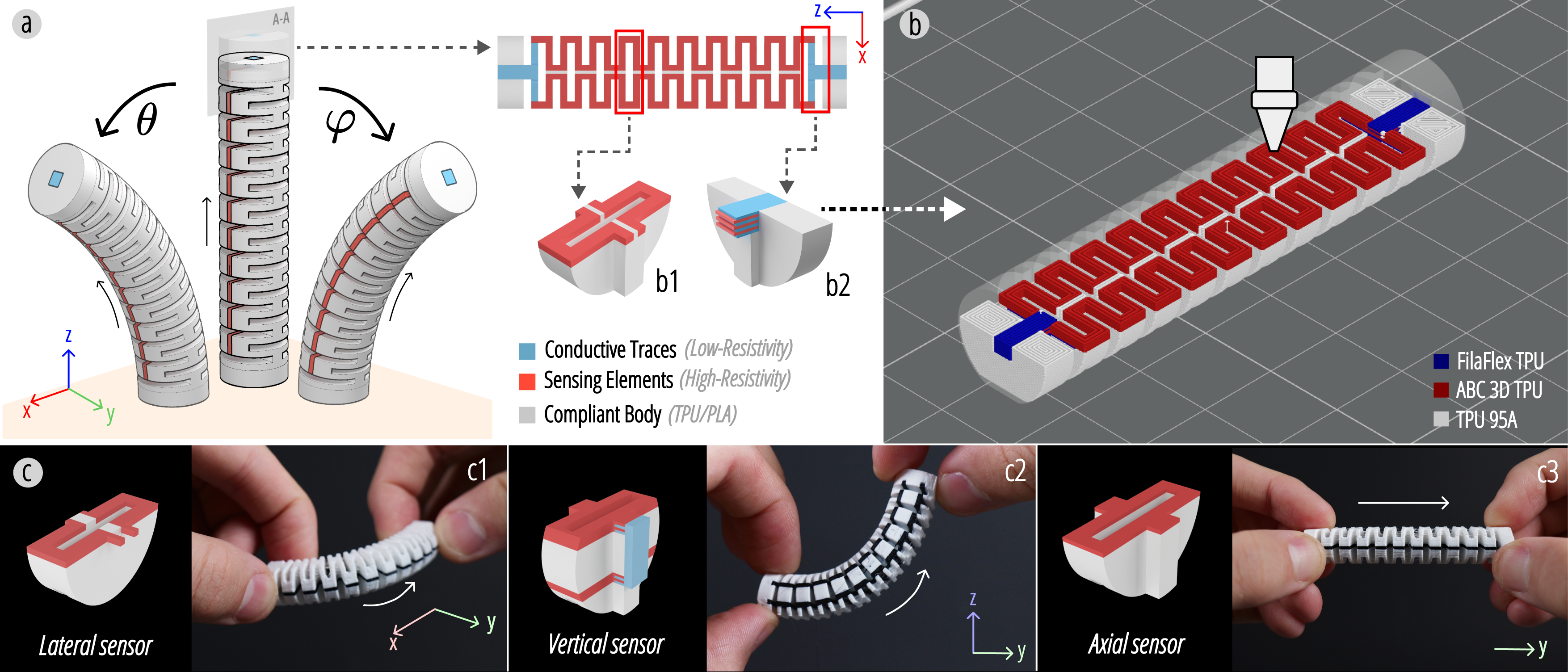
Original research Figure 2 explains how conductive filaments are positioned to measure lateral bending, vertical bending and axial deformation. Source: Chang and colleagues, ACM UIST 2026 accepted manuscript.
Unlike many earlier single-axis approaches, a joint can detect movement in three directions: sideways bending, vertical bending and compression or extension. This is a measurement of motion, not proof that an object possesses consciousness or general artificial intelligence. The sensing concept connects with MIT’s earlier shape-sensing sheet research.
A robot glove, a lamp and a toy
In one prototype, a wearable glove measures finger motion and sends it to a robotic hand that imitates grasping movements. An origami-style lamp changes brightness as it folds; a tactile platform distinguishes objects placed on it. These are laboratory demonstrations rather than retail products.

Original research Figure 1 shows four working prototype applications. Source: X-Hinges team, arXiv:2609.11077.
That approach could eventually complement robot learning from human demonstrations and tactile robot fingertips. The striking difference is where sensing happens: inside the printed mechanism, not attached to its exterior afterward.
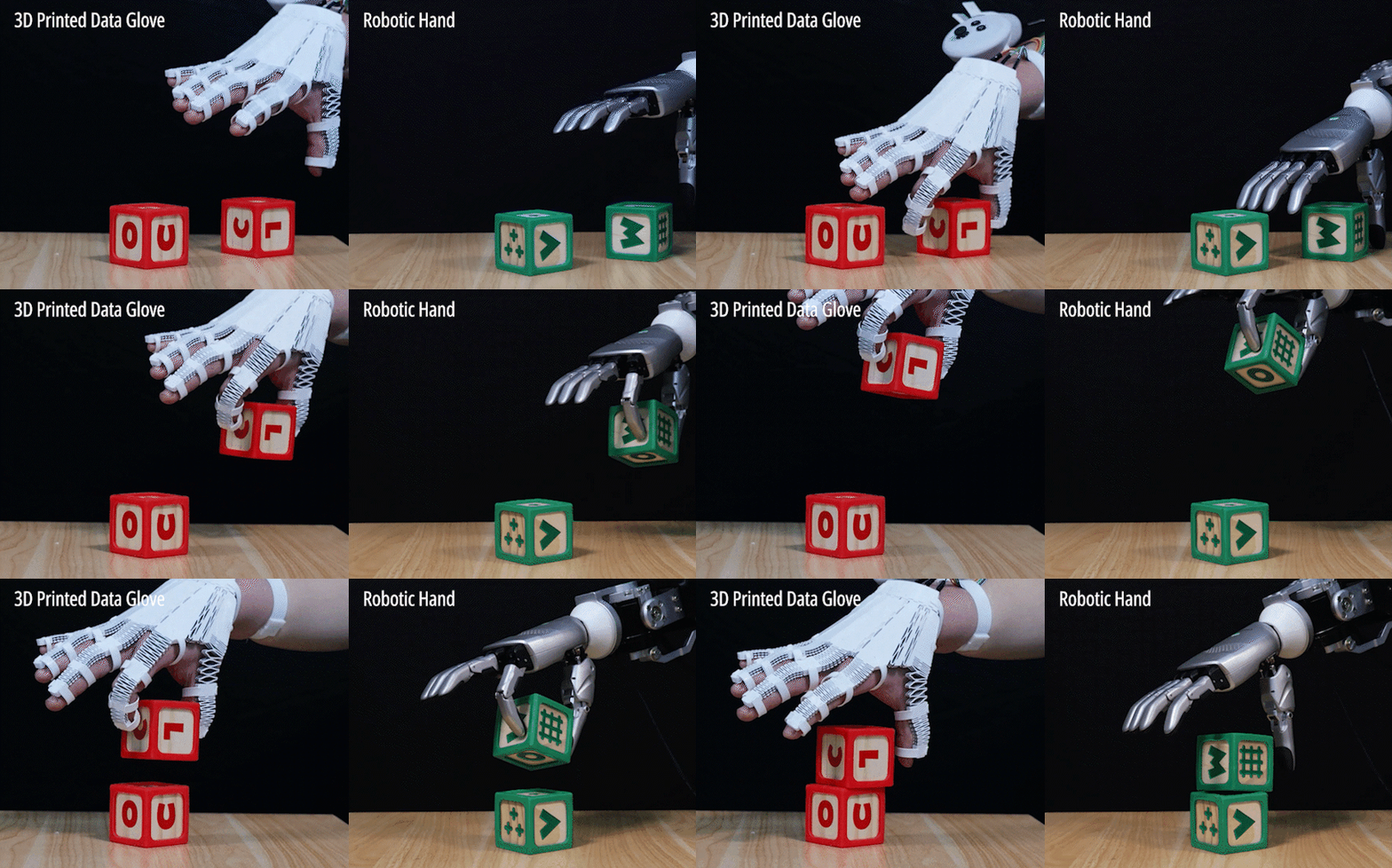
MIT CSAIL demonstration animation of the printed sensing glove and robotic hand. Credit: MIT CSAIL and the researchers.
The calibration problem remains
The accepted research paper identifies an engineering limitation: nominally identical prints can yield different electrical readings, while material creep and sensor interference complicate precision. Researchers currently use camera-assisted calibration and data-driven decoding. Their next objective is to integrate sensing and actuation more completely into the print.
For manufacturers, this could simplify prototypes of gloves, controllers and flexible tooling, alongside advances in specialized 3D-printing filaments. Commercial reliability, durability and production cost still require testing. X-Hinges is a research platform, not a shipping consumer product.
Support BitcoinVersus.Tech
We volunteer daily to ensure the credibility of the information on this platform is Verifiably True. Please scan the original QR code below to donate 5,000 sats if you would like to support our independent reporting. For best results, open this page on a laptop or larger screen.

On mobile, display the QR code on another screen to scan it with a Bitcoin wallet; alternatively, use a wallet’s saved-image QR-scanning feature if available. Bitcoin donation address: 3C9o19EH5HSiwEPyCTmEKzxhNCbo2X6TTb.
BitcoinVersus.tech is not a financial advisor. This media platform reports on financial subjects purely for informational purposes.


Leave a Reply