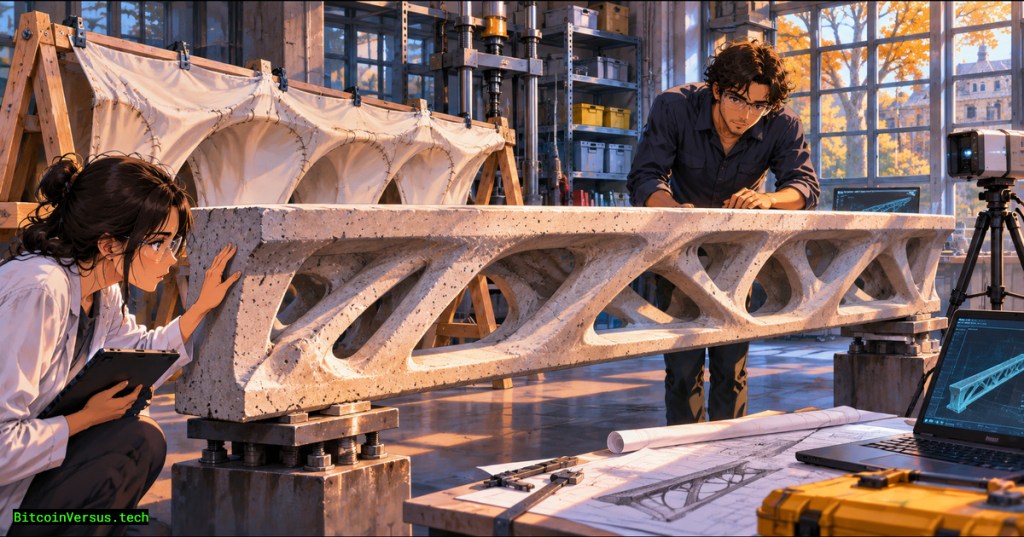
MIT engineers have built a three-meter concrete beam using sewn fabric molds that required about one-third the concrete and half the steel reinforcement of a conventional comparison beam designed for the same loading. Published November 6, 2026, the experiment combines computational structural design with inexpensive cotton and timber formwork. The achievement is a proof of concept, not approval for routine bridge or building construction.
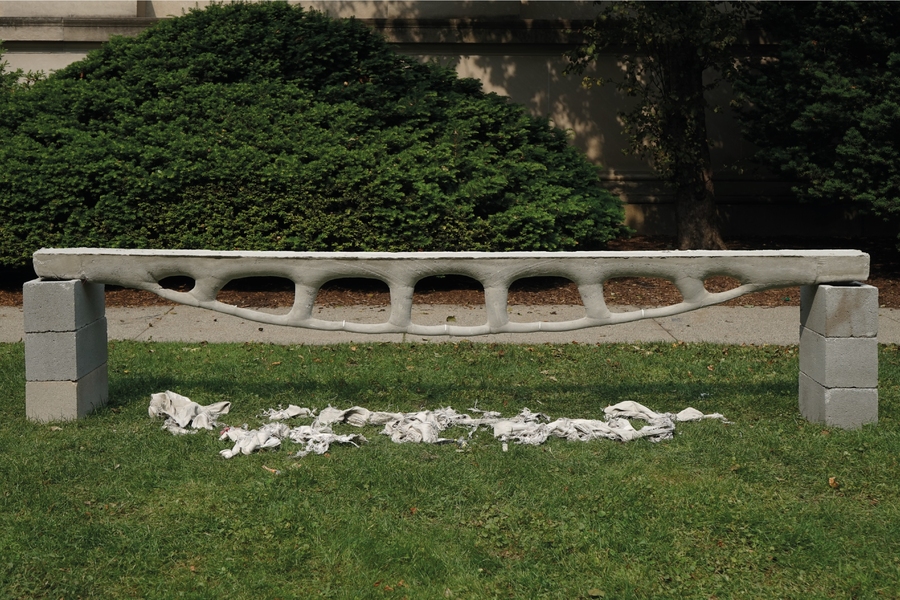
Conventional concrete beams often contain more material than structural forces require because rectangular forms are simple to manufacture. Topology optimization uses a computational model to place material along important load paths and remove less useful regions. An optimized shape may be difficult to cast using plywood, steel forms or precision-machined molds.
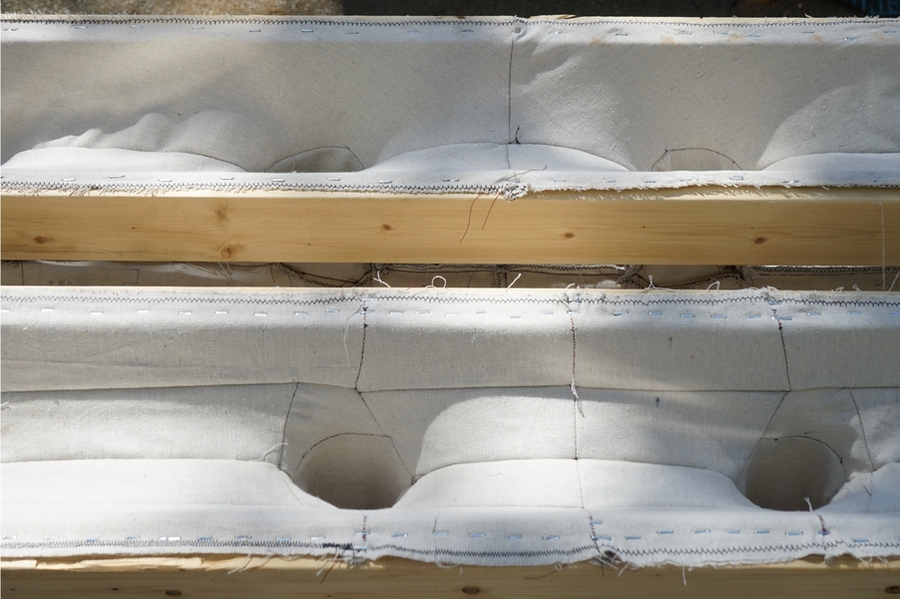
The MIT team instead transformed a three-dimensional beam design into flat fabric patterns. Sewn cotton panels were stretched and attached to a simple timber frame. As wet concrete filled the mold, the fabric bulged into the branched geometry, leaving a long upper flange, angled struts and a slender lower portion containing reinforcing steel.
Architectural engineer Mariana Popescu explains textile and knitted-concrete formwork in a 2020 TEDxBucharest talk. Original-source historical and engineering context, not footage of MIT’s 2026 experiment. Credit: TEDx Talks / Mariana Popescu.
A beam designed around the forces it carries
The reinforcement layout came from graphic statics, a method that uses force relationships to guide structural geometry. The concrete layout came from topology optimization. Together they produced a beam that illustrates the same principle explored in MIT’s structural AI copilot research: place material and geometry according to mechanical performance rather than habit.
Fabric molds have a practical complication. Wet concrete changes their shape, and a mix that flows too easily can lose water through the cotton. The researchers used a sand-rich mix with small aggregate, then packed it by hand, tapping and kneading the textile to move the concrete into narrow passages.
Three versions of the formwork used 36, 56 and 76 sewn panels. More seams provided better local shape control but added cutting, alignment and sewing errors. The 56-panel configuration achieved the best balance in the team’s comparison. Similar interest in geometry-driven fabrication appears in Northwestern’s rapid lattice-printing work, although the production methods differ.
What the testing actually proves
The critical limitation is load testing. Researchers stacked 36 water-filled buckets onto one prototype, reaching approximately 30% of the design load to represent ordinary service conditions. Its measured midspan deflection differed from the computer prediction by about 2%. That agreement supports the model under the tested conditions; it does not establish the beam’s ultimate load, fatigue life, crack resistance or long-term field durability.
The cost study was also conditional. For the one-off components modeled, fabric molds were about 10%–20% cheaper in lower-wage construction settings, while higher sewing labor costs made them approximately 16%–55% more expensive in wealthier markets. Reusable rigid formwork could remain preferable for repetitive components.
Material savings matter because cement manufacture is emissions-intensive. Reducing concrete volume can reduce associated material demand, but a full carbon comparison would need to include transport, textile consumption, fabrication, reinforcement, concrete mix and long-term service life. The network-inspired structural metamaterials field similarly shows why laboratory geometry results must be tested against intended real-world loads.
Original Chalmers University architecture-and-engineering course workshop recording of cable-net and fabric concrete-shell construction in 2023–24, published by Emil Adiels in June 2024. A related method, not MIT’s fabric-beam trial. Credit: Emil Adiels / YouTube.
A promising prototype, not a certified replacement
Fabric formwork has predecessors. ETH Zurich researchers previously used knitted textiles and cable nets for complex concrete shells; MIT’s new beam addresses a different challenge, tailoring reinforced load-bearing beams through automated flat-pattern generation. Neither technique makes cast concrete interchangeable with 3D-printed components, whose equipment and material deposition rules differ.
For small runs of custom beams, pedestrian structures and exposed architectural supports, inexpensive molds could make optimized shapes more accessible. Broader applications would require repeated destructive tests, code-compliant reinforcement details, documented quality assurance and verified performance under construction and service loads. Another MIT example, X-Hinges printed sensors, also illustrates the gap between a working prototype and a validated industrial product.
The next engineering milestone is straightforward: load several fabric-formed beams to failure, compare variability across manufacturing batches and demonstrate longer spans. Until then, the strongest verified claim concerns economical fabrication and material efficiency in a carefully defined laboratory comparison—not a universal formula for cutting concrete in every building.
Sources and methodology: MIT’s original November 6, 2026 research report; Journal of Building Engineering paper, “Affordable construction of topology optimized reinforced concrete through fabric formwork”; Construction Briefing industry coverage, November 9, 2026; ETH Zurich KnitCrete original project background. Figures describe the specified beam, service-load test and one-off cost scenarios; they are not generalized building-industry averages.
Editor’s Note: MIT’s 3-meter sewn-fabric concrete beam is a research demonstration. Approximately one-third concrete and one-half steel compare the optimized prototype with a conventional design carrying the same nominal load. The measured deflection agreement was observed at approximately 30% of design load, not at failure. The 1200 × 630 featured cover is original cinematic anime artwork depicting a fictional lab, not a documentary photograph. The cover includes the provided black-background pixel-lettering watermark in neon green. In-story MIT photographs are authentic and attributed. The TEDx and Chalmers recordings are separately identified historical context; playback on every device remains unconfirmed.

BitcoinVersus.Tech is volunteer-run and publishes independent technical journalism. An optional 5,000-satoshi donation supports ongoing research. Scan the original QR from a second screen using a compatible Bitcoin wallet; on the same phone, use a wallet that can import a saved QR image when supported. Independently verify recipient 3C9o19EH5HSiwEPyCTmEKzxhNCbo2X6TTb and the 5,000-satoshi amount before sending. Bitcoin transfers are generally irreversible.
We volunteer daily to ensure the information on BitcoinVersus.Tech is Verifiably True. Technical and financial coverage is educational and informational, not personalized engineering, securities, tax or investment advice.


Leave a Reply