
A team at the Massachusetts Institute of Technology and Northeastern University has 3D-printed a class of mechanical metamaterials that distribute deformation across irregular networks rather than repeating identical lattice cells. The peer-reviewed Nature study, published November 11, 2026, reports enhanced energy dissipation in impact tests and a 190-fold tunable range of elastic anisotropy across tested designs. Researchers see possible uses in protective padding, lightweight structures and vibration control, but the prototypes are laboratory samples—not certified helmets or commercial armor.
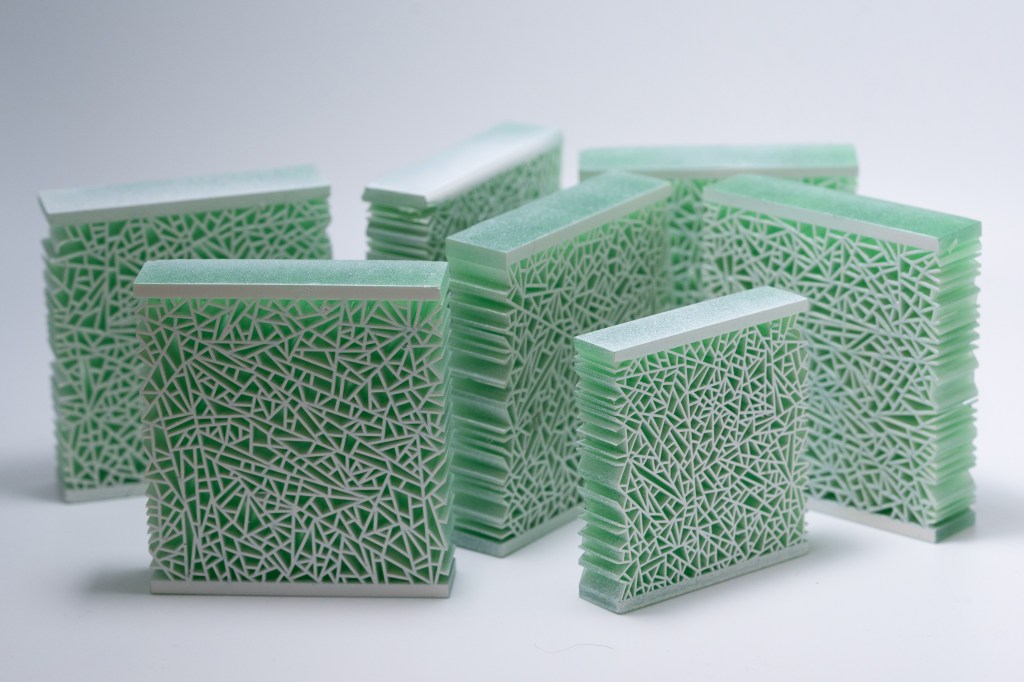
Network architecture replaces the repeating unit cell
Traditional mechanical metamaterials rely on precisely repeated shapes. Lattice spacing, beam thickness and geometry govern their stiffness, density and ability to absorb a load. Under compression, however, a localized buckle can propagate through neighboring cells with similar geometry. The MIT–Northeastern team instead borrowed ideas from network science and biological patterns, including leaf veins and dragonfly wings.
The researchers designed “scale-rich” networks with interconnecting beams of many lengths, thicknesses and degrees of connectivity. Their algorithm adds progressively shorter and thinner segments inside a defined space. By adjusting only two generation parameters, designers can tune the resulting structure’s mechanical response. Engineers then printed polymer specimens roughly the size of a credit card, incorporating features spanning micrometer to centimeter scales.
The research illustrates a different route for additive manufacturing and 3D printing. Rather than choosing only a new chemical composition, engineers can tune the physical arrangement of an existing material. Material density, print precision, defects and directional forces still shape the outcome.
What laboratory tests established
Researchers compressed and impact-tested network-based structures alongside conventional honeycomb and ordered-lattice samples. In the reported comparisons, network-rich specimens spread their deformation more broadly and dissipated impact energy more effectively under selected loading conditions. The 190-fold figure measures the tunable range of elastic anisotropy across the design space; it does not mean every sample is 190 times stronger, 190 times lighter or 190 times safer.
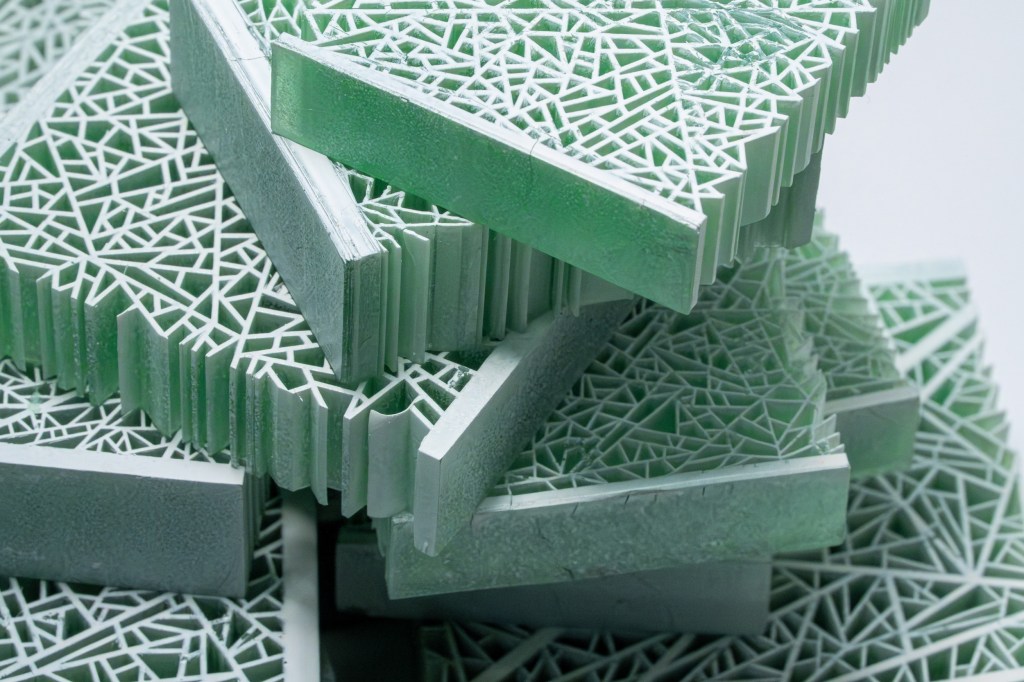
To test localized protection, the researchers also created a design with greater beam density near the exterior, inspired by the cushioning structure of a pomelo rind. A fragile object embedded in the center survived the demonstration. Results establish feasibility for the tested polymer architectures, not durability across real-world manufacturing batches, temperatures or sustained wear. The authors also report programmable control of elastic-wave behavior in simulation and experiments.
MIT provides an official laboratory video comparing deformation between an ordered lattice and the new networks. The original research is available in Nature, with open-source code for generating network designs released by the authors.
Implications and remaining limits
Potential applications include sports padding, protective packaging, acoustic components and engineered materials for aerospace equipment. Commercial adoption would require impact standards, repeatability studies, scalable production, aging tests and performance comparisons against established products. The study does not report a production qualification or any completed consumer safety certification.
The findings complement other manufacturing research covered by BitcoinVersus.Tech: Northwestern’s faster lattice-printing experiment, MIT’s human-guided structural optimization and diamond-based thermal material trade-offs. Those projects address distinct problems and should not be treated as direct performance competitors.
By making internal structure a tunable network rather than a fixed cell, researchers broaden the mechanical design options available to engineers. The promising result is experimentally demonstrated impact behavior in small samples; broader protection claims remain to be proved.
Primary sources
MIT News — November 11, 2026 research announcement and test video; Nature — “Scale-rich network-based metamaterials,” original peer-reviewed paper; U.S. National Science Foundation — November 12 research summary; Barabási Lab — open-source implementation.


Leave a Reply