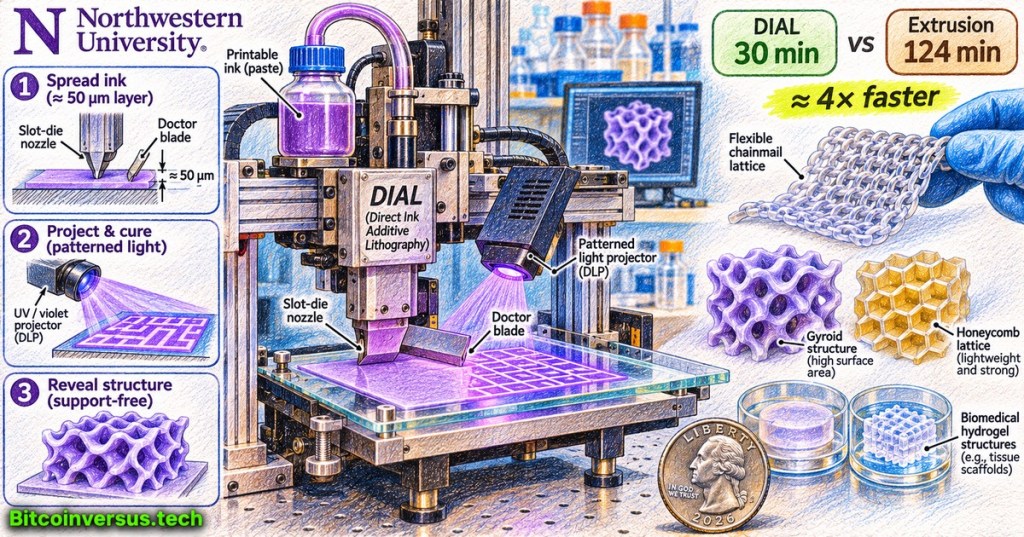
A team at Northwestern University has developed a 3D-printing method that completed a lattice in 30 minutes instead of the 124 minutes required by the conventional extrusion process used for comparison. The result, published November 4, 2026, in Science Advances, points toward faster production of intricate materials for robotics, batteries and laboratory equipment—but does not establish a fourfold advantage for every printer or design.
The method, called direct ink additive lithography (DIAL), combines thick functional inks with patterned light. Unlike a conventional extrusion printer that draws one strand at a time, DIAL spreads a thin sheet of paste, exposes selected regions with a projector and repeats the process layer by layer.
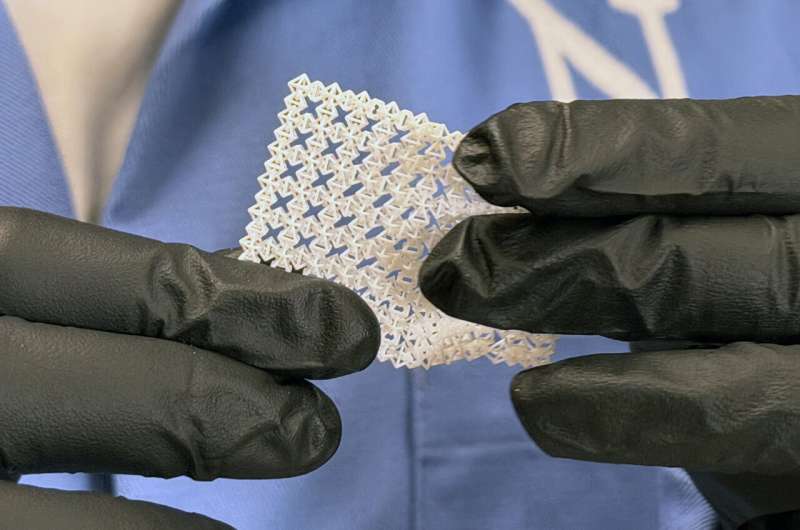
The interlocking chainmail shown here is a real DIAL-printed sample, not a computer rendering. Credit: Ryan Truby/Northwestern University.
How a sheet of ink becomes a precision part
First, a slot-die nozzle deposits paste onto a flat build surface. A blade levels the paste into a sheet about 50 micrometers thick. Projected light then hardens chosen regions while the surrounding uncured paste remains in place. Unlike vat photopolymerization, the process does not require a large bath of free-flowing resin.
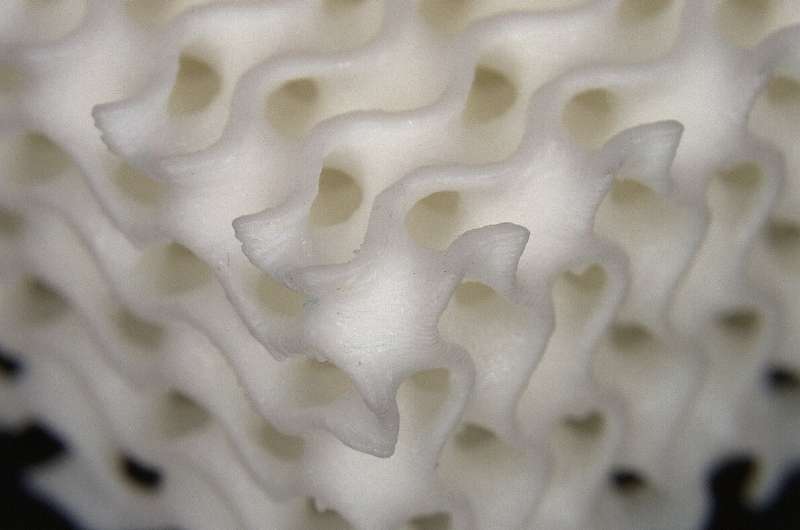
Northwestern researchers mixed a light-curable resin with fumed silica nanoparticles to create an ink with yield stress: it flows under the blade and stiffens again afterward. As a result, the uncured material can hold overhangs and delicate features until the finished part is washed out, reducing the need for separately printed support structures.
In earlier BitcoinVersus.Tech coverage, the fundamentals of 3D printing explain how layer-by-layer manufacturing differs from machining. DIAL changes how each layer is delivered and hardened.
30 minutes versus 124, with a meaningful limitation
In one benchmark, DIAL printed a porous log-pile structure in 30 minutes, compared with 124 minutes for the team’s reference direct-ink-writing process. Dividing 124 by 30 gives a 4.13× speed ratio, or a 75.8% reduction in elapsed printing time for that test. The researchers also formed walls around 150 micrometers thick and printed linked chainmail and gyroid lattices.
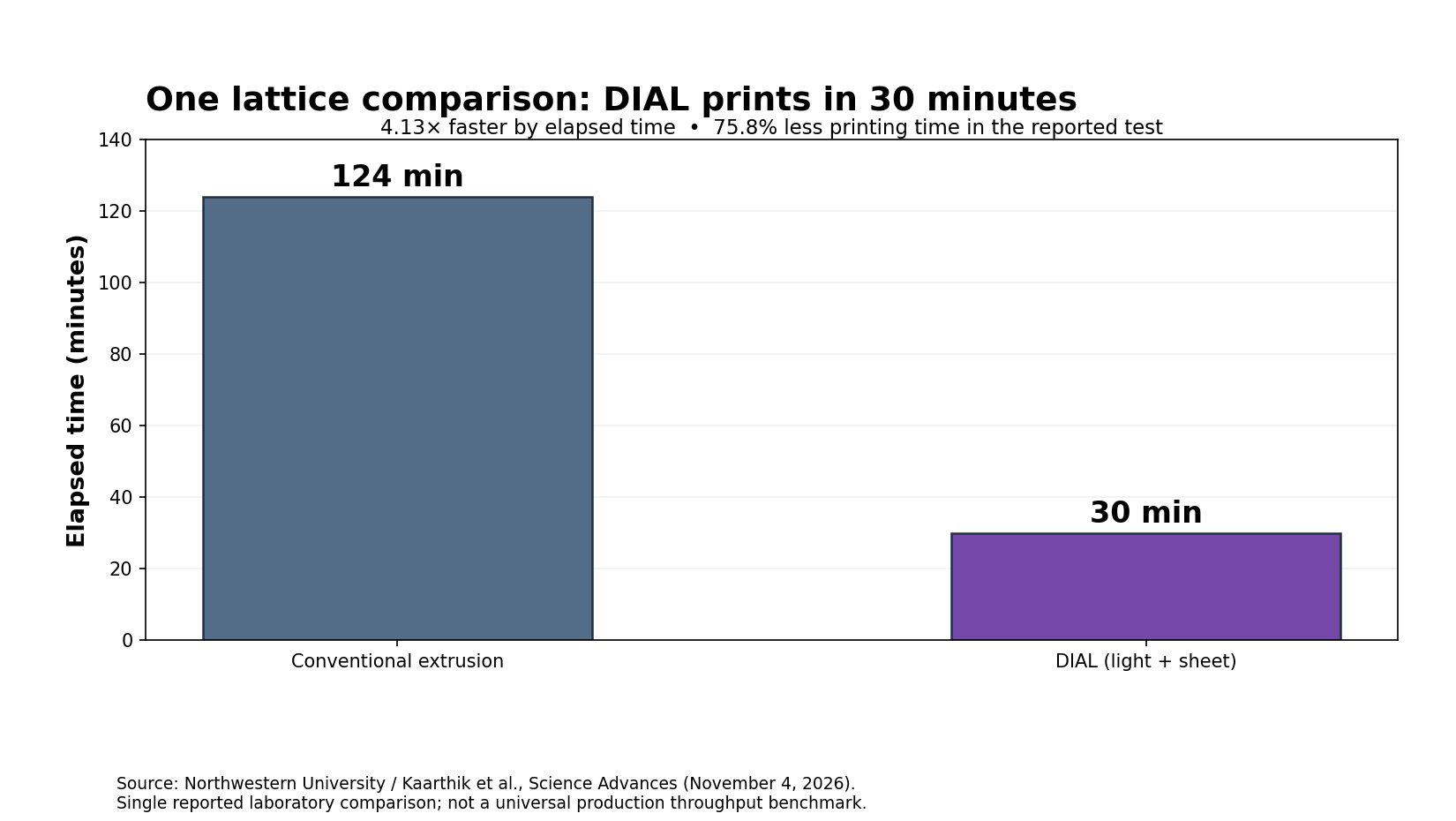
The authors say a desktop light-based printer needed additional supports for certain geometries, while the selected extrusion setup could not produce the same delicate lattices. Performance will depend on ink formulation, machine design, geometry, post-processing and the comparison printer; the reported result is a laboratory benchmark rather than an industrial throughput guarantee.
The new work connects with MIT’s printed motion-sensing hinges, which also depend on sophisticated geometry rather than simple solid plastic parts.
Functional inks could widen the applications
Northwestern demonstrated a structural-electrolyte ink by printing 15 intricate lattices in a single 15-minute run. The electrolyte structures are research samples—not working commercial batteries. The group also produced hydrogel containers inspired by cell-culture inserts, featuring microscopic inverted-pyramid patterns relevant to tissue-engineering experiments.
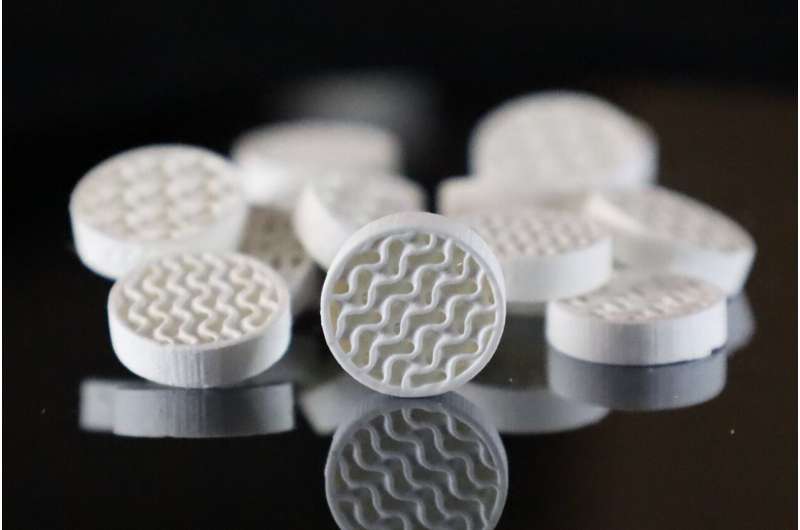
The battery angle is distinct from solid-state battery endurance research: DIAL offers a way to shape candidate materials, not a demonstrated increase in battery capacity or service life.
For biomedical applications, the new process may eventually complement low-cost systems such as the University of Rochester’s bioprinter, although DIAL’s published demonstrations are material structures, not clinically validated living implants.
Where DIAL still needs proof
Light-curable chemistry is a constraint, and intricate printed geometries can complicate removal of remaining paste. Researchers must also prove long-term reliability, material properties, scale-up economics and repeatability beyond the reported test configurations. The paper notes a Northwestern provisional patent application involving two of its authors.
Bottom line: DIAL is a credible laboratory advance in combining precision, geometry and functional inks. The most compelling claim is a measured improvement on a defined lattice—not a promise that all manufactured parts can be printed four times faster.
Sources: Northwestern University, November 4, 2026; Kaarthik and colleagues, Science Advances, November 2026, DOI 10.1126/sciadv.aei1146. Benchmark figures are from the study; industry applications remain prospective.


Leave a Reply