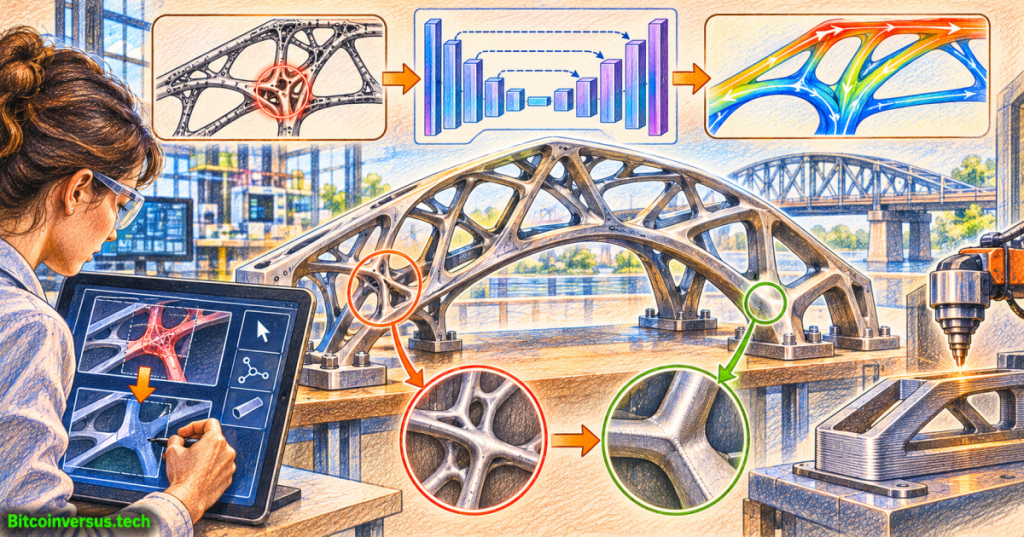
Engineers at MIT have developed an AI-assisted structural design system that invites human judgment before a computer finishes optimizing a part. In a published simulation example, the approach improved a structure’s calculated linear buckling load by 39% while adding approximately 15 seconds to the design process. The results were described in a November 13, 2026 MIT announcement and a peer-reviewed paper published November 10. They do not constitute a tested 39% improvement in real bridges or buildings.
Official Ansys demonstration of conventional topology optimization, published January 2017. Educational background only; the video does not demonstrate MIT’s new AI system or validate its performance figures.
The problem with a black-box optimized beam
Topology optimization starts with a proposed design space, physical loads, supports and material limits. A numerical solver repeatedly redistributes material, retaining regions that carry useful stresses and removing regions with less structural value. The method can produce lightweight brackets, aircraft components and lattice-like beams, but computed shapes may include awkward junctions or connection details that a manufacturer cannot produce economically.
For buildings and bridges, an engineer must also consider constructability, connections, inspection access, load combinations and applicable safety codes. Algorithms can optimize a mathematical objective without incorporating every practical requirement. Earlier BitcoinVersus.Tech coverage of MIT’s 3D-printed X-Hinges shows another research path where digital design must ultimately match physical fabrication.
AI suggests where the engineer should intervene
Lead author Dat Quoc Ha and colleagues used a U-Net image-segmentation model to predict portions of an evolving structure that a designer might want to revise. Researchers trained it on synthetic preferences applied to thousands of designs, including preferences for changing long members or crowded joints. In the resulting workflow, the system highlights candidate regions, while a person decides how to change them.
The demonstrated controls are deliberately narrow: the user may thicken or thin identified structural regions. The optimization solver then continues. The software does not independently certify a load-bearing design, choose every material or manufacture a building. The human input is the central feature, not evidence that an AI has replaced a structural engineer.
Why 39% and 15 seconds need context
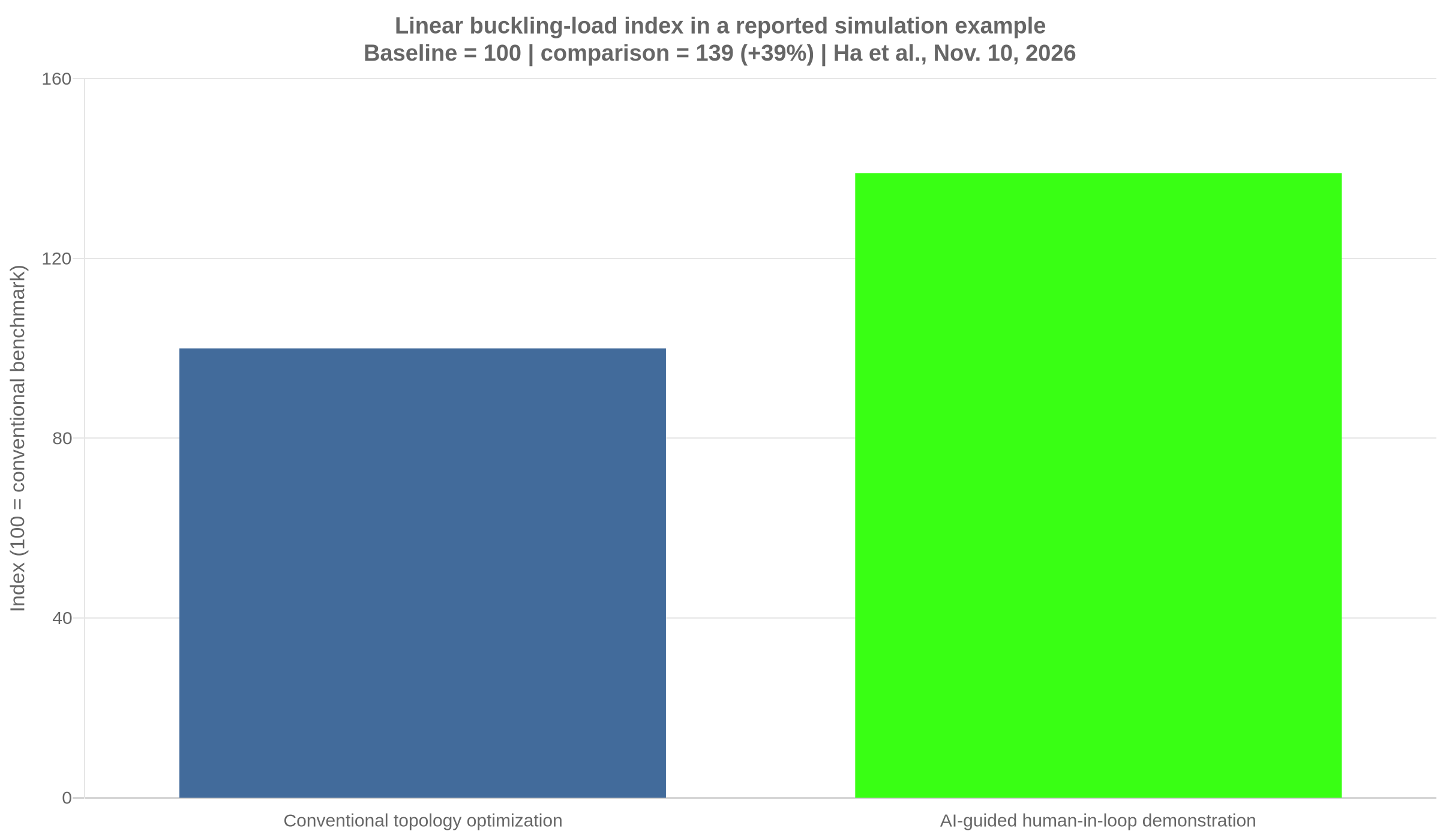
The journal paper describes demonstration examples in which the human-guided process improved manufacturability or raised calculated linear buckling load by 39%, depending on the example. Linear buckling analysis predicts an idealized instability threshold for a specified model. Actual structures can behave differently because of imperfections, joints, material variability, fatigue and nonlinear loading.
The reported extra 15 seconds compares a simulated design workflow with a conventional baseline, not construction schedules, engineering sign-off or total project delivery time. No independent full-scale load test or broad survey of professional engineers was disclosed. Comparable distinctions apply to research-stage 3D-printing hardware, where laboratory capability and industrial readiness remain separate questions.
Official Autodesk Fusion demonstration of generative design, published June 2024. It illustrates how manufacturing constraints affect computer-generated geometries; Autodesk is not claimed to be a participant in the MIT study.
The route from optimization software to usable hardware
More predictable connections and fewer fabrication headaches could make optimized parts attractive in machinery, buildings or aerospace. But a practical tool would need interfaces with existing CAD and finite-element software, repeatable designs, human-factors testing, documented design approvals and independent structural validation. In Caltech’s orbital truss assembly, for example, even assembling a successful structural section was distinct from proving an entire operational antenna.
The study also raises a broader software-design lesson: model recommendations are most useful when experts can understand and correct them. Human review matters in operational robotics too, as Robust AI’s worker-guided warehouse robots illustrate. The next research task is to expand permitted edits and test whether practitioners can achieve reliable gains under actual production constraints.
Primary sources: MIT News, November 13, 2026; Ha, Alam, Buehler, Ahmed and Carstensen, Communications Engineering, November 10, 2026. Original preprint: arXiv January 15, 2026. The U-Net, synthetic preference training, limited manual edits and simulated performance metrics come from the published study; no physical benchmark was independently performed for this article.
Editor’s note: The 1200 × 630 featured image is original editorial concept artwork, not an actual bridge produced by MIT. The in-story indexed column graphic normalizes a comparative simulated result and does not present raw load units. Both embedded videos are authentic engineering demonstrations predating the November paper; neither shows the specific MIT copilot. No field deployment or independent playback test is asserted.


Leave a Reply