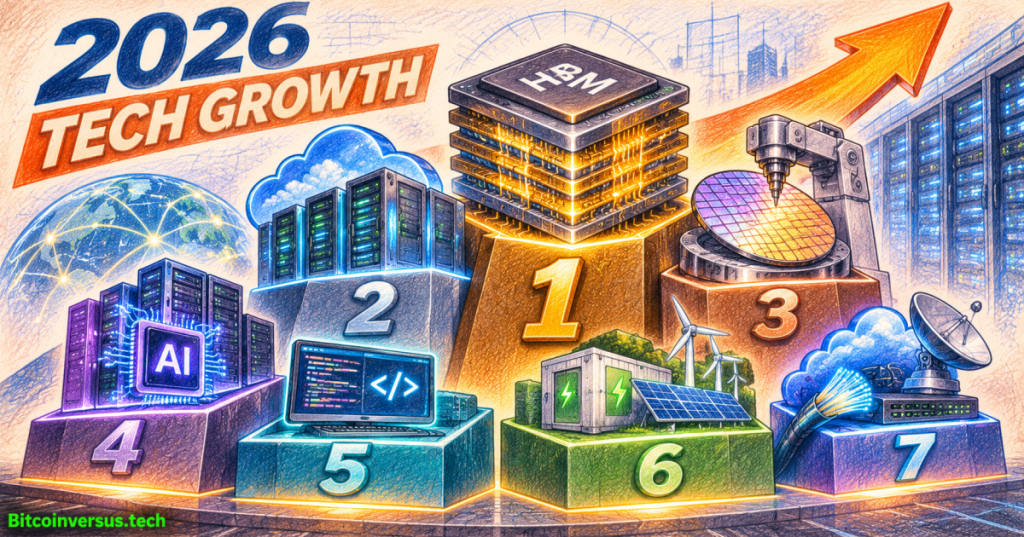
Memory chips, AI cloud infrastructure and data-center equipment lead a new ranking of seven fast-growing technology markets by projected 2026 revenue or spending growth. A Gartner forecast released October 21 places worldwide information-technology spending at $6.391 trillion for 2026, up 14.5%. Growth rates vary sharply across the hardware, cloud and software markets supporting artificial intelligence.
Official NVIDIA GTC 2026 keynote, March 16, on AI factories, accelerated computing and the memory-intensive infrastructure behind modern AI. Company presentation; not an independent verification of Gartner forecasts.
Method: Seven selected global technology-market categories are ordered from lowest to highest projected 2026 year-over-year growth, using Gartner publications dated July 20, August 10 and 24, and October 21. The 2026 calendar year is not complete. The markets overlap—memory belongs to semiconductors, and AI-optimized cloud belongs to IaaS—so revenues must never be summed or treated as seven mutually exclusive industries. The list is not an exhaustive worldwide census.
#7 — Software: +15.2%
2026 market spending: $1.464 trillion. Gartner’s October forecast covers software broadly, including enterprise applications and infrastructure programs. AI features support new budgets, but subscription inflation, vendor consolidation and uncertain productivity returns can erode customer value. The broad software market grows more slowly than the specialized compute markets powering AI.
#6 — Cloud infrastructure as a service: +31.3%
2026 market spending: $292 billion. IaaS rents computation, storage and networking rather than requiring customers to operate every server. Gartner’s October estimate reflects stronger cloud demand. The specialized AI cloud segment at #2 is already included within the wider IaaS market, and must not be counted again when calculating totals.
#5 — AI models and development platforms: +63.4%
2026 market spending: $64.252 billion, versus $39.311 billion in 2025, in Gartner’s July analysis. The category covers foundation models, specialized models and AI development platforms. Gartner noted that buyers increasingly demand reliable results and transparent inference costs, a warning that rapid spending is not equivalent to proven profitability.
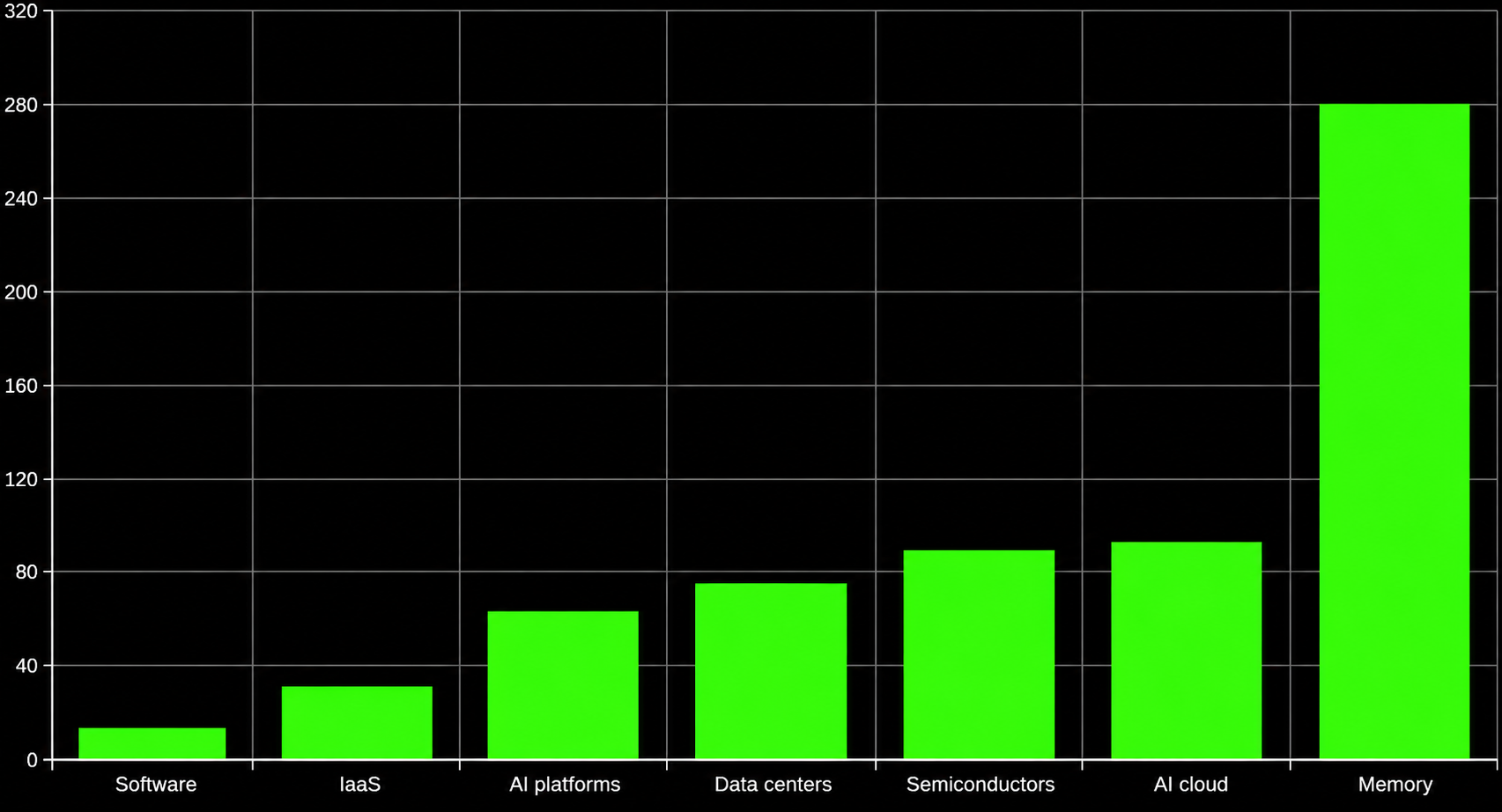
#4 — Data-center systems: +73.8%
2026 market spending: $879 billion. Servers, storage and related hardware are expanding rapidly as AI clusters require additional processors, memory, networking and power equipment. Gartner’s October estimate reflects both shipments and pricing pressures. For a closer engineering view, BitcoinVersus.Tech examined 800-volt power architecture for megawatt-scale racks.
Counterpoint Research’s April 8 interview with Micron Technology’s Vijay Nain explains HBM4, memory bandwidth and power-efficiency trade-offs. Interview material provides technical context; it does not validate the independent market-growth projections.
#3 — Semiconductors: +92.2%
2026 revenue: $1.5552 trillion, compared with $809.0 billion for 2025, according to Gartner’s August 24 forecast. The calculated increase is 92.24%, rounded to 92.2%. Memory pricing dominates the surge; the nonmemory chip segment is expected to rise only 21.9%. Separately, TSMC’s monthly revenue illustrates foundry demand without standing in for the entire chip industry.
#2 — AI-optimized cloud infrastructure: +96.4%
2026 market spending: $42.276 billion, versus $21.529 billion in 2025. Gartner’s August 10 report estimates $23.3 billion for inference workloads and $19.0 billion for training. Renting specialized accelerators can shorten deployment time, but energy costs, GPU availability and utilization remain central risks. Major buyers also develop custom AI chips to manage infrastructure expense.
#1 — Memory semiconductors: +280.4%
2026 revenue: $837.3 billion, up from $220.1 billion in 2025. Calculation: ($837.3B − $220.1B) ÷ $220.1B × 100 = 280.4%. Gartner projects DRAM revenue growth of 246.6% and NAND flash growth of 371.9%. High-bandwidth memory supports AI accelerators, but higher average selling prices—not a tripling in memory units shipped—are a decisive part of the revenue boom. Related analysis of memory capacity expansion in AI servers provides system-level context.
What a revenue-growth ranking cannot prove
Revenue growth is not unit growth, improved profit margins or a guaranteed return for investors. Memory inflation, supply bottlenecks and a concentrated group of cloud buyers can reverse quickly. Gartner’s October outlook also warns that higher component prices may suppress demand for PCs, storage and other devices. The ranking identifies powerful forecast market shifts, not independently audited 2026 sales or an investment recommendation.
Source and calculation notes: Gartner global IT forecast (Oct. 21, 2026); AI platforms and models (July 20); AI-optimized IaaS (Aug. 10); semiconductors and memory (Aug. 24). Growth reflects Gartner estimates published on different dates, not identical final-release snapshots. Semiconductor and memory rates were recalculated from forecast annual revenue; other growth percentages follow the respective published forecasts. Submarkets overlap.
Editor’s note: Both YouTube videos are authentic 2026 educational/promotional background, and the vertical-column chart is an original BitcoinVersus.Tech rendering of the cited forecast rates. The original colored-pencil featured cover is conceptual, not a photograph or numerical data visualization. Because 2026 is ongoing, all seven industry growth figures remain projections as of November 15.


Leave a Reply