
Penguin Solutions has introduced a new way for AI data centers to reuse older server memory. Announced on November 12, 2026, the SMART CXA-8F2W-D4 is a Compute Express Link (CXL) add-in card that accepts qualified DDR4 modules and exposes them as additional memory capacity to compatible servers. The design targets organizations facing rising memory demand and large inventories of DDR4 retired during infrastructure upgrades.
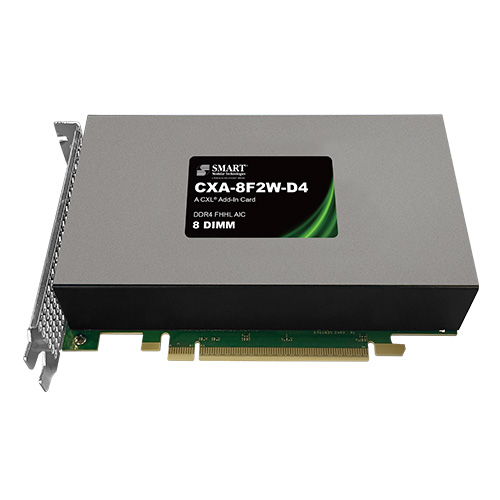
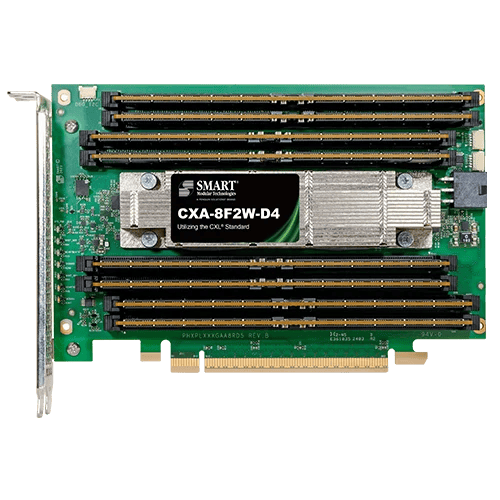
The company says the card uses a Marvell StructeraX CXL controller to connect up to eight DDR4 registered DIMMs through a PCIe Gen5 x16 host interface supporting CXL 2.0. Its published maximum is 1 terabyte, with a 512 GB baseline configuration of eight 64 GB modules. The product specification lists a host-interface throughput of up to 64 GB/s; it does not provide independently tested workload throughput or end-to-end latency.
A bridge between DDR4 inventory and newer servers
Modern DDR5 systems cannot normally accept DDR4 modules in their processor memory sockets because electrical signaling, controllers and connectors differ. CXL provides another route: a Type 3 memory device can attach through a supported PCIe link and offer capacity to system software. The DDR4 still runs behind the add-in card’s controller; it is not converted into DDR5.
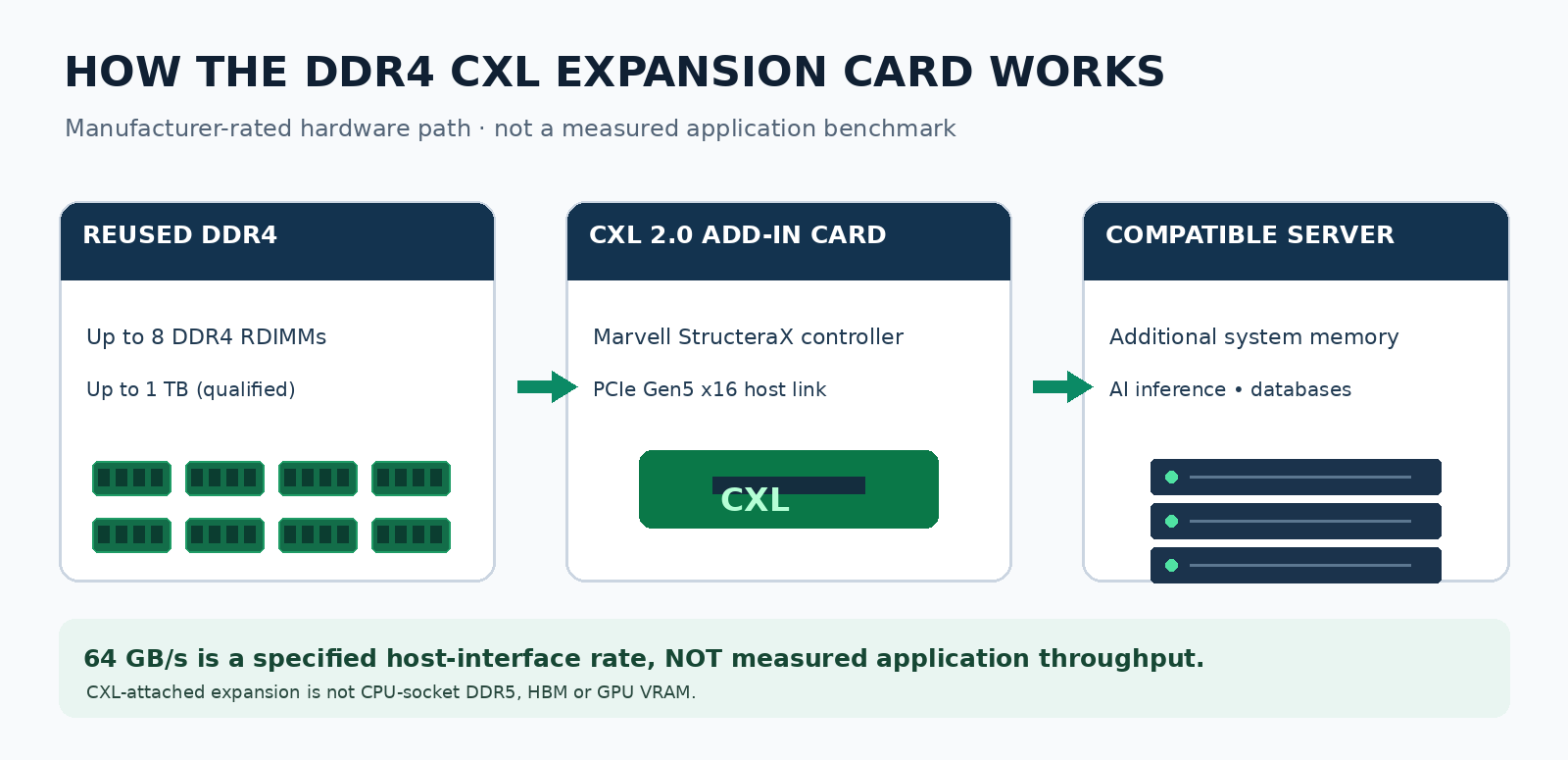
Capacity is the selling point. Additional addressable RAM could be useful for AI inference state and key-value caches, analytics or large in-memory databases when datasets exceed a server’s locally installed DRAM. Yet CXL-attached memory is not an equivalent replacement for processor-local DDR5 or an accelerator’s high-bandwidth memory. Applications sensitive to memory latency or bandwidth must be profiled, and firmware, operating-system support and workload placement all matter.
The underlying Marvell StructeraX architecture was covered earlier by BitcoinVersus.Tech, while our CXL 4.0 explainer describes a newer interconnect generation. Penguin’s DDR4 product specifically supports CXL 2.0, not an advertised CXL 4.0 operating mode.
Memory recovery comes with testing requirements
Penguin has also announced a sourcing and qualification program to reclaim modules during server refreshes or purchase DDR4 stock from resellers. Its Zefr memory-screening process checks recovered modules under stress, then tests a populated CXL card inside a compatible host before shipment. A reused DIMM should not be assumed production-ready merely because it powers on.
For procurement teams, the economic question is broader than old-versus-new DIMM prices. CXL card costs, validated memory supply, host compatibility, power, software tuning and possible performance losses can offset apparent savings. Penguin has not released a standardized public price comparison, independent performance result or named deployment count for the new D4 card.
Other approaches tackle the same memory bottleneck: Astera Labs’ CXL memory expansion, SK hynix’s memory-centric rack concepts, and Everspin’s CXL-attached MRAM work. The products and architectures differ in maturity, memory type and target application.
Availability and the next test
The CXA-8F2W-D4 is available for qualified customer opportunities on supported CXL 2.0 server platforms, according to Penguin. That phrasing is narrower than an unrestricted retail release. A coming industry demonstration may help illustrate the memory-reuse workflow, but demonstrations should not be mistaken for independent production benchmarks.
Penguin’s release cites a TechInsights estimate that AI data centers account for 34% of DRAM demand in 2026 and could approach half by 2029. The projection supports the company’s rationale but is not a measured future outcome. For operators with retired DDR4 modules, reuse through CXL is a credible additional capacity option—provided compatibility, validation and real workload economics are established.
Primary sources: Penguin Solutions announcement, November 12, 2026; manufacturer CXA-8F2W-D4 specifications and official photographs; TechPowerUp reproduction of product announcement. The maximum 1 TB and 64 GB/s are vendor-rated specifications, not independently benchmarked sustained performance. TechInsights demand figures are third-party estimates attributed in Penguin’s release.
Editor’s Note: The eight-DIMM SMART CXA-8F2W-D4 is a DDR4 CXL 2.0 memory expansion device. Its specifications differ from Penguin’s similar DDR5 CXA-8F2W product, which is not used as documentary imagery here. The announced card adds memory capacity to compatible host systems, not direct GPU HBM or physically interchangeable DDR5 modules. No independent bandwidth, latency, cost-saving or installation benchmark was completed. The 1200 × 630 colored-pencil cover and CXL data-path diagram are original conceptual editorial artwork; two in-story card photographs originate from Penguin’s exact-model product page. A confirmed relevant official YouTube video or individually verified social post with a working embed was not available; the publisher’s official source links are provided instead. Mobile layout testing limitations are reported separately.

BitcoinVersus.Tech is volunteer-run and publishes independent educational technology reporting. An optional 5,000-satoshi donation supports ongoing research. Scan the original QR from a second screen with a compatible Bitcoin wallet; on mobile, use a wallet that supports scanning a saved image. Independently verify the recipient address 3C9o19EH5HSiwEPyCTmEKzxhNCbo2X6TTb and the payment amount before sending. Bitcoin transfers are generally irreversible.
We volunteer daily to ensure information on the BitcoinVersus.Tech platform is Verifiably True. Coverage is educational and informational and does not constitute financial or investment advice.


Leave a Reply