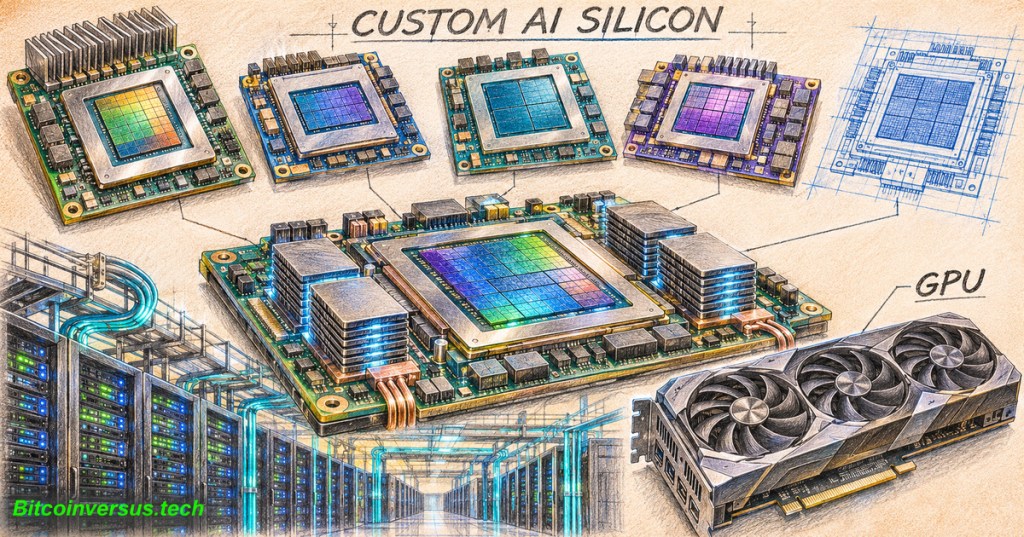
Six major AI companies using Nvidia computing platforms have also pursued proprietary accelerators, but their programs are far from equivalent. Google and Amazon already operate custom silicon at scale; Meta and Microsoft have production deployments; OpenAI has demonstrated working samples; and Anthropic is assembling a chip-design team. An online claim that “six of seven” Nvidia customers build their own chips captures a genuine shift, yet offers no independently verified list of seven or consistent definition of a completed chip.
The distinction matters after Google expanded its eighth-generation TPU portfolio on November 9 and Amazon disclosed surging chip commitments on October 30. Custom silicon is becoming a procurement option, not evidence that those companies have stopped buying Nvidia GPUs.
Google Cloud’s official April 22, 2026 presentation with Amin Vahdat and Jeff Dean explains the TPU 8t and 8i architectures. Manufacturer presentation; performance statements are not independent comparative benchmarks.
Six programs, six different stages
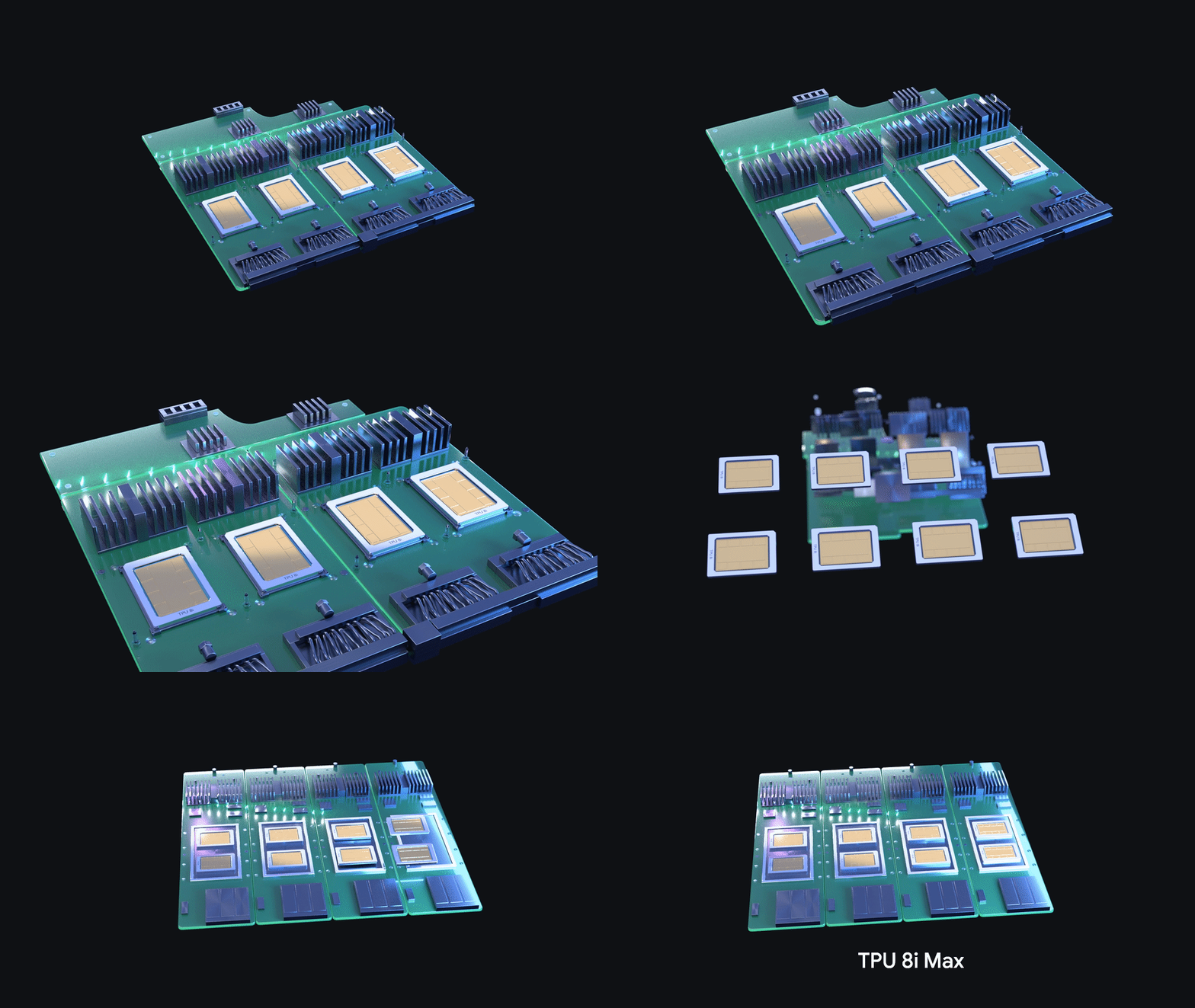
Google — TPU: Its eighth-generation portfolio includes TPU 8t for training and TPU 8i for inference. November additions, 8tx and 8i Max, emphasize confidential computing and higher memory density. Google says TPU services have nearly 100 customers. BitcoinVersus.Tech separately covered the new configurations and their memory architecture.
Amazon — Trainium: Amazon says Trainium3 is serving production workloads. In its October 30 comments, CEO Andy Jassy said Graviton and Trainium revenue commitments each grew more than twentyfold year over year, and customers saved over $2 billion using custom silicon during Q3. Those are Amazon-reported figures, not an independent Nvidia-versus-Trainium cost study. Amazon intends to offer Trainium beyond AWS in late 2027.
Microsoft — Maia: Microsoft says Maia 200 runs production services, including Copilot, while Maia 300 is scheduled for deployment in 2027. The announced Maia 300 rack combines 96 accelerators within a 167-kilowatt power envelope. Earlier BitcoinVersus.Tech coverage examines the Maia 300 hardware announcement without treating its future shipments as completed deliveries.
Meta — MTIA: Meta reported hundreds of thousands of MTIA chips deployed and described additional 300-, 400-, 450- and 500-series designs for recommendations and generative-AI inference. Its separate Nvidia agreements show that internally designed ASICs and externally sourced GPUs can coexist in the same infrastructure roadmap.
OpenAI — Jalapeño: OpenAI and Broadcom unveiled an inference processor in June. Engineering samples have run models in the laboratory; a multigeneration program targets broader deployment. Initial efficiency measurements remain vendor claims until comparable external tests appear. Related BitcoinVersus.Tech reporting examines OpenAI’s reported interest in other accelerator suppliers.
Anthropic — early design: Reuters reported in August that the company was forming a team to create its own AI chips. No independently confirmed mass-produced Anthropic accelerator or shipment total accompanies the announcement. Its use of AWS Trainium, Google TPUs and Nvidia GPUs remains a separate, existing strategy.
Why custom silicon is not a Nvidia exit
An application-specific integrated circuit (ASIC) can dedicate more area and power to a narrower mix of tensor operations, memory access and communication. At high utilization, reduced cost per useful output token may offset design expense. The calculus changes with model revisions, programming effort, compiler support, high-bandwidth memory, network topology, electricity prices and fabrication yields. A custom chip can outperform on one inference workload while falling behind a general-purpose GPU on another.
Nvidia’s official January 6, 2026 Rubin engineering video shows its own integrated compute, networking and memory-system approach. Company video, not an independent comparison with TPU, Trainium, Maia or MTIA.
Nvidia’s October partnership disclosures still describe deployments with Meta and Oracle, while its Rubin platform is being supplied through AWS, Google Cloud and Microsoft Azure. A customer developing alternative silicon may simultaneously order Nvidia processors, switches and networking components. BitcoinVersus.Tech previously examined Google’s TorchTPU software push and Oracle’s cloud arrangement.
What the six-of-seven claim does not prove
No audited ranking of the seven largest Nvidia end customers accompanies the cited social post. Nvidia often sells through cloud providers, equipment makers and distribution partners, complicating attempts to infer final hardware ownership from a vendor list. Even counting six independently documented initiatives would not establish the proportion of Nvidia revenue at risk, the date each accelerator reaches volume production, or an equivalent price-performance advantage.
The next decisive measurements are deployed chip counts, customer-accessible capacity, reproducible model benchmarks, total infrastructure cost and Nvidia purchases disclosed over comparable periods. The hardware landscape is diversifying, but its competitive outcome remains open.
Reporting sources: Google Cloud, November 9; Amazon, October 30; Microsoft, October 12; Meta, March 11; OpenAI–Broadcom, June 24; Reuters on Anthropic, August 5; Nvidia–Meta, October 26; Nvidia–Oracle, October 27. Company-supplied sales, performance and shipment claims are explicitly attributed.
Editor’s Note: The online “six of seven” assertion has no validated denominator or uniform customer definition. Six documented development initiatives are not equivalent to six production-scale competitive suppliers. The cover is original 1200 × 630 colored-pencil conceptual artwork, rather than photographs of the named chips. The Google product graphic and both videos come from official corporate sources. Video identity was checked from publisher listings; saved-player rendering, playback permissions and mobile performance still require independent live-device verification.

BitcoinVersus.Tech is volunteer-run and publishes independent educational technology reporting. An optional 5,000-satoshi donation supports research. Scan the QR from a second screen with a compatible Bitcoin wallet; on a phone, save the QR image and scan it using a compatible wallet application. Verify address 3C9o19EH5HSiwEPyCTmEKzxhNCbo2X6TTb and the amount before sending. Bitcoin payments are generally irreversible.
We volunteer daily to ensure information on the BitcoinVersus.Tech platform is Verifiably True. Coverage is for educational and informational purposes and is not financial or investment advice.


Leave a Reply