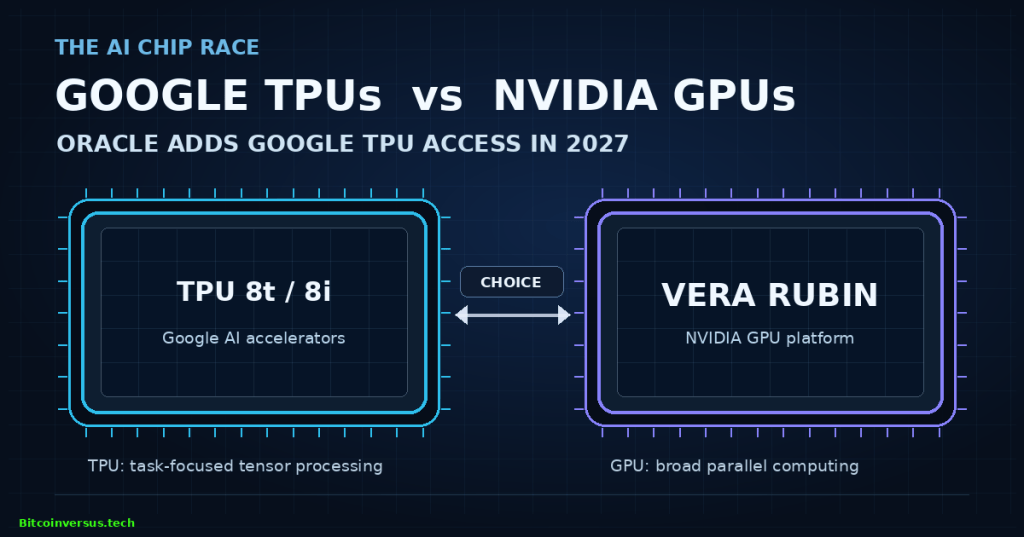
Google is making its AI accelerators easier to program while preparing to distribute them through a rival cloud operator. On October 20, 2026, Google open-sourced TorchTPU, allowing familiar PyTorch workflows to target Tensor Processing Units. Seven days later, Google and Oracle announced planned TPU availability on Oracle Cloud Infrastructure (OCI) in 2027. Both steps could strengthen Google’s alternative to Nvidia, but neither proves a cost or performance victory.
The engineering question is broader than peak chip speed: can a model be trained or served with lower end-to-end costs, predictable latency, high cluster utilization and manageable software effort? BitcoinVersus.Tech previously covered reported interest from OpenAI and Oracle’s confirmed TPU arrangement. The newer software-and-systems comparison reveals why buyers increasingly seek more than one accelerator family.
Tradeoff Layer’s “Can Google Beat Nvidia? TPU vs GPU Explained” examines accelerator architecture, CUDA software and procurement tradeoffs. YouTube video ID verified through public listings; publisher: Tradeoff Layer. Video commentary is not treated as independent hardware benchmark evidence.
How a TPU differs from a GPU
A GPU is a widely programmable parallel processor. Nvidia’s GPU platform combines tensor hardware, high-bandwidth memory, interconnects and a mature CUDA-based software ecosystem. Google’s TPUs are custom tensor accelerators built around matrix computation, compiler scheduling and closely integrated networking. Both families train and run modern neural networks; neither operates without moving model weights, activations and intermediate values through memory.
Google’s TPU 8t targets large-scale training, whereas TPU 8i targets latency-sensitive inference. Oracle attributes nearly three times the previous generation’s compute performance per pod to TPU 8t; the statement is a vendor comparison against an earlier TPU, not a measured advantage over Nvidia Rubin. For a specification-oriented view, see BitcoinVersus.Tech’s AI accelerator compute ranking, which explicitly separates FP8 and FP4 metrics.
Official Google Cloud video: “How Google’s 8th Generation TPUs Power the Agentic Era” (April 22, 2026). Amin Vahdat and Jeff Dean explain the separate TPU 8t and TPU 8i designs. Source: verified Google Cloud YouTube channel.
CUDA matters, but PyTorch support is changing
Nvidia’s CUDA libraries, tooling and established deployment workflows reduce development friction for teams already running GPU software. Google has long supported JAX and XLA compilation on TPUs. TorchTPU now gives PyTorch users a more direct route, with Google reporting integration across vLLM, SGLang, Hugging Face, TorchTitan and Ray. Its open-source release matters because rewriting kernels and debugging numerical differences can erase nominal hardware savings.
A new software backend does not make every model portable at identical performance. Some operations still require tuning, compatibility testing, compilation management and dedicated kernels. Anthropic’s April 2026 infrastructure statement identifies AWS Trainium, Google TPUs and Nvidia GPUs among the platforms used for Claude, illustrating procurement diversity rather than a winner-take-all transition.
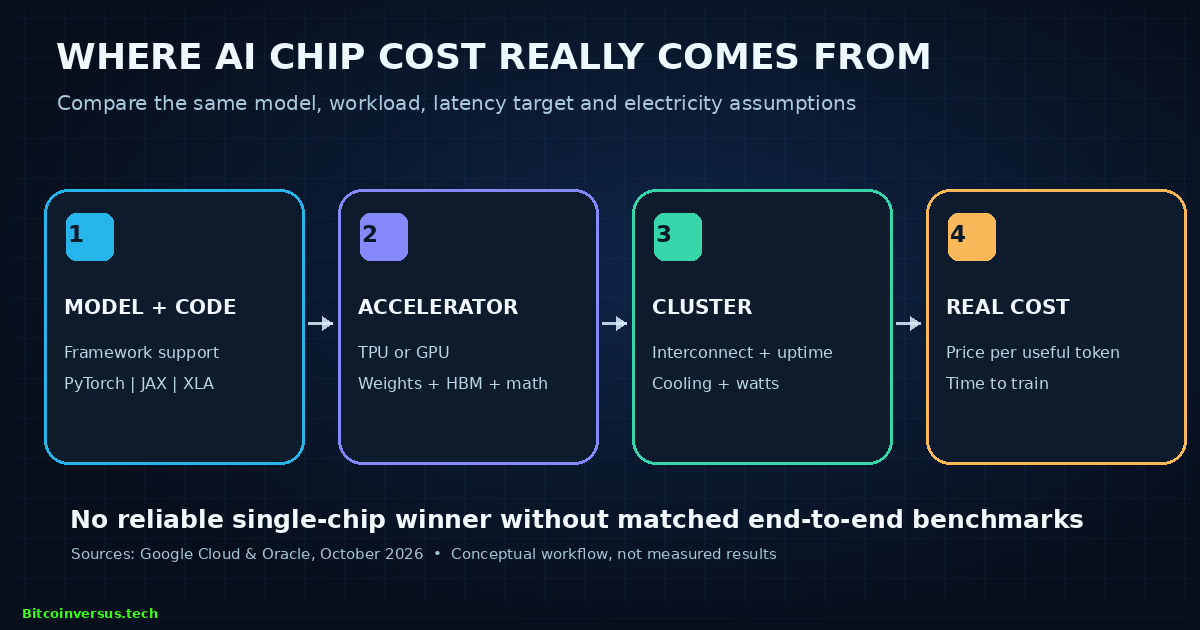
The real contest is cost per useful result
Training efficiency depends on productive compute time, cluster failures and time to a validated model. Inference economics depend on tokens per second, request latency, batching, memory capacity, utilization and energy. Google has claimed over 97% training goodput for large TPU runs and up to 80% better performance per dollar for some low-latency serving configurations; those vendor-reported claims do not constitute controlled, cross-vendor comparisons.
A sound procurement comparison must benchmark identical models at matched output quality and service-level targets, then include chip rental, memory, networking, cooling, electricity, staff and software migration. BitcoinVersus.Tech’s token-value-per-watt analysis examines why useful output, not theoretical FLOPS alone, matters.
The surprising overlap between rivals
Oracle’s TPU offering is planned for 2027, not yet generally available. Meanwhile, on October 27, Oracle and Nvidia separately announced Vera Rubin availability and expansion plans. Google Cloud also announced plans for Nvidia Vera Rubin A5X infrastructure. Competing chip companies can cooperate as cloud suppliers and customers at the same time.
For the next year, the meaningful evidence will be shipped TPU systems on OCI, independently reproducible workload benchmarks, open-software reliability and disclosed pricing. A broader comparison of existing GPU memory and throughput constraints appears in BitcoinVersus.Tech’s Nvidia B200 versus AMD MI350X analysis. Hardware choice is widening, but Nvidia’s installed software base and large-scale deployment capability remain substantial competitive strengths.
Primary sources and verification
Google TorchTPU release, October 20; Google–Oracle infrastructure announcement, October 27; Oracle TPU press release, October 27; Nvidia–Oracle announcement, October 27; Anthropic compute disclosure. Manufacturer performance claims are attributed, not independently benchmarked.
Editor’s Note: Google’s TorchTPU release is an observed software milestone; Oracle TPU service availability is a forward-looking 2027 plan. No apples-to-apples benchmark or verified price schedule establishes a universal TPU or GPU advantage. The featured graphic and separate in-story cost diagram are original conceptual illustrations, not photographs of processor dies. Vendor performance estimates cannot be used as direct cost comparisons without matching workload assumptions.
Support BitcoinVersus.Tech
To make an optional 5,000-satoshi contribution, scan the original BitcoinVersus.Tech QR below using a Bitcoin wallet. On a mobile phone, use a second screen to scan or a wallet application that supports importing a QR from a saved image. Always verify the recipient and payment amount before confirming.

We volunteer daily to ensure the information on this platform is Verifiably True. If you would like to support the research, please scan QR code.


Leave a Reply