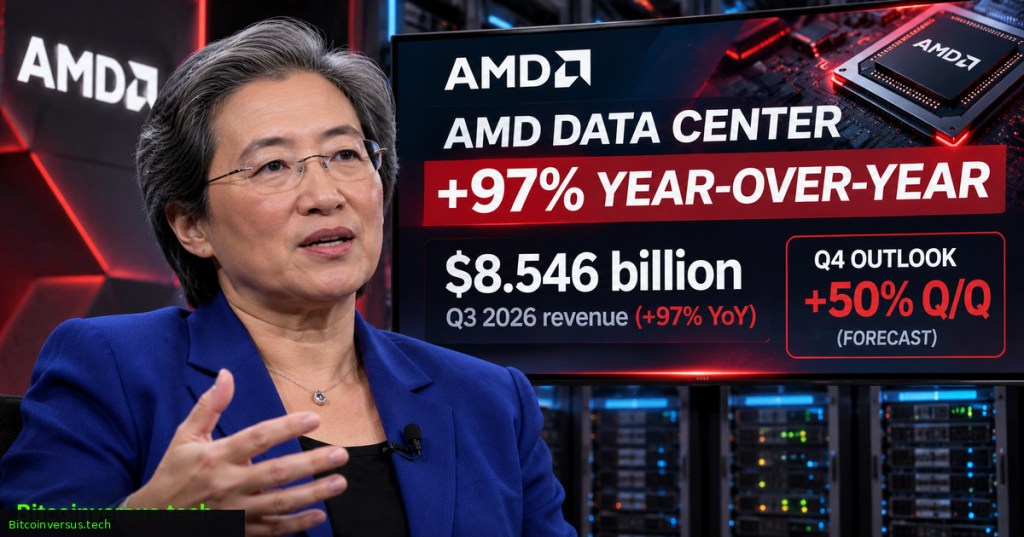
AMD Chair and Chief Executive Lisa Su says the speed of artificial intelligence adoption is disrupting the way companies plan computing budgets. In a November 5 interview with Yahoo Finance Executive Editor Brian Sozzi, Su described annual operating plans becoming moving targets as customers request more processors, accelerators and servers than originally budgeted.
The interview followed AMD’s November 3 earnings announcement. Its Data Center segment generated $8.546 billion during the third quarter of 2026, rising 97% year over year from $4.341 billion. Sequential growth was 27% from the second quarter’s $6.718 billion. The 97% figure compares corresponding quarters in different years, not adjacent quarters.
Why Annual AI Budgets Are Harder to Forecast
Su pointed to Meta’s Muse agent as an example of demand arriving faster than planning cycles. She said more than 10 million people activated Muse in 45 days, a pace she suggested would not have appeared in a conventional annual forecast. The statistic is Su’s account of adoption, not an independently audited Meta disclosure. Activations also should not be equated with paying customers, sustained usage or the revenue those users generate.
The engineering consequence is potentially important. AI agents may call models repeatedly, requiring inference compute, memory bandwidth, networking and CPU orchestration beyond the demand created by a single user prompt. AMD is positioning its Helion rack-scale architecture for agent-driven workloads while selling EPYC server CPUs and Instinct GPUs. Earlier BitcoinVersus.Tech coverage of Muse examined Meta’s model launch and surrounding technical ambitions.
AMD Projects Another 50% Data Center Increase
During the interview, Su said AMD expects Data Center revenue to grow about 50% sequentially from the third quarter to the fourth. Applying that percentage to $8.546 billion implies approximately $12.82 billion in quarterly segment sales if the forecast is realized. The company’s separate, formal fourth-quarter guidance is for approximately $17 billion in total company revenue, plus or minus 3%. The two numbers describe different measures.
Su also spoke of doubling or more than doubling the Data Center business in 2027. Her comments describe management’s growth ambitions, not confirmed sales or a guaranteed upper bound. Execution depends on semiconductor manufacturing capacity, advanced packaging, high-bandwidth memory, customer deployment schedules and competitive product performance. AMD’s earlier HBM4 supply reporting illustrated how memory availability can affect high-end accelerator ramps.
Investors Are Testing the Spending Assumptions
Sozzi pressed Su about Wall Street’s concern that hyperscaler capital spending could outrun financial returns. She argued that investment decisions should be evaluated over several years, because companies increasingly depend on computing capacity for productivity and AI development. Her conviction does not establish that every proposed data-center expansion will earn an adequate return.
AMD’s quarterly results also reveal differences across its businesses: Client and Gaming revenue declined 8% year over year to $3.722 billion, with gaming alone falling 40%. Data Center contributed roughly 64% of AMD’s total $13.377 billion quarterly revenue. The concentration makes AI spending plans especially consequential for the chipmaker, even as hyperscaler financing structures draw scrutiny.
The central question is whether faster AI adoption will translate into sustained, profitable hardware demand after initial deployments. AMD’s reported revenue growth is established; its fourth-quarter acceleration, 2027 ambitions and the economics of customers’ AI investments remain forward-looking.
BitcoinVersus.Tech Editor’s Note: AMD’s November 3 earnings release and prepared remarks establish the quarterly results and company guidance; Lisa Su’s November 5 Yahoo Finance interview establishes her statements on Muse, customer planning and future demand. The Muse activation figure is attributed to Su and has not been independently audited. The featured cover is an editorial illustration, not a documentary image of the interview. Embedded videos include archival footage. We volunteer daily to ensure the information on this platform is Verifiably True. If you would like to support the research, please scan the original 5,000-satoshi QR code below, after verifying the receiving address 3C9o19EH5HSiwEPyCTmEKzxhNCbo2X6TTb.

To scan on mobile, open the page on another screen and scan the QR code with a compatible Bitcoin wallet, or use your wallet’s supported saved-image scanning feature. BitcoinVersus.Tech publishes technology and financial news for informational purposes and does not provide investment advice.


Leave a Reply