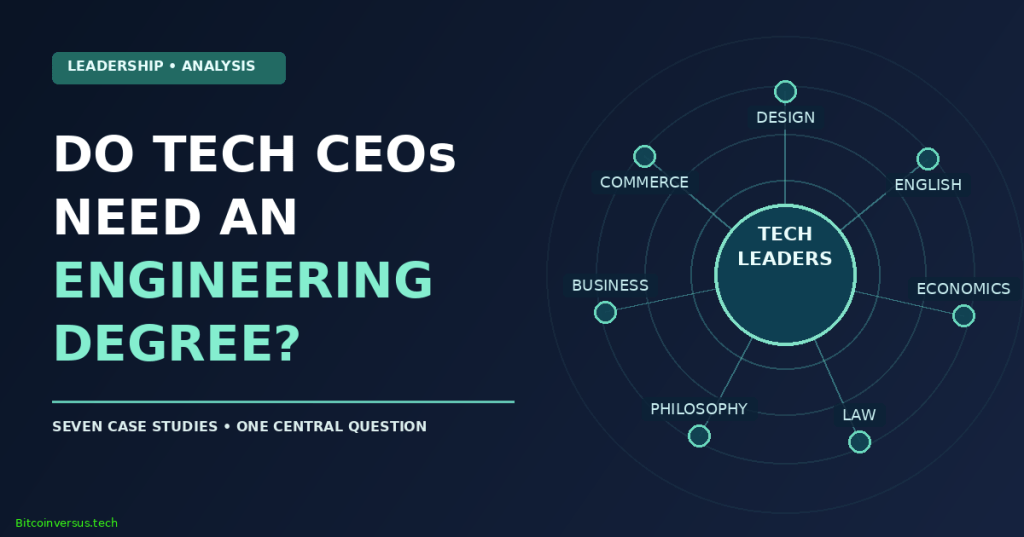
Can a technology company prosper under a CEO without an engineering degree? The records of seven business leaders show that it can. Their backgrounds range from English education and economics to law, industrial design and philosophy. The important qualification: a nonengineering education is not the same as an absence of technological knowledge.
The debate has a fresh case study. On November 5, 2026, Airbnb reported $4.9 billion in Q3 revenue, up 19% year over year, and $1.9 billion in quarterly net income. Co-founder and CEO Brian Chesky graduated from design school rather than a computer-science program. The figures reflect company performance, not proof that design education caused revenue growth. Airbnb’s Q3 2026 results and its SEC filing supply the figures.
Video: TIME interview with Airbnb CEO Brian Chesky; September 14, 2026. Watch on YouTube.
Seven careers, seven different educational routes
1. Brian Chesky — Airbnb: industrial design
Chesky studied at the Rhode Island School of Design. The company’s official biography credits his design-oriented approach to product and community development. Airbnb’s success still required software engineers, security specialists, payment systems and sophisticated marketplace operations. Chesky’s example challenges a degree requirement, not the need for technical staff.
2. Jack Ma — Alibaba: English education
Jack Ma earned a bachelor’s degree in English education at Hangzhou Normal University and worked as a teacher before leading Alibaba’s founding group in 1999. He served as chief executive through May 2013. Alibaba’s company history and the University of Hong Kong biography establish his background. His role centered on customers, commerce and organizational ambition, while technical teams developed the platform.
Video: World Economic Forum interview with Jack Ma at Davos; February 3, 2015. Watch on YouTube.
3. Meg Whitman — eBay: economics and business
Meg Whitman studied economics at Princeton and earned an MBA from Harvard. She joined eBay as CEO in 1998 after working in brand management. When she arrived, eBay reported $4.7 million in revenue; by her 2008 departure announcement, annual revenue was nearly $7.7 billion. The company attributed major growth to her tenure, though it also reflected the rapid expansion of online commerce. The comparison comes from eBay’s official announcement.
Video: Stanford Graduate School of Business: Whitman discusses eBay; July 27, 2009 upload; recorded May 23, 2006. Watch on YouTube.
4. Safra Catz — Oracle: law and investment banking
Safra Catz graduated from Wharton and the University of Pennsylvania Law School, then worked in investment banking. She led Oracle as CEO from September 2014 until September 22, 2025, when she moved to executive vice chair. Oracle’s 2026 proxy statement explicitly distinguishes her responsibility for corporate operations from product development and engineering. Oracle co-founder Larry Ellison continued serving as chief technology officer. She is a former CEO, not Oracle’s current chief executive.
Video: Oracle CloudWorld keynote featuring Safra Catz; September 10, 2024. Watch on YouTube.
5. Melanie Perkins — Canva: communications, psychology and commerce
Canva co-founder Melanie Perkins studied communications, psychology, marketing and management at the University of Western Australia. Her experience teaching design programs exposed difficulties people faced with complex tools. She developed Fusion Books before building Canva with colleagues who supplied complementary engineering and business abilities. Her conference biography and a 2026 founder interview describe the origins. The case illustrates the importance of recognizing an underserved user problem.
Video: Upstarts Media interview with Canva CEO Melanie Perkins; February 12, 2026. Watch on YouTube.
6. Stewart Butterfield — Slack: philosophy
Stewart Butterfield earned philosophy degrees from the University of Victoria and Cambridge. He helped create Flickr and later Slack. Salesforce’s agreed acquisition of Slack carried an approximately $27.7 billion enterprise valuation when announced in December 2020. Butterfield is also an important qualification to the argument: he taught himself programming, so he lacked a formal engineering degree but did not lack technical ability. See Slack’s SEC biography and Salesforce’s deal announcement.
Video: NPR’s How I Built This interview with Stewart Butterfield; May 1, 2020. Watch on YouTube.
7. Marc Benioff — Salesforce: business administration
Salesforce co-founder Marc Benioff received a business-administration degree from the University of Southern California. He nevertheless sold software as a teenager, wrote video games and spent 13 years at Oracle before launching Salesforce. His official biography makes the distinction clear: nonengineering degree, substantial hands-on technology experience. Treating Benioff as a CEO with no technological background would be inaccurate.
Video: CNBC interview with Salesforce CEO Marc Benioff; August 26, 2026. Watch on YouTube.
Why engineering expertise still matters
The examples challenge credential gatekeeping, but cannot establish that non-STEM CEOs outperform engineers. A 2023 peer-reviewed study in Finance Research Letters reported an association between STEM-trained CEOs and stronger corporate digital transformation. Such findings describe patterns in the studied firms; they do not prove that one degree causes superior results or prescribe a universal hiring rule.
The counterexamples are equally instructive. AMD’s Lisa Su trained as an electrical engineer, and recent BitcoinVersus.Tech reporting on her CEO recognition shows the value of deeply technical leadership. Corporate strategy also involves different models of executive risk-taking, capital and demand constraints, and manufacturing bottlenecks.
For chip design, cybersecurity, cloud infrastructure and AI systems, executives must be able to challenge assumptions on reliability, security, performance, cost and engineering feasibility. A business-trained CEO can develop enough technical fluency to make responsible decisions, provided technical leaders have authority, resources and access to the board.
The practical conclusion
A technology company needs technical excellence; its CEO need not hold a technical degree. The strongest lesson from the seven careers is that leadership capability depends on the problem a company faces, the executive’s acquired expertise and the quality of the team. Market timing, financing, competition and survivorship bias all limit conclusions drawn from seven success stories. The examples disprove an absolute educational requirement, not the importance of engineering.
Reporting method: Degree histories were checked against institutional biographies, SEC filings or company records. Business results were tied to the dated disclosures linked above. Videos are independently identified interviews or official presentations and are archival evidence unless dated otherwise. No interview excerpt is presented as a direct quotation without verification.
Editor’s Note: Originally published November 12, 2026 as an analysis tied to Airbnb’s November 5 earnings. Catz is correctly identified as Oracle’s former CEO; Butterfield and Benioff had meaningful technical experience despite their nonengineering degrees. Success cases alone cannot establish how CEOs should be selected. Video links are attributed to their publishing organizations. Automatic playback, live embed rendering and physical mobile layout require independent browser checks. The featured graphic is an original conceptual diagram, not a photograph of any executive.

BitcoinVersus.Tech is volunteer-run and publishes independent educational technology reporting. An optional 5,000-satoshi donation supports continued research. Scan the QR with a Bitcoin wallet from another screen; on mobile, use a wallet that supports QR scanning from saved images. Independently confirm the recipient and payment amount before sending. Bitcoin transfers are generally irreversible.
We volunteer daily to ensure information on BitcoinVersus.Tech is Verifiably True. Coverage is educational, not financial or investment advice.


Leave a Reply