
- AMD’s Instinct MI455X carries 432 GB of HBM4 across 12 stacks, with up to 23.3 TB/s of memory bandwidth.
- Samsung is a primary HBM4 supply partner for MI455X and is also working with AMD on DDR5 for EPYC “Venice” and Helios.
- Lisa Su says memory supply remains tight and AMD is encouraging suppliers to increase production as quickly as possible.
- Samsung’s current HBM4 platform reaches up to 13 Gbps per pin and as much as 3.3 TB/s per stack.
- AMD and Samsung are still exploring foundry cooperation; no major advanced-node AMD logic manufacturing award to Samsung has been publicly confirmed.
AMD is trying to secure more high-bandwidth memory as its MI455X accelerator and Helios rack-scale platform move from launch toward larger deployments, making Samsung one of the most important supply-chain partners in AMD’s challenge to NVIDIA.
During a visit to Seoul this week, AMD CEO Lisa Su said the company continues to explore a broader relationship with Samsung Electronics spanning both memory and foundry services. Reuters reported that Su described memory supply as tight and said AMD is encouraging suppliers to build capacity “as fast as possible.”
The immediate pressure point is HBM4. AMD’s Instinct MI455X integrates 432 GB of HBM4 across 12 stacks and delivers up to 23.3 TB/s of peak memory bandwidth. A complete Helios rack combines 72 MI455X GPUs for roughly 31 TB of aggregate HBM4 capacity.
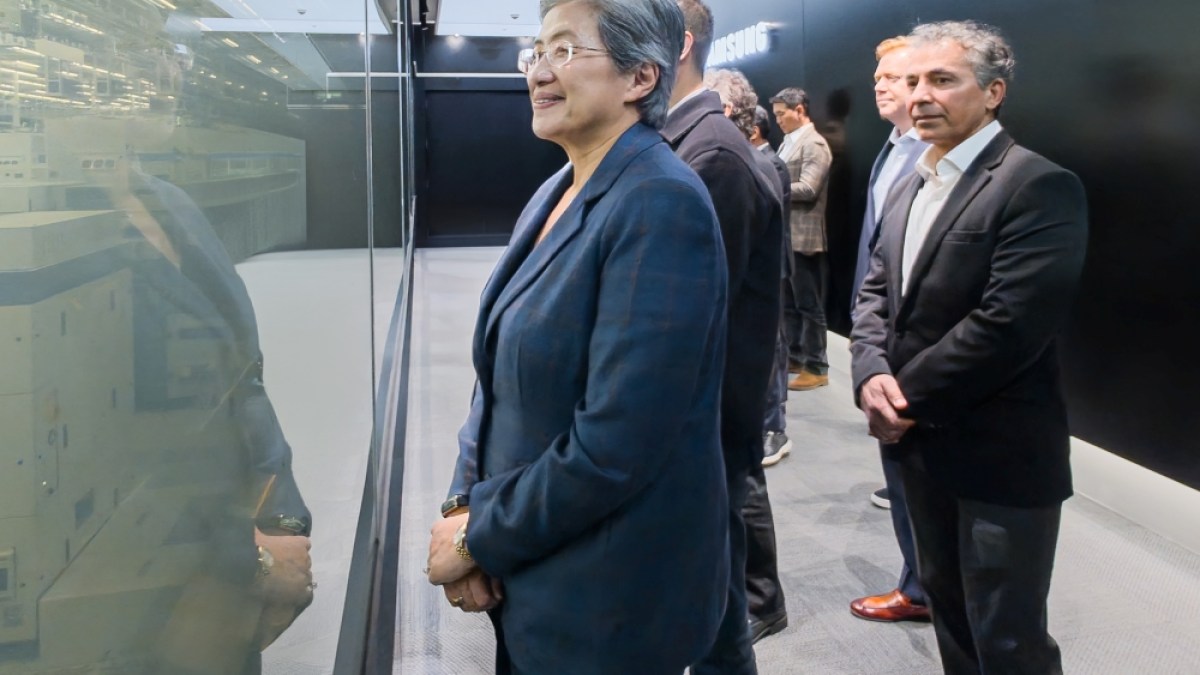
Samsung Was Already Locked Into the MI455X Memory Roadmap
The October discussions build on a relationship that was formalized months ago. In March, Samsung and AMD signed a memorandum of understanding covering primary HBM4 supply for MI455X, advanced DDR5 for sixth-generation EPYC “Venice,” and memory integration for the Helios rack-scale platform.
Samsung says its HBM4 combines sixth-generation 10nm-class 1c DRAM with a 4nm logic base die. The company lists speeds of up to 13 Gbps and maximum bandwidth of 3.3 TB/s per stack. That makes the memory itself a major part of the accelerator performance story rather than a commodity component attached after the GPU is designed.
BitcoinVersus.Tech recently covered Samsung’s record AI-memory-driven quarter. The same demand boom that is lifting Samsung’s memory business is also creating the supply pressure AMD is now trying to manage.
One Helios Rack Consumes a Huge Amount of HBM4
The scale becomes clearer at the rack level. One MI455X uses 12 HBM4 stacks. A 72-GPU Helios rack therefore represents hundreds of high-bandwidth-memory stacks before the system even reaches a multi-rack cluster. AMD lists about 31 TB of HBM4 capacity and 1.67 PB/s of aggregate memory bandwidth for a full Helios rack.
That is why memory availability can constrain accelerator shipments even when AMD has sufficient GPU wafer capacity. The AI server is a supply-chain product: compute dies, I/O dies, HBM, advanced packaging, substrates, networking, power delivery and liquid cooling all have to arrive together.
BitcoinVersus.Tech’s earlier look at HPE’s $1.2 billion Vultr Helios order showed how quickly this architecture is moving from a reference design into commercial deployments. More rack orders translate directly into more pressure on HBM4 production.
AMD Wants Supply Growth Across the Whole AI Stack
Su’s South Korea stop is part of a wider supplier tour. AMD has said it plans to substantially increase CPU and GPU supply in 2027, and Su has been meeting foundry, packaging, system and memory partners across Asia to make sure capacity can expand with demand.
That expansion is broader than memory. BitcoinVersus.Tech recently covered AMD’s planned 2027 CPU and GPU supply ramp. HBM4 now sits beside advanced wafers and packaging as one of the components that can decide how many complete AI systems AMD can actually ship.
Foundry Talks Are Real, but a Major Logic Order Is Not Confirmed
The Samsung relationship could eventually become broader than memory. The March MOU explicitly said the companies would discuss foundry opportunities for next-generation AMD products, and Su reiterated this week that AMD continues to explore partnership opportunities with Samsung in both memory and foundry businesses.
That does not mean AMD has shifted its flagship CPU or GPU production away from TSMC. Publicly disclosed MI455X specifications still describe a multi-die accelerator built with advanced TSMC process technologies and CoWoS-L packaging. A future Samsung foundry agreement could begin with a smaller or less critical component before expanding, or talks could remain exploratory.
The distinction matters because memory supply leverage and foundry diversification are separate strategic questions. Samsung wants to sell more than HBM, while AMD wants enough manufacturing flexibility to support years of expected AI growth without creating unnecessary execution risk.
HBM Is Becoming as Strategic as the GPU Die
The AI accelerator market used to be described mainly through compute throughput. Increasingly, the decisive numbers are memory capacity, memory bandwidth and how much data can remain close to the accelerator. Larger models, longer context windows and KV caches all consume memory quickly.
AMD’s 432 GB per MI455X is a deliberate part of its competitive pitch. The company is betting that large local memory pools and very high bandwidth can reduce system complexity for memory-heavy training and inference workloads.
This is also why the broader memory market is feeling the AI buildout. BitcoinVersus.Tech examined that spillover in AI’s HBM boom and its effect on conventional DRAM pricing. Wafer capacity devoted to premium AI memory competes with other memory products for equipment, materials and investment.
What to Watch Next
- HBM4 volume: whether Samsung and SK hynix can increase output quickly enough to match AMD’s 2027 accelerator ramp.
- MI455X deployments: larger Helios customer orders will translate into very large aggregate HBM4 requirements.
- Foundry scope: whether exploratory Samsung foundry talks produce an actual AMD manufacturing award.
- Advanced packaging: HBM supply alone does not solve the problem if CoWoS-L and substrate capacity become the next bottleneck.
- Pricing: sustained HBM shortages can increase accelerator system cost even when GPU silicon supply improves.
- Next-generation memory: AMD and Samsung have described the relationship as multi-generation, so the collaboration is unlikely to stop with the current MI455X cycle.
Bottom Line
AMD’s next AI growth phase depends on more than designing a competitive GPU. Helios turns each deployment into a demand engine for HBM4, CPUs, networking, advanced packaging and cooling. Samsung is already central to that system as a primary MI455X HBM4 partner, and Lisa Su is now signaling that AMD wants the supply chain to move faster.
The foundry angle is worth watching, but it remains a future possibility rather than a completed shift. The confirmed story today is simpler: AMD needs a great deal of HBM4, Samsung wants to supply it, and the scale of Helios means memory availability is becoming one of the defining limits on how fast AMD can grow its AI infrastructure business.
Editor’s Note: Samsung and AMD have publicly confirmed HBM4 and DDR5 collaboration and have said they will discuss foundry opportunities. This article does not treat speculative Samsung foundry orders for flagship AMD logic as confirmed.
BitcoinVersus.Tech is not a financial advisor. This media platform reports on technology and financial subjects for informational purposes.


Leave a Reply