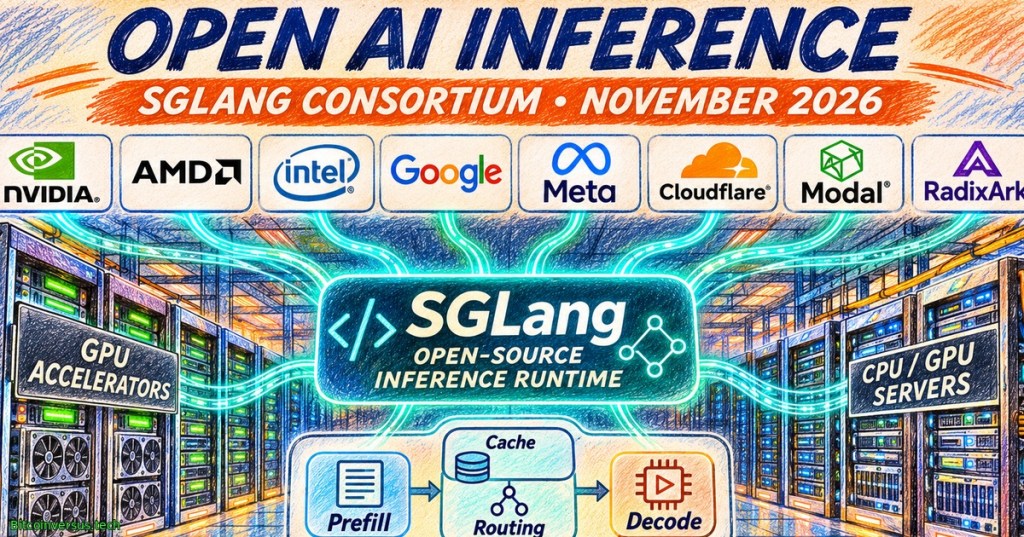
November 15, 2026 — Software / Artificial Intelligence. NVIDIA, AMD, Intel, Google, Meta, Cloudflare, Modal and RadixArk are the eight founding members of a newly announced SGLang Consortium. LMSYS Org announced the group on November 12 at the inaugural SGLang Summit in San Francisco, promising shared engineering priorities for open-source AI inference rather than a new proprietary chip or a guaranteed performance breakthrough.
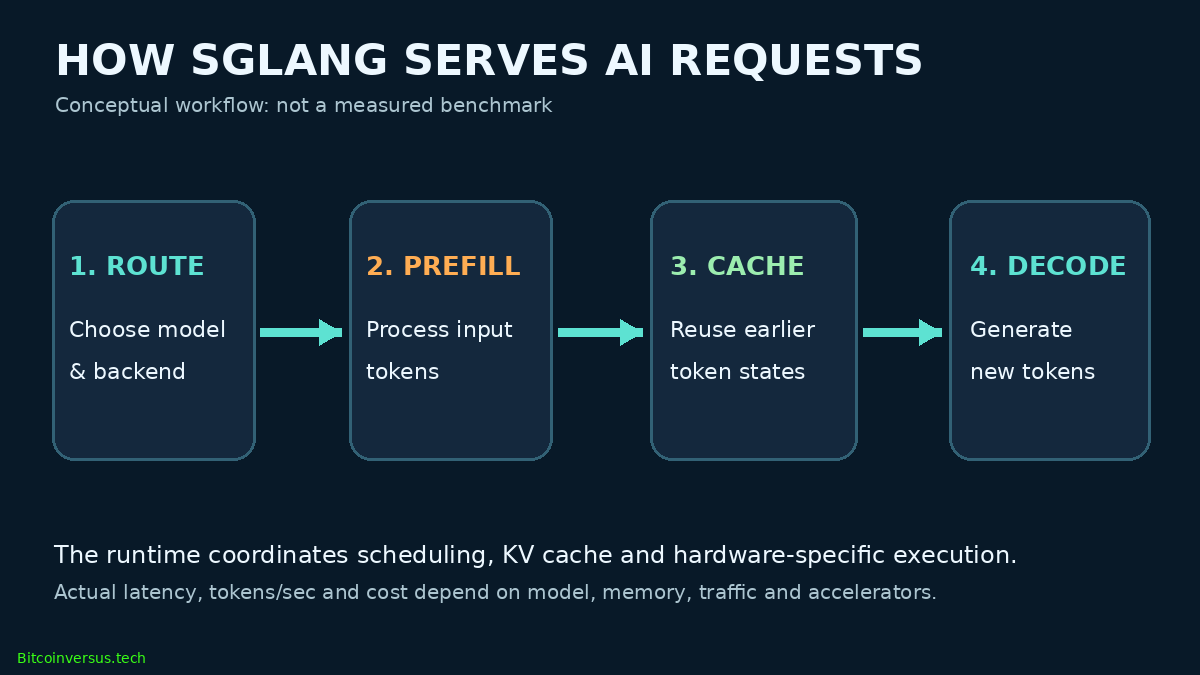
Inference is the process of running a trained model to answer requests. Modern servers must route requests, compute an input prompt (prefill), manage previously calculated attention states in key-value caches, and produce output tokens (decode). The SGLang software stack coordinates those operations across hardware, making its efficiency important to latency, accelerator utilization and operating expense.
Rivals join the same open-source roadmap
The consortium spans direct accelerator rivals and companies deploying AI at scale. Under its published governance plan, each founding member nominates a technical representative and joins two roadmap meetings annually. Participants can contribute engineering, deployment feedback, testing and joint development. Project maintainers retain responsibility for code acceptance; membership does not give a vendor unilateral control.
Areas of cooperation include frontier-model compatibility, reasoning and multimodal serving, distributed inference and optimizations for different hardware. LMSYS says SGLang operates on hundreds of thousands of GPUs, a project-supplied adoption claim rather than a third-party hardware census. Deloitte’s forecast that inference could consume roughly two-thirds of AI compute in 2026 is likewise a projection, not a measured global total.
Intel and RadixArk pursue CPU, GPU and accelerator optimizations
In a separate November 12 announcement, Intel and RadixArk said they will optimize SGLang for Intel CPUs, GPUs and accelerators, including support for Intel Advanced Matrix Extensions (AMX). The companies intend to upstream improvements into the core open-source project instead of maintaining an isolated vendor-only implementation.
Intel promises faster deployments and lower latency, but the release gives no named test configuration, tokens-per-second result, measured energy savings or date for a completed optimized build. Production users should compare identical models, prompt lengths, concurrency, first-token latency and cost on their actual hardware before assuming an advantage. For context, BitcoinVersus.Tech has reported on Google’s TPU software push and open XLA model serving.
A separate AWS Trainium plugin is already in public preview
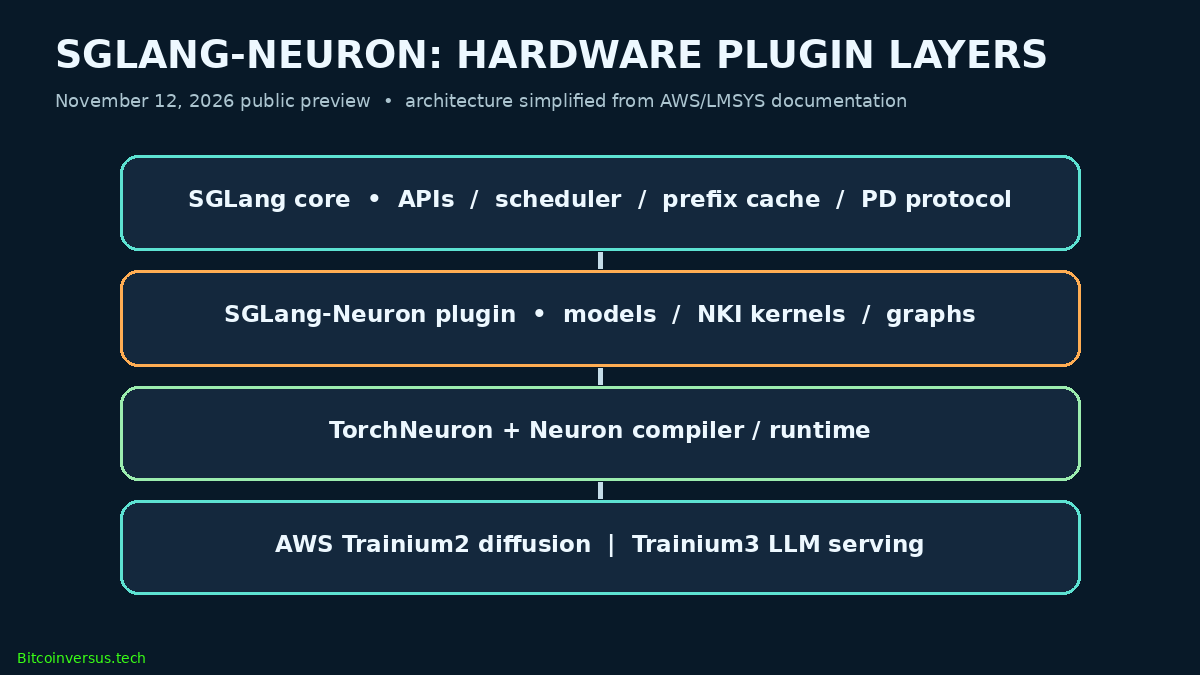
A concrete software release arrived the same day. SGLang-Neuron v0.1.0, co-developed by RadixArk and AWS Annapurna Labs, brings the serving stack to AWS Trainium through a native PyTorch plugin. AWS release notes confirm a November 12 public preview, not general availability.
The implementation separates prompt prefill from token decoding across nodes, uses hardware-specific NKI kernels, and can retain evicted cache pages in host memory through HiCache. The developers report Kimi-K3 operation across three Trainium3 nodes and diffusion model support on Trainium2. These are scoped implementation claims, not evidence of equivalent performance on every model and workload.
Open software still needs independent results
SGLang’s team also announced a version 1.0 milestone, citing more than 330 adopting organizations and day-zero support for 217 models. Its public release tracker described remaining stabilization work; an announcement should not be confused with proof that every feature is production-ready. The broader market for custom AI accelerators, discussed in our custom-chip investigation, raises the stakes of interoperable runtimes.
Open governance can reduce duplicated engineering and vendor lock-in, but it cannot remove hardware limitations, cloud fees, driver requirements or regressions. Memory bottlenecks also matter, as our CXL 4.0 technical review explains. The consortium’s real test will be merged code, reproducible cross-platform benchmarks and deployment experiences—not its founding-member list.
Editor’s note: Member list, meeting schedule and project claims were checked against LMSYS; Intel’s performance language remains attributed to Intel; AWS identifies its Neuron plugin as public preview. The featured cover and two diagrams are original illustrations, while the PyTorch graphic is historical source media. No unverified numerical comparison chart is presented.


Leave a Reply