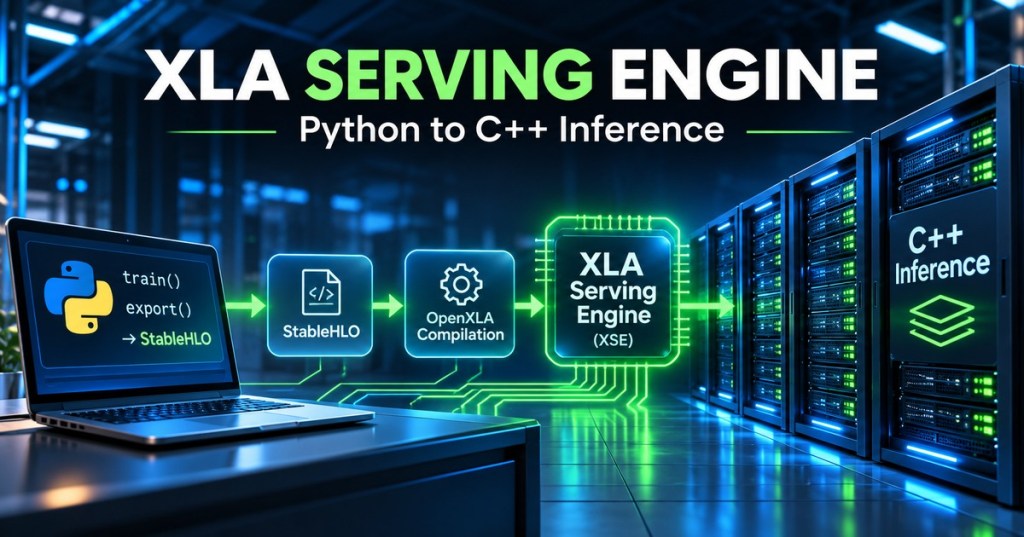
Google has released XLA Serving Engine (XSE), an Apache 2.0 open-source inference runtime that moves machine-learning predictions from Python-based development into a C++ serving process. Announced November 5, 2026, the software targets high-volume, low-latency inference across CPUs, GPUs and Google Cloud TPUs. Google reports gains of two to five times against its optimized Python serving implementation for short requests; outside replication remains unverified.

From Python development to C++ prediction servers
AI inference means running an already trained model to produce predictions, recommendations or classifications. Engineers commonly prepare models using Python libraries such as JAX or PyTorch, but production servers must also manage scheduling, model weights, memory allocation and thousands of incoming requests. Python’s interpreter and deployment dependencies can add overhead to smaller, frequent inference calls.
XSE exports model computations into an XLA SavedModel containing StableHLO, an intermediate representation for machine-learning programs. The package retains model weights through Orbax checkpoints. A native C++ runtime loads the exported artifact, uses Google’s XLA compiler and PJRT execution interface, and exposes predictions through gRPC. The public repository includes Docker images and sample workflows, with single-host and multi-host operation.
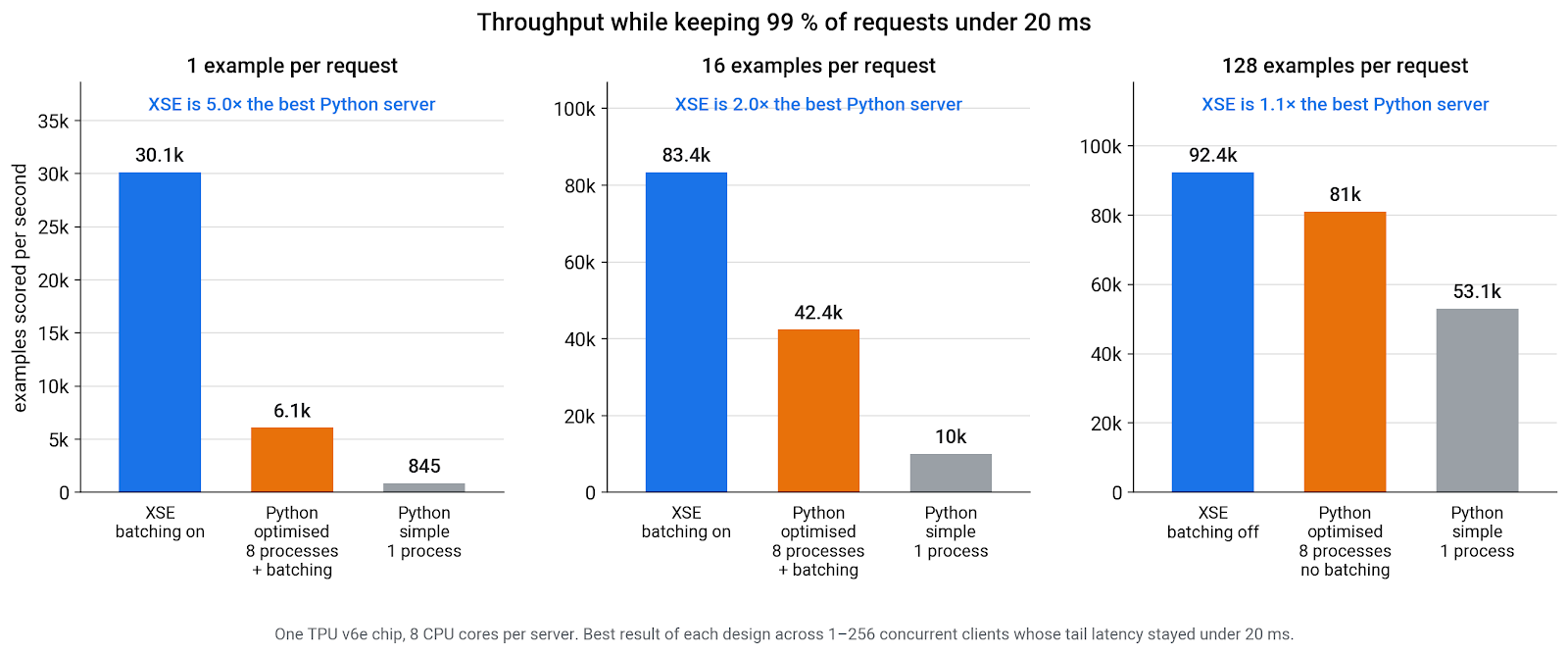
Google’s own chart shows where speed gains shrink
The release reports over six million queries per second from XSE components already serving Google products, including YouTube Shorts, Ads, Search and parts of Gemini Omni. Google began internal deployments in 2025. The company also claims 30–70% less CPU time per prediction and approximately one-quarter the memory compared with its Python implementation, under its reported test conditions.
Google’s published benchmark supplies important context. With one example per request, XSE processed about 30,100 examples per second against 6,100 for its optimized Python server: approximately 4.9 times the throughput. At 16 examples per request, the figures were 83,400 versus 42,400, or about 2.0 times. At 128 examples per request, the advantage narrowed to 92,400 versus 81,000, or roughly 1.14 times. Tests required 99% of requests to finish within 20 milliseconds. Hardware and workload conditions matter; no universal fivefold acceleration can be inferred.
Competition is about software and hardware efficiency
An inference stack affects how much useful work each chip and CPU core performs, not merely advertised peak accelerator specifications. Earlier BitcoinVersus.Tech reporting examined Google TPU capacity expansion and the role of NUMA memory placement in Linux servers. Lower runtime overhead could reduce hardware demand for suitable prediction workloads, but energy savings and total ownership cost require end-to-end measurements rather than throughput numbers alone.
The competitive landscape includes specialized caches, memory and orchestration. BitcoinVersus.Tech has covered AI inference cache acceleration and CXL memory pooling. XSE addresses a different bottleneck: the software path between model execution and incoming requests.
Important limits before deployment
Google describes XSE as a lightweight, one-shot inference engine, particularly suited to recommendation systems, vision models and compact prediction calls. For long-context, autoregressive language models, the company instead points developers toward vLLM and SGLang, whose continuous batching and memory handling target token-by-token generation. Planned TorchTPU integration and expanded ahead-of-time compilation are not evidence of completed general deployment features.
Open source availability permits developers to inspect the implementation, adapt the integration and run reproducible tests. Production adoption still depends on hardware compatibility, request shapes, latency targets, monitoring and model correctness. Independent comparisons will be needed to determine whether Google’s headline gains transfer beyond its chosen benchmarks.
Editor’s Note: The November 5 release, Apache 2.0 license, deployment claims and test figures were checked against Google’s original announcement, the OpenXLA project repository and its technical documentation. The throughput chart is Google’s own measurement; independent replication and public-player playback remain unverified. The editorial cover is a conceptual diagram, not a photograph of a deployed XSE system. Embedded videos are earlier official technical background and are not demonstrations of the November 2026 release.

To donate 5,000 sats, open the article on a separate display and scan the original QR code with a compatible Bitcoin wallet. On mobile, use another screen or your wallet’s supported image-scanning feature. Verify the destination 3C9o19EH5HSiwEPyCTmEKzxhNCbo2X6TTb before sending.
We volunteer daily to ensure the information on this platform is Verifiably True. If you would like to support the research, please scan QR code.
BitcoinVersus.tech is not a financial advisor. Financial and technology coverage is provided for informational purposes.


Leave a Reply