
Supermicro has announced a shared key-value (KV) cache platform with IBM and NVIDIA that the companies say reduced the time to first token by as much as 56 times in a particular long-context AI inference benchmark. The November 5, 2026 announcement combines Supermicro all-flash storage servers, IBM Storage Scale, NVIDIA Dynamo and Spectrum-X Ethernet. The figure comes from vendor-led tests, not independent production measurements.
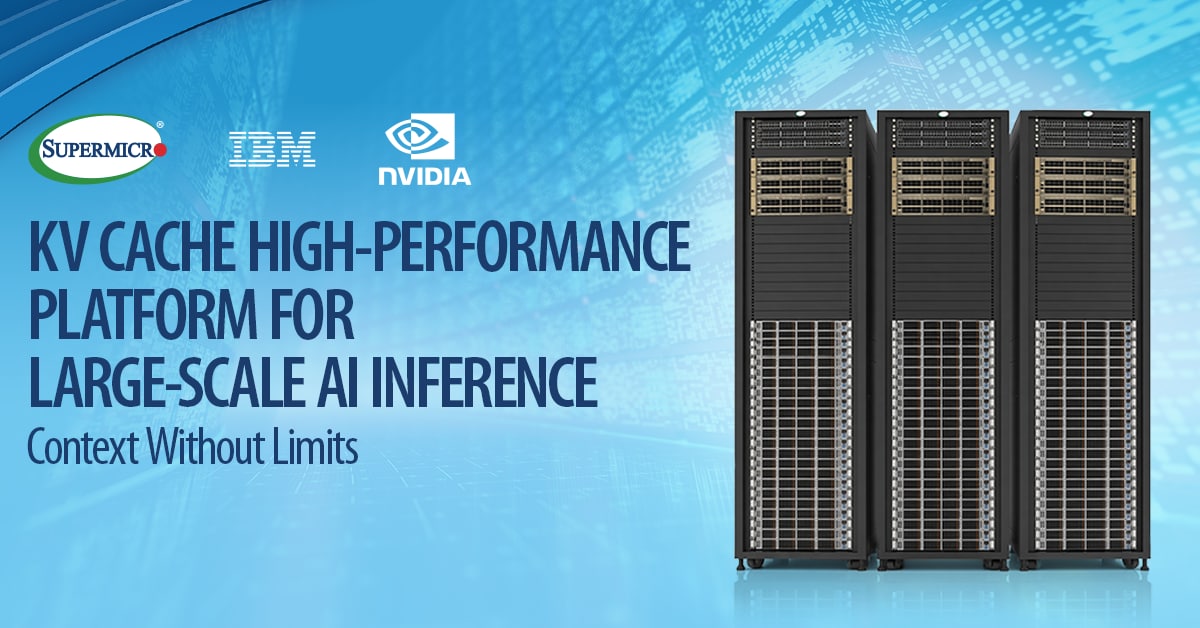
According to the original company announcement, the persistent storage tier lets AI systems reuse intermediate attention states previously computed for long prompts. Conventional inference first processes the input during a prefill phase, then generates output during decode. Reprocessing the same lengthy context can consume accelerator time even when only a small part of a request changes.
What the 56× benchmark measured
With an approximately 120-billion-parameter language model and a 130,000-token input, the partners reported time to first token near 0.57 seconds when fetching reusable state from shared storage, compared with approximately 32.14 seconds when recomputing the prompt. Their technical reference architecture also reported 4.26 requests per second with KV caching versus 0.19 requests per second without it under a separate concurrency test.
The reported comparison is workload-specific. Independent analysis by StorageReview notes the benchmark used one NVIDIA RTX PRO 6000 Blackwell GPU with an eight-node flash storage tier. Performance across hundreds of GPUs simultaneously requesting shared cache was not established by the published results. StorageReview said it neither ran nor audited the tests.
Storage moves beyond GPU memory
A KV cache contains the keys and values that an attention-based model uses while processing context. Keeping relevant state nearby can avoid redundant arithmetic, but long conversations, coding sessions and retrieval-augmented generation workloads can exceed GPU memory. Supermicro’s design moves reusable state into a shared, high-capacity tier while NVIDIA Dynamo manages distributed inference and IBM Storage Scale provides the underlying storage layer.
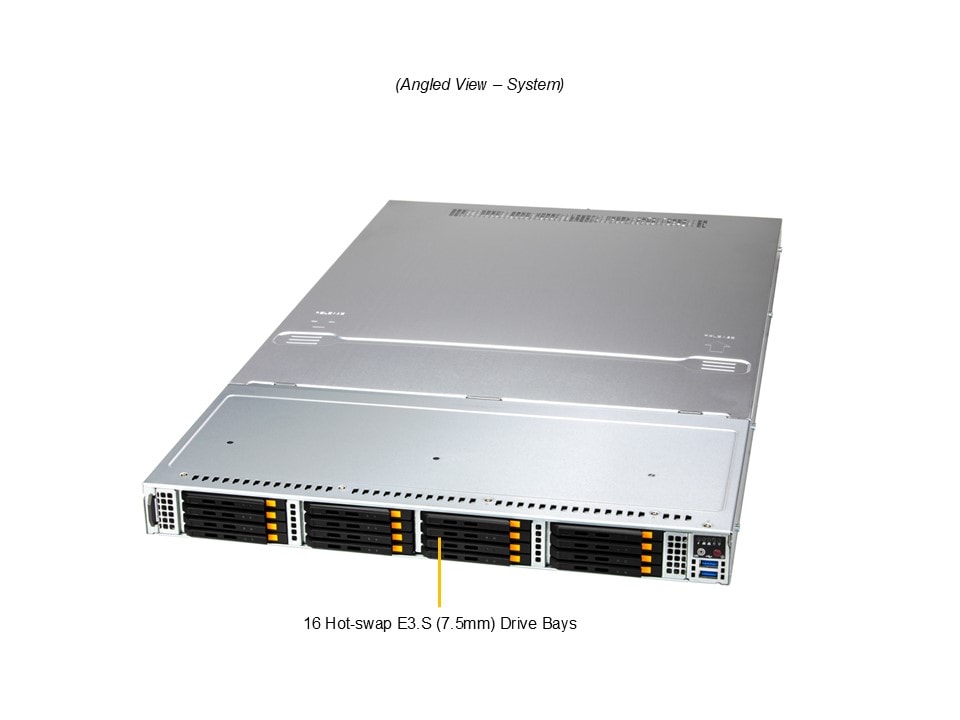
Each reference storage node is based on the Supermicro ASG-1115S-NE316R, a 1U server with 16 hot-swap E3.S NVMe slots and AMD EPYC processor support. The additional storage and network fabric can bring operational costs and cache-consistency challenges even when redundant GPU computation falls. The companies have not supplied a universal cost-per-token comparison, public pricing or a confirmed commercial deployment date.
Implications for AI infrastructure
The announcement builds on the market for inference-focused storage and networking. BitcoinVersus.Tech previously covered Tensormesh’s enterprise KV-cache technology, Supermicro’s Open Compute rack expansion, NVIDIA’s open rack designs and token consumption by AI agents. Storage, interconnect bandwidth and reuse of working context are increasingly significant alongside the raw number of accelerators.
The next validation step is testing full production-scale clusters with varying cache hit rates, mixed prompt lengths, security boundaries and concurrent workloads. Until then, the reported 56× acceleration is a promising result from a specified reference configuration, not a guaranteed speedup for every AI application.
We volunteer daily to ensure the information on this platform is Verifiably True. If you would like to support the research, please scan QR code.

Editor’s Note: The headline performance number comes from Supermicro, IBM and NVIDIA’s vendor-led reference benchmarks released November 5, 2026. It does not establish independently reproduced performance or a commercial service-level guarantee. The article’s official hardware and announcement photographs are credited to Supermicro; the featured cover is an editorial rendering.


Leave a Reply