How many facts can a modern graphics processor hold? There is no universal GPU fact count, because a fact might occupy 12 bytes as three numeric identifiers or hundreds of bytes as a machine-learning embedding. Researchers behind AtlasKV’s billion-triple experiment reported serving a massive knowledge graph with less than 20GB of inference VRAM. The breakthrough concerns how the model accesses knowledge, not a claim that an entire billion-fact database fits permanently inside GPU memory.
Presented at ICLR 2026, AtlasKV augments LLaMA 3.1 8B using specialized attention. Its method contrasts with traditional retrieval-augmented generation, which searches an external store and then sends relevant text to the model.
Researcher Haoyu Huang’s original ICLR 2026 paper announcement. Original X post.
How much knowledge can GPUs store?
Consider one 384-dimensional embedding per item, represented in FP16 precision. Each vector needs 384 × 2 = 768 bytes. One billion such vectors occupy 768GB, before an index, model weights, GPU runtime or working buffers. A separate key and value vector pair needs 1.536TB. The all-MiniLM-L6-v2 sentence encoder supplies a familiar 384-dimensional example, but vector dimensions vary between systems.
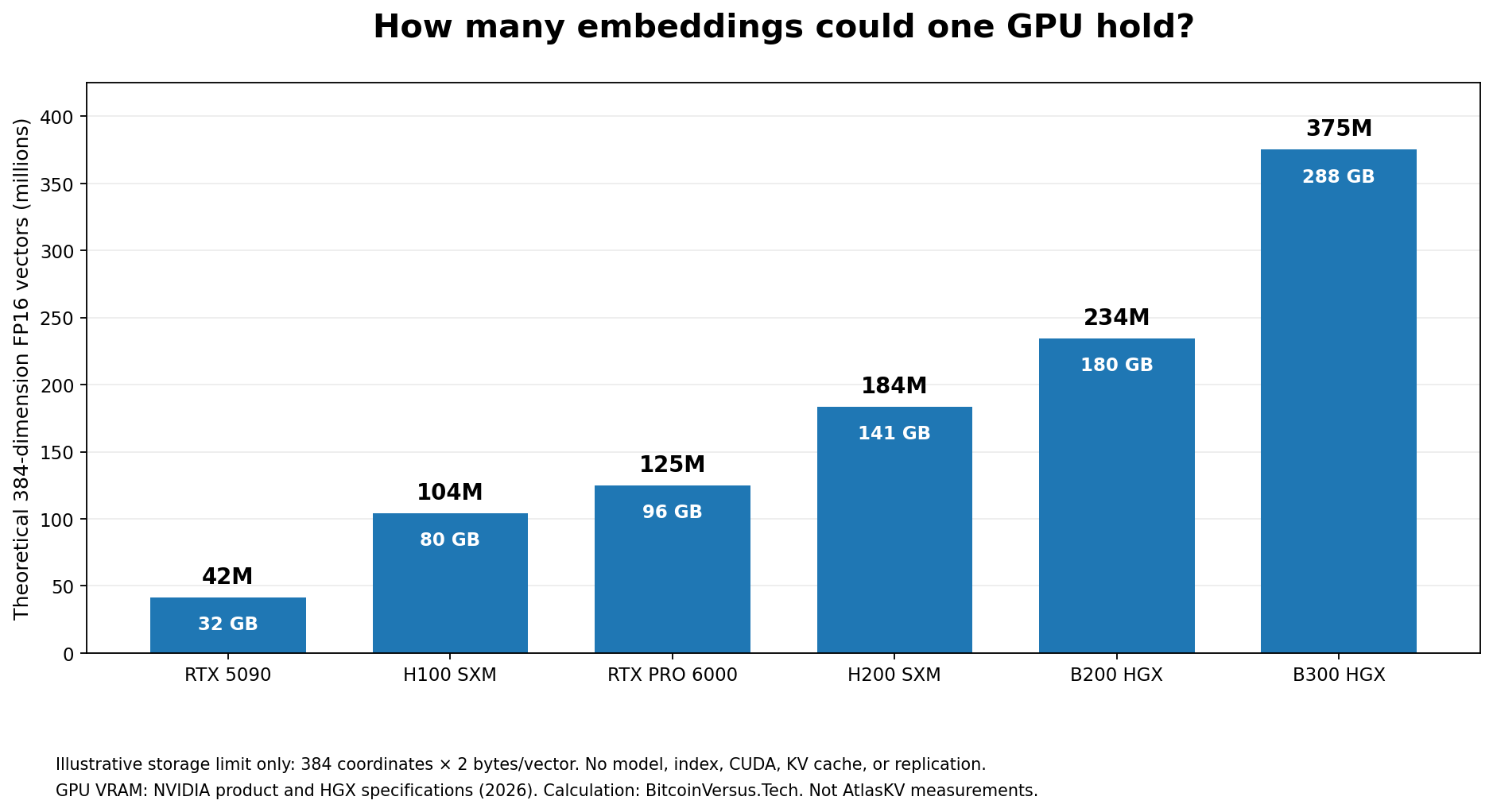
On that deliberately simplified basis, a 32GB RTX 5090 holds approximately 41.7 million vectors. An 80GB H100 reaches 104.2 million, a 96GB RTX PRO 6000 reaches 125 million, a 141GB H200 reaches 183.6 million, a 180GB HGX B200 reaches 234.4 million, and a 288GB HGX B300 reaches 375 million. Production AI applications reserve substantial memory for other purposes, so the plotted figures are theoretical ceilings, not typical deployed fact counts.
Why AtlasKV uses so little VRAM
HiKVP, the research team’s hierarchical key-value pruning method, leaves most intermediate and leaf-layer knowledge vectors in CPU memory. Selected keys and values move into GPU memory when queried. The attention calculation can consider relevant knowledge without keeping every triple resident on the accelerator. The researchers report that an older system called KBLaM needs over 40GB of VRAM at 100,000 triples, while AtlasKV stays below 20GB at one billion.
Axe Compute’s August 2026 walkthrough of its NVIDIA B300 GPU cluster provides authentic high-memory accelerator context, not footage of AtlasKV tests. Original video.
Dividing 20GB by one billion gives an apparent 20 bytes of GPU budget per triple. However, the quotient is not a compression ratio: model execution contributes to the GPU measurement while the full knowledge representation lives partly elsewhere. Three 32-bit identifiers already require only 12 bytes per raw triple, before dictionaries, labels or indexes. Storing facts efficiently differs from presenting selected facts to a language model’s attention mechanism.
The important accuracy limitation
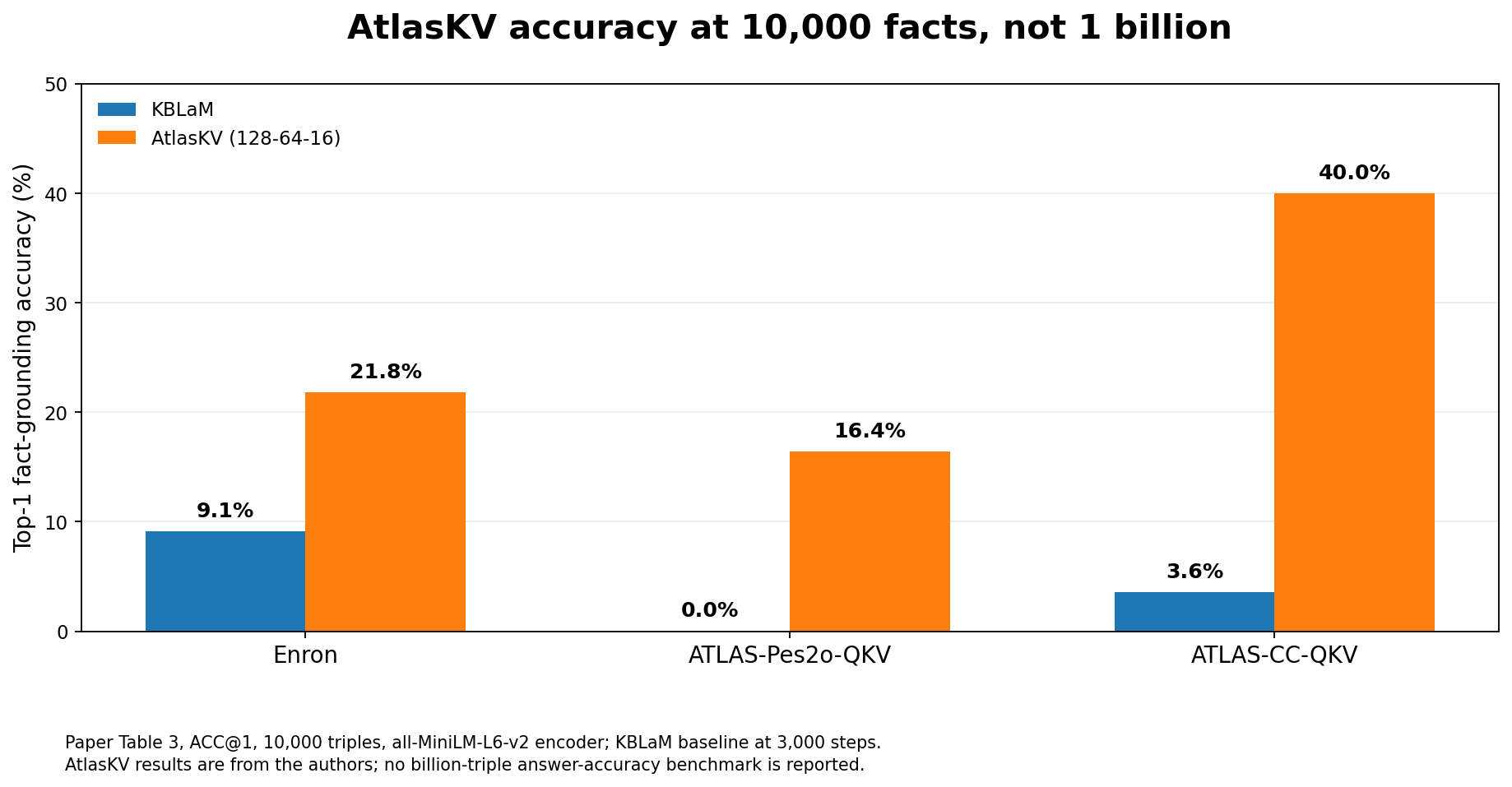
Detailed fact-grounding evaluations in the paper reach 10,000 triples, not one billion. On ATLAS-CC-QKV, AtlasKV achieved 40.0% Top-1 grounding accuracy versus 3.6% for KBLaM. On Enron, it reached 21.8% versus 9.1%. Both measurements indicate progress but leave substantial errors. Moreover, grounding selection accuracy is not the same as overall answer accuracy.
Data-center planners must also consider system RAM, CPU-to-GPU bandwidth, updates, graph construction, latency and reproducibility. The authors explicitly identify CPU-to-GPU transfers as additional latency. Our coverage of an H200-powered supercomputer illustrates infrastructure scale, while reporting on KV-cache acceleration examines a separate GPU memory bottleneck.
The conclusion: AtlasKV offers highly efficient access to immense structured knowledge graphs, not magical storage or proof that RAG is obsolete. Successful deployment still requires strong factual accuracy and clear accounting of CPU storage, bandwidth and total infrastructure cost.
Sources and methodology
Primary sources: AtlasKV paper, Figures 3–4 and Table 3; ICLR 2026 record; NVIDIA HGX specifications; RTX 5090; RTX PRO 6000; and MiniLM model card. Calculations use decimal gigabytes and 384-dimensional FP16 vectors. Authors’ experiments were not independently reproduced.
Visual note: Featured cover is a photorealistic illustration, not a hardware photograph. Charts distinguish hypothetical memory arithmetic from measured grounding benchmarks.
Editor’s Note: We volunteer daily to ensure the credibility of the information on this platform is Verifiably True. If you would like to support to help further secure the integrity of our research initiatives, please scan the QR code below

BitcoinVersus.tech publishes informational technology journalism and does not provide investment, financial, legal or cybersecurity assurance.


Leave a Reply