
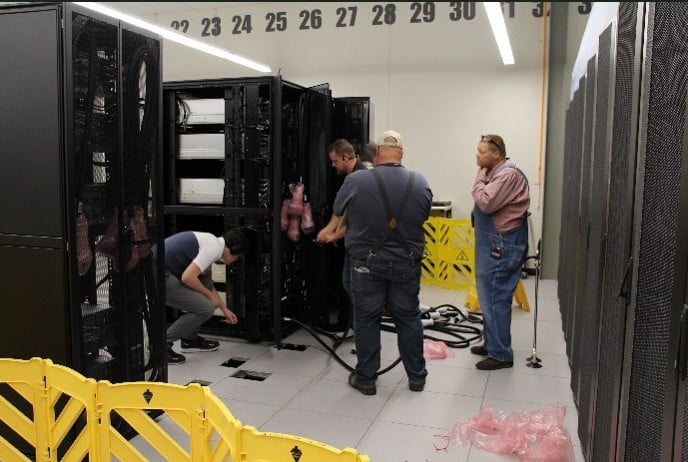
Idaho National Laboratory has added a GPU-powered supercomputer named Arco to its nuclear-energy research program, alongside a newly designated federal high-performance computing user facility. Announced November 18, 2026, the Idaho facility is the first U.S. Department of Energy Office of Nuclear Energy user facility specifically dedicated to high-performance computing. Arco itself arrived July 30; the news is its deployment and the formal research-access designation, not a claim that the hardware was delivered overnight.
Idaho National Laboratory’s June 2026 documentary on the development of advanced nuclear energy. Archival laboratory footage, not a tour of the newly deployed Arco machine.
160 H200 GPUs, 20 TB of memory
According to INL’s computing-facility specification, Arco is a Hewlett Packard Enterprise XD670 system with 160 NVIDIA H200 Tensor Core GPUs and 20 terabytes of total system memory. INL lists maximum performance of 5.44 petaflops using double-precision floating-point calculations and 10.72 petaflops using single precision. One petaflop represents one quadrillion floating-point operations per second.
Those figures describe different numerical formats and stated peak capability, not measured throughput in a reactor simulation. The single-precision value is about 1.97 times the double-precision value (10.72 ÷ 5.44), but scientific accuracy, memory traffic and workload design govern useful performance. Nuclear fuel and neutron-transport simulations can require double precision, whereas selected AI training and inference workloads may use lower precision.
Why nuclear researchers need two kinds of supercomputers
INL also operates Teton, a CPU-focused system commissioned in January 2026. Its 1,024 compute nodes each contain 384 CPU cores and 768 GB of memory, for 393,216 cores in total. Teton’s many general-purpose cores suit large conventional simulation workloads; Arco’s accelerators provide a different platform for AI models and applications parallelized for GPUs.
The distinction extends beyond hardware marketing. Reactor engineers model fuel behavior, thermal hydraulics, structural stress and neutron transport across multiple scales. A GPU can accelerate suitable mathematical kernels, but code migration, memory access, numerical validation and data movement still matter. Readers can compare architectures in BitcoinVersus.Tech’s history of exascale computing and supercomputer hardware ranking.
Idaho National Laboratory’s April 2026 overview of its nuclear research program. Official background footage, not a performance benchmark for Arco.
A national research facility, not an unrestricted public cloud
The designation operates through the Nuclear Science User Facilities program. INL says qualified researchers at universities, industry, national laboratories and government agencies can seek access for open research aligned with its mission; the program supplies no-cost access to selected resources. Researchers still face project review, allocation policies, software compatibility and scheduling limits.
INL’s fiscal 2026 impact report says the laboratory’s high-performance systems served about 1,600 researchers, ran 7 million computing jobs, and delivered more than 4 billion computing hours during the reported year. Those are figures across the laboratory’s computing resources, not Arco-only production results. The 7 million jobs were reported as 44% above the previous year, implying roughly 4.86 million a year earlier (7 million ÷ 1.44), subject to rounding.
What the laboratory expects next
The federal designation is also connected to DOE’s Genesis Mission and INL’s 32-partner Prometheus effort, which aims to apply AI across nuclear plant design, licensing, manufacturing and operations. Related scientific computing initiatives include the DOE’s investment in AI-enabled research and work on hybrid scientific computing at Fermilab. Neither initiative establishes that Arco has already shortened reactor approval cycles or produced commercial power.
Arco gives the nuclear research community a dedicated accelerator platform. Its practical value will depend on reproducible research results, validated scientific models, accessible computing allocations and measurable improvements over existing workflows, rather than peak flop figures alone.
Sources and verification
Primary sources: Idaho National Laboratory’s November 18 announcement, INL Computing Facility specifications, and the laboratory’s fiscal 2026 nuclear research impact report. Images and two background videos are attributed to the laboratory. The original featured colored-pencil cover is illustrative artwork, not a photograph of the installed system.


Leave a Reply