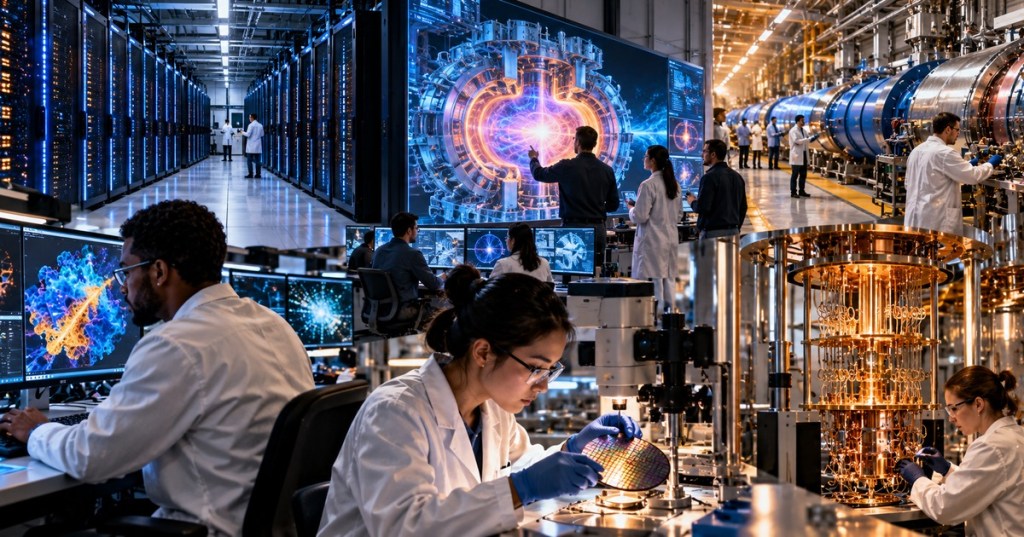
The U.S. Department of Energy has awarded $159 million to 12 Phase II projects in its Genesis Mission, funding AI-assisted work across fusion energy, extreme-environment chip design, geothermal reservoirs, quantum error correction, particle accelerators, enzyme engineering, rare-earth extraction and scientific software. DOE announced the awards on October 8, 2026.
Key Takeaways
- DOE announced 12 new Phase II Genesis Mission awards totaling $159 million.
- The projects span fusion, semiconductors, geothermal energy, quantum computing, accelerator operations, biology and critical materials.
- DOE also announced six new Phase I projects, but the October 8 release did not assign a dollar figure to those six awards.
- The additions bring the first-year Genesis Mission portfolio to 297 projects and the Phase II total to 14.
- DOE calls the program “Super Intelligence” for science; that wording is the department’s program terminology, not evidence of a single independently validated superintelligent system.
The primary source is the Department of Energy’s October 8 award announcement. DOE says the 12 Phase II awards total $159 million and are intended to connect researchers with advanced AI, supercomputing, scientific datasets and national-laboratory infrastructure.
The Money Is Going to 12 Very Different Problems
The award list is unusually broad. Commonwealth Fusion Systems leads a project to build an AI-enabled digital twin for SPARC. Fermilab will use AI to accelerate the design of rugged microchips for extreme environments. Harvard is working on application-aware quantum error-correction codesign. UC Irvine’s MAESTRO project targets deep geothermal reservoirs, while Lawrence Berkeley National Laboratory is building a shared AI platform for particle accelerators.
Other projects cover RNA structure, lattice quantum chromodynamics, critical-mineral separations, enzyme design, scientific software optimization, quantum magnets and automated rare-isotope separator operations. DOE does not break out the $159 million award total by individual Phase II project in the announcement.
One Project Is Specifically About Designing Chips Faster
Fermilab’s AXESS project is particularly relevant to semiconductor engineering. DOE says the project will use AI to rapidly design high-performance microchips capable of surviving extreme environments such as space, high-radiation conditions and ultra-cold systems.
That puts scientific AI directly into the chip-design workflow rather than using AI only as a workload running on finished silicon. BitcoinVersus.Tech recently covered NVIDIA and other companies pledging $2.4 billion in AI compute for U.S. science. The new DOE awards show where some of that broader push toward AI-assisted research is heading: not just bigger models, but faster design loops for physical systems.
Fusion Gets an AI Digital Twin
Commonwealth Fusion Systems will lead a project to build an AI-enabled digital twin for SPARC, its fusion demonstration device. A digital twin is a computational representation of a physical system that can be used to simulate behavior, test operating conditions and optimize decisions before applying them to the real machine.
The award does not mean SPARC has achieved commercial fusion. It funds a research tool intended to improve simulation and operations. That distinction matters as private fusion developers race toward increasingly ambitious hardware. BitcoinVersus.Tech recently reported on Pacific Fusion’s planned $1 billion New Mexico machine, another example of how computing and physical experiments are becoming more tightly coupled in fusion development.
Quantum Is Part of the Portfolio, Not the Whole Program
Harvard’s ASQC project will combine AI with quantum hardware to work on error correction, one of the central engineering barriers to useful fault-tolerant quantum computers. Oak Ridge National Laboratory will use a physics-informed AI framework to design functional quantum magnets by working backward from desired properties.
Those awards arrive while quantum hardware is moving deeper into manufacturing and validation. BitcoinVersus.Tech recently covered Xanadu and GlobalFoundries moving photonic quantum chips toward mass production. DOE’s new awards attack a different part of the stack: algorithms, error correction and materials discovery.
What DOE Means by “Super Intelligence”
DOE repeatedly uses the term “Super Intelligence,” or SI, in its Genesis Mission materials. The October 8 announcement describes SI as a layer that works with scientific expertise, data, advanced computing and research infrastructure. The release does not identify one model that has independently demonstrated general superhuman scientific capability.
In practical terms, the listed projects look more like specialized AI systems connected to scientific tools: digital twins, agentic assistants, physics-informed models, software-optimization systems, automated experiment support and domain-specific reasoning platforms. Treating those systems as distinct engineering projects is more precise than assuming “Super Intelligence” describes one unified machine.
The Portfolio Is Now 297 Projects
DOE says the new selections bring the first-year Genesis Mission portfolio to 297 projects. The 12 newly announced Phase II projects raise the Phase II total to 14 because two projects—GridFM 2.0 and Prometheus—had already been announced through the Office of Electricity and Office of Nuclear Energy.
The department also announced six new Phase I awards. The October 8 release does not assign those six projects a combined dollar amount, so they should not be added to the $159 million Phase II total without separate funding documentation.
What to Watch Next
The next useful evidence will be project-level milestones rather than program branding: whether the SPARC digital twin improves operating decisions, whether AXESS shortens chip-design cycles, whether the accelerator platform reduces tuning time, and whether the quantum projects produce measurable improvements in error correction or materials discovery.
Nextgov independently reported the $159 million Phase II total and placed the awards alongside DOE’s other October 8 science and quantum initiatives. That broader context matters: the department is not funding one AI model. It is spreading AI-assisted scientific workflows across multiple disciplines and facilities at once.
Bottom Line
The most important part of DOE’s October 8 announcement is not the phrase “Super Intelligence.” It is the project list. The department is putting $159 million behind concrete attempts to use AI inside fusion operations, semiconductor design, quantum error correction, geothermal modeling, accelerator control and other scientific workflows.
Whether those systems materially accelerate discovery will depend on measured results. For now, the awards show where the federal AI-for-science strategy is moving from broad ambition into funded engineering work.
Editor’s Note: The award total, project descriptions, project count and Phase I/Phase II status come from DOE’s October 8, 2026 announcement. “Super Intelligence” is DOE’s terminology for the Genesis Mission. BitcoinVersus.Tech uses the term only when describing the department’s program and does not treat the label itself as proof of a particular capability level.
Support independent reporting: BitcoinVersus.Tech volunteers daily to help keep its research verifiably true. Bitcoin donation address: 3C9o19EH5HSiWEPyCTmEKzxhNCbo2X6TTb.
BitcoinVersus.Tech is not a financial advisor. This media platform reports on technology and financial subjects for informational purposes.


Leave a Reply