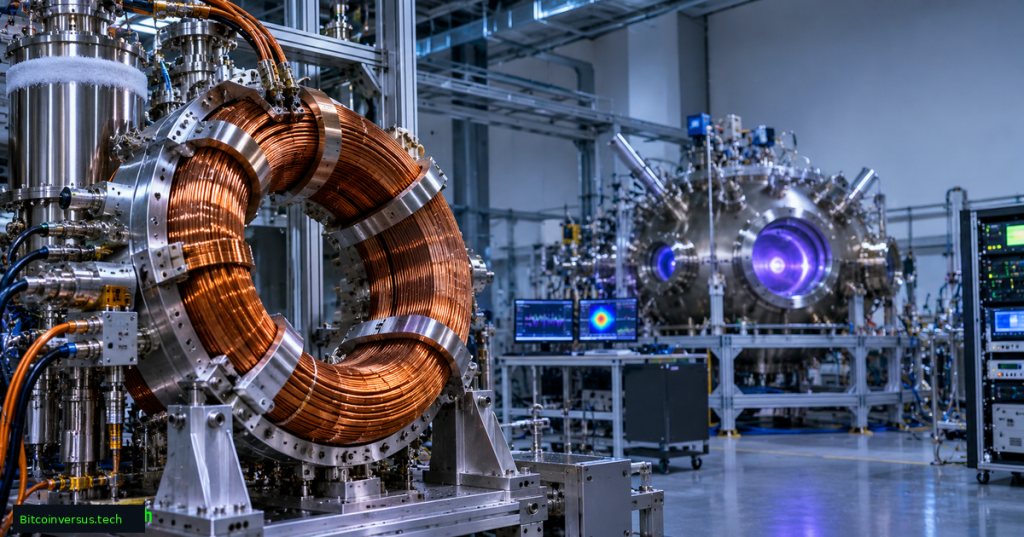
Nuclear fusion combines light atomic nuclei and releases energy, but practical reactors must still solve severe engineering problems involving hot plasma, radiation-resistant materials, superconducting magnets and fuel handling. The U.S. Department of Energy (DOE) announced on November 2, 2026, that it selected 28 fusion research projects for negotiations covering $8.5 million through its Innovation Network for Fusion Energy (INFUSE) program. The selections involve 22 commercial organizations; the funding has not yet been guaranteed or disbursed.
Princeton University and Princeton Plasma Physics Laboratory — “Fusion energy and the path to commercialization” (October 26, 2023). The official laboratory overview describes the research partnerships behind commercial fusion development; older background footage is not documentation of the November 2026 selections.
The 28 projects and their research partners
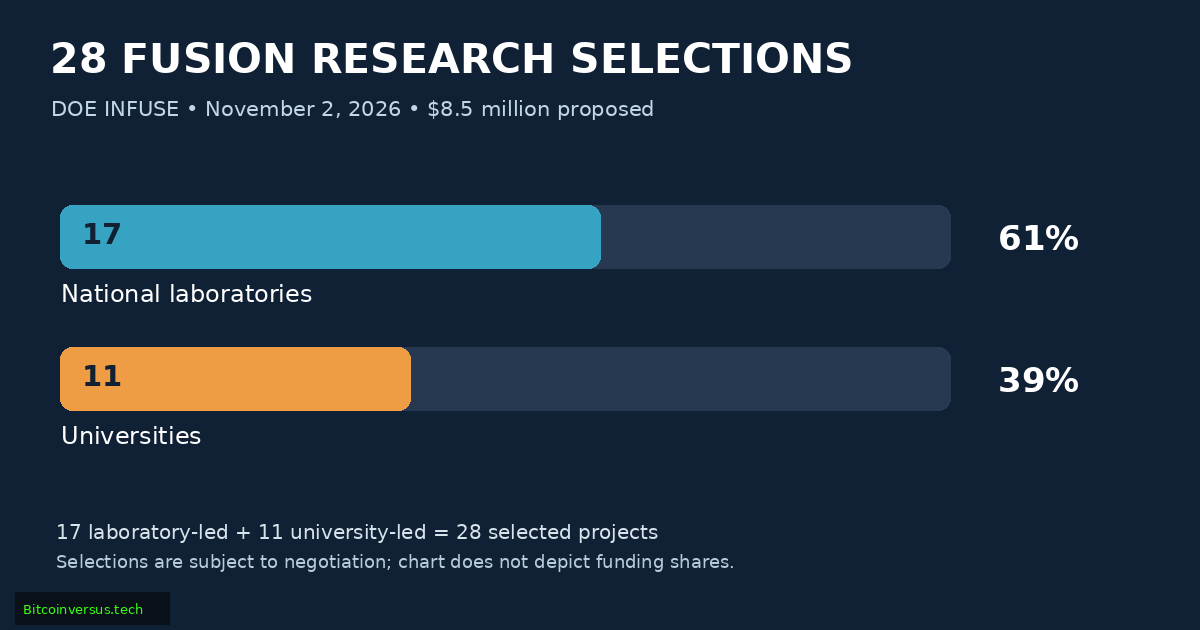
DOE’s award selection includes 17 national laboratory-led projects and 11 university-led projects, representing approximately 61% and 39% of the announced project count. Selected work covers one- or two-year research collaborations with individual proposed budgets from $100,000 to $500,000. The program gives private companies access to specialized scientific facilities and expertise, rather than buying power from commercial fusion plants.
The published DOE selection list identifies Thea Energy’s proposed work on radiation effects in high-temperature superconductors with Massachusetts Institute of Technology researchers, as well as magnet-control and boron-shielding research. Superconducting materials help produce intense magnetic fields while limiting electrical resistance, but neutron damage, manufacturing defects and thermal instability remain significant barriers.
Helion Energy will work with Princeton Plasma Physics Laboratory (PPPL) using experiments and simulations to investigate plasma stability in its field-reversed-configuration approach. PPPL also announced work with Kyoto Fusioneering on liquid-metal flow and heat transfer in fusion reactor blankets. These investigations complement earlier BitcoinVersus.Tech reporting on Princeton’s proposed lower-energy route to fusion ignition, a theoretical result rather than a commercial operating milestone.
Princeton Plasma Physics Laboratory — “What is a diagnostic?” (July 24, 2025). PPPL physicist Luis Delgado-Aparicio explains how instruments measure fusion-plasma conditions. The video provides scientific context, not footage of any newly selected INFUSE experiment.
Why measurements and materials matter
The selection includes Commonwealth Fusion Systems research with the University of Michigan on vanadium-alloy swelling under fusion-relevant irradiation, plus Pacific Fusion research with University of California, Berkeley scientists on praseodymium-based neutron diagnostics. Reliable measurements help researchers compare experimental data with simulation predictions. The role of computational models is also explored in BitcoinVersus.Tech’s earlier report on mathematical constraints in fusion-plasma modeling.
DOE’s partnerships also address fundamental challenges with fuel, radiation and the large-scale machines needed to test fusion reactions. Such work could complement separately funded programs, including DOE-backed AI research for fusion modeling and Pacific Fusion’s planned New Mexico demonstration facility. A research collaboration is not evidence of successful sustained fusion power generation.
Funding selection is not final approval
DOE explicitly warns that selection for award negotiations does not commit federal funding. The department can cancel negotiations, and proposed work remains subject to contractual and administrative conditions. The next INFUSE request for assistance for fiscal year 2027 also introduces consortium eligibility and preconceptual fusion pilot-plant design review, extending the scope of future proposals.
The broader significance lies in coordinating plasma experiments, specialized materials, computational modeling and commercial reactor development. Unlike a completed power plant, no selected INFUSE project independently demonstrates net electricity delivered to the grid. BitcoinVersus.Tech has previously examined fusion’s unresolved engineering and economic obstacles alongside other emerging energy technologies.
Sources: DOE Office of Science announcement, November 2, 2026; DOE FY2026 project selection list; PPPL research partnerships, November 2026; UC Berkeley and Pacific Fusion, November 6, 2026.
BitcoinVersus.Tech Editor’s Note
Research funding and project counts are verified against the November 2, 2026, DOE announcement and its project-selection list. All 28 selections remain subject to negotiation, and the $8.5 million is a proposed funding total rather than money already paid to recipients. The featured cover is an original conceptual fusion laboratory illustration, not a photograph of a named awardee facility. Both Princeton laboratory videos are educational background recorded before the announcement. The in-story chart displays project counts, not funding allocations.
We volunteer daily to ensure the information on this platform is Verifiably True. If you would like to support the research, please scan QR code.

Support independent reporting with an optional donation of 5,000 satoshis. Scan the original QR from a separate screen using a Bitcoin wallet, or use a compatible saved-image scanner on mobile. Verify the destination address 3C9o19EH5HSiwEPyCTmEKzxhNCbo2X6TTb and the amount before sending.
BitcoinVersus.Tech is not a financial advisor. Financial coverage is provided purely for informational purposes.


Leave a Reply