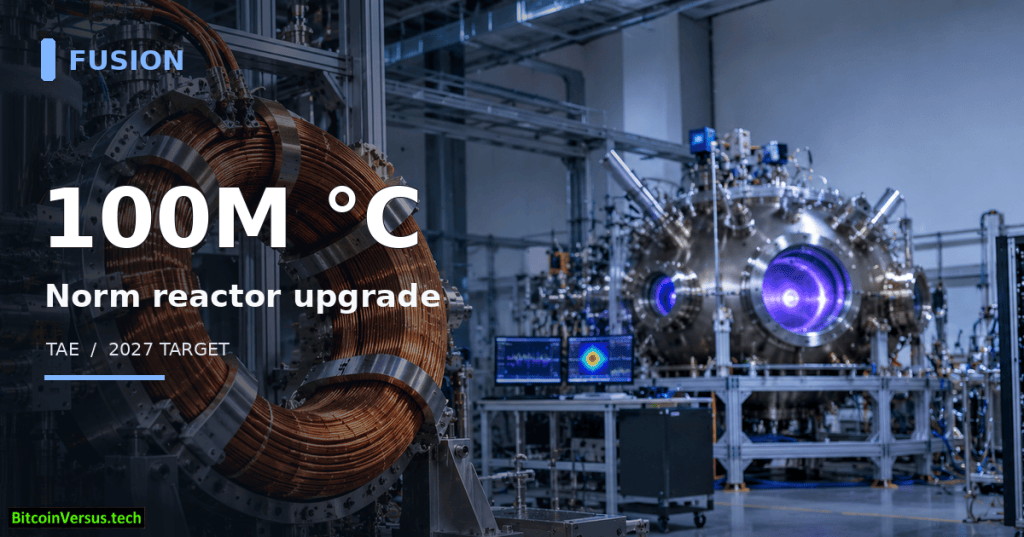
An experimental milestone, not commercial generation
On November 17, 2026, TAE Technologies announced upgrades to Norm, its sixth-generation experimental fusion machine. The developer reports a previous plasma temperature of 70 million degrees Celsius and is targeting 100 million degrees in 2027, with density and confinement appropriate to fusion research. The target depends on installation and testing. It is not an announcement of achieved net electricity generation or commercial reactor operation.
Featured cover: conceptual editorial illustration, not a photograph of the named project. Documentary and contextual images are identified in their captions.
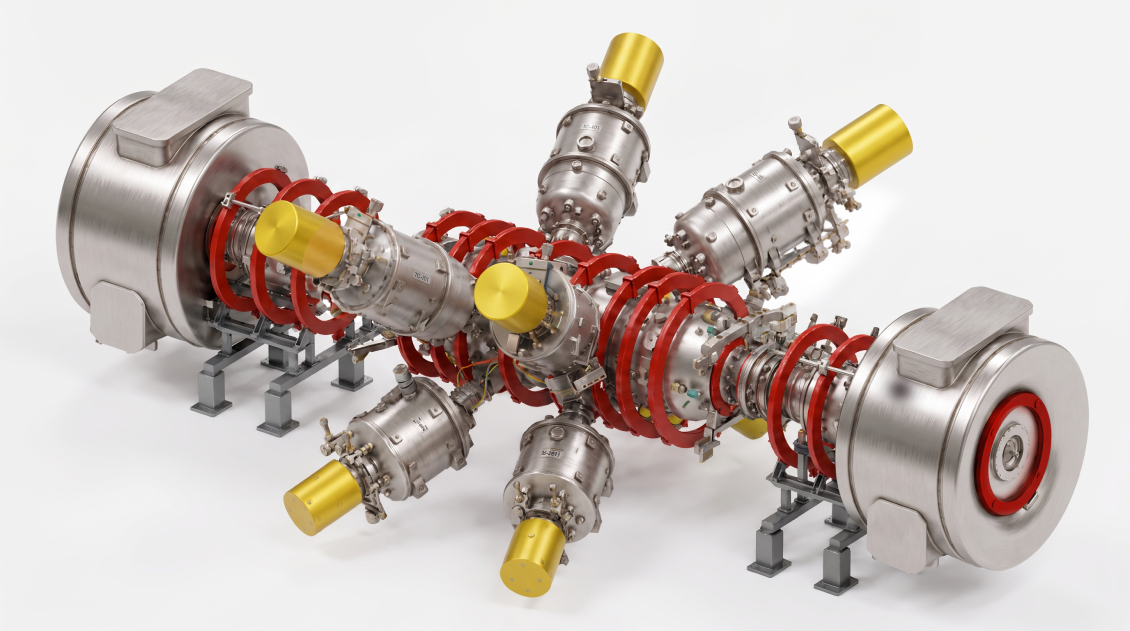
Norm upgraded machine rendering (not a photograph). Credit: TAE Technologies.
How a field-reversed configuration works
Norm uses a field-reversed configuration, a compact magnetic arrangement that confines an ionized gas known as plasma. Currents flowing through the plasma help create the magnetic field structure. Unlike a solid fuel assembly in a conventional fission reactor, the reacting material must remain hot and sufficiently confined without touching the surrounding machinery. Energy losses, instability and particle escape make sustained operation challenging. A high temperature alone is insufficient to demonstrate a commercially useful fusion reaction.
Three upgrade paths
TAE identifies improvements in fueling, neutral particle beams and radio-frequency heating. Fueling controls the available particle population, while energetic neutral beams can penetrate the magnetic field before transferring energy to the plasma. Radio-frequency systems can add energy through electromagnetic coupling. Combining heating and fueling controls gives researchers more flexibility to investigate the plasma conditions needed for useful fusion reactions. Each subsystem introduces electrical demand and engineering constraints that matter when evaluating overall energy balance.
Temperature versus energy balance
Increasing the reported temperature from 70 million to 100 million degrees is approximately a 42.9% increase in Celsius numerical terms. Fusion performance also depends on particle density, confinement time and the fuel mixture. Researchers often examine the product of density, temperature and confinement time rather than any isolated record. Net electrical output would additionally depend on conversion efficiency and energy consumed by magnets, heating equipment, vacuum pumps and other supporting machinery.
The commercial research pathway
The company plans to carry lessons from Norm into Da Vinci, a proposed 50 MW demonstration plant. TAE also identifies hydrogen-boron as its longer-term fuel objective, a technically demanding reaction compared with deuterium-tritium fusion. The company targets a demonstration of fusion energy by 2031. Both the schedule and output are company objectives, not guaranteed results. Independent measurements of plasma conditions and energy accounting across the entire facility will be important evidence for assessing progress.
Fusion gain itself also has several possible definitions. Plasma gain compares fusion energy produced with energy delivered to the plasma; an engineering gain calculation may include the consumption of additional facility equipment. Neither is necessarily equivalent to electricity exported to a power network. A meaningful demonstration should identify where input and output are measured, how long operation persists, and whether the machine can repeat its performance. Those distinctions are especially important when comparing magnetic confinement experiments with other fusion approaches.
Sources and further reading
Announcement or reporting | Additional source
DOE fusion research projects | Princeton’s fusion ignition research | Idaho’s nuclear research supercomputer | U.S. electricity generation mix
We volunteer daily to ensure the credibility of the information on this platform is Verifiably True. If you would like to support to help further secure the integrity of our research initiative, please scan the QR code below.

For mobile scanning, open the article on another display and scan the QR code with a Bitcoin wallet. The voluntary donation amount is 5,000 sats. Verify the receiving address 3C9o19EH5HSiwEPyCTmEKzxhNCbo2X6TTb before sending.
BitcoinVersus.tech is not a financial advisor. This media platform reports on financial subjects purely for informational purposes.


Leave a Reply