From installation to commissioning
Van Oord announced on November 2, 2026, that the final turbine at the Ecowende offshore wind farm had been installed on October 30. The Dutch North Sea project comprises 52 Vestas V236-15.0 MW machines and has a stated grid-delivery capacity of 760 MW. Turbine installation is an important construction milestone, but completing mechanical installation does not by itself establish that every machine is operating commercially.
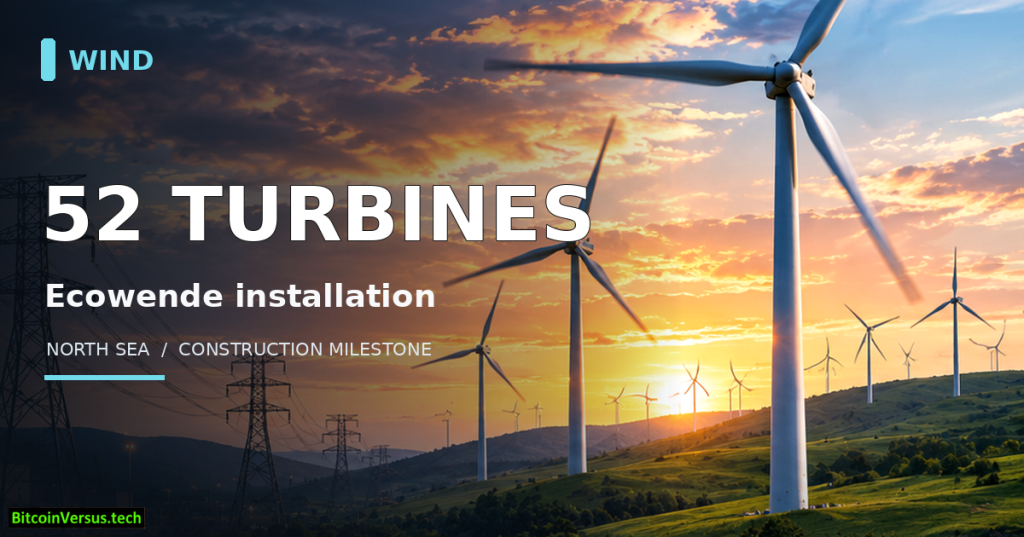
Featured cover: conceptual editorial illustration, not a photograph of the named project. Documentary and contextual images are identified in their captions.
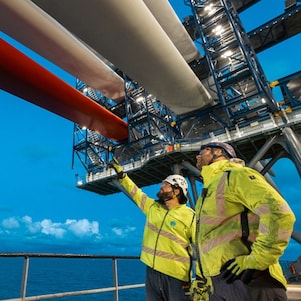
Boreas offshore installation crew at Ecowende. Credit: Van Oord via Shell.
Building above a moving ocean
Offshore construction requires the installation contractor to coordinate foundations, electrical cables, turbine components, vessels and available weather windows. Van Oord used its Boreas installation vessel to transport equipment from Eemshaven and install turbines offshore. Large wind turbines place substantial mechanical loads on their supporting structures. Engineers must account for aerodynamic thrust, cyclic fatigue, waves and corrosion while protecting electrical equipment from the marine environment.
Why 52 times 15 is not 760
Multiplying 52 turbine nameplate ratings by 15 MW gives 780 MW of aggregate turbine ratings. Ecowende separately states a full operational delivery figure of 760 MW. The two quantities should not be treated as interchangeable. A wind farm can have a different export or operational capacity from the arithmetic total of individual machine ratings. The available announcements do not establish the exact engineering or contractual reason for the difference, so assigning it entirely to transmission losses would be unwarranted.
Electricity from variable winds
Turbines convert the kinetic energy of moving air into rotational energy and then electricity. Actual production varies with wind conditions, turbine availability, wake interactions and grid constraints. At a hypothetical 760 MW constant export for 24 hours, output would be 18,240 MWh. Annual output is better modeled using a measured or explicitly assumed capacity factor. A hypothetical 45% factor corresponds to approximately 3.0 TWh annually, not an operator forecast.
Environmental and operational performance
Ecowende has also emphasized ecological considerations in the design of its offshore development. Assessment of those ambitions requires monitoring rather than assuming the construction strategy guarantees a particular ecological outcome. Final commissioning, grid acceptance, electrical availability and maintenance performance will determine how consistently the facility contributes to the Dutch electricity system. Offshore wind’s engineering value lies in accessing strong marine wind resources at scale, while its economic value depends on sustained production and the cost of delivering and maintaining that generation.
The electrical collection system is another important part of offshore infrastructure. Individual generators feed an array of cables that connects the turbines to equipment responsible for exporting power toward land. Electrical losses depend on operating current and cable resistance, while outages in shared infrastructure can affect several machines simultaneously. Evaluating the wind farm as an integrated electrical system therefore requires more than inspecting individual turbine specifications. A completed installation campaign establishes physical progress, but availability and export records establish operating performance.
Sources and further reading
Announcement or reporting | Additional source
Fervo’s geothermal transmission rights | China’s 60 MW liquid-air battery | U.S. electricity generation mix | Utah’s 600 MWh battery
We volunteer daily to ensure the credibility of the information on this platform is Verifiably True. If you would like to support to help further secure the integrity of our research initiative, please scan the QR code below.

For mobile scanning, open the article on another display and scan the QR code with a Bitcoin wallet. The voluntary donation amount is 5,000 sats. Verify the receiving address 3C9o19EH5HSiwEPyCTmEKzxhNCbo2X6TTb before sending.
BitcoinVersus.tech is not a financial advisor. This media platform reports on financial subjects purely for informational purposes.


Leave a Reply