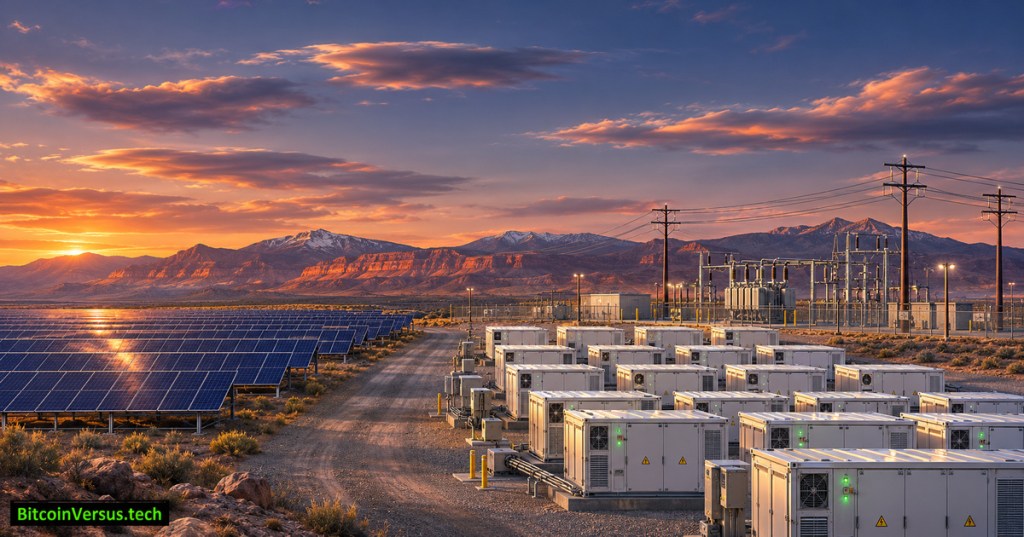
A new 150-megawatt battery in Utah County can store 600 megawatt-hours of electricity, adding a four-hour grid resource to a growing data-center power market. Lydian Energy reports that its Faraday battery energy storage system began commercial operation on September 18, 2026, with contracted capacity supplied to PacifiCorp in support of Meta’s Eagle Mountain data center.
The lithium-iron-phosphate (LFP) installation occupies approximately eight acres beside the 525 MW Faraday solar facility. Both projects share a substation and grid interconnection. Sharing electrical infrastructure can simplify storage development, although it does not prove every battery charging cycle uses solar electricity.
Educational context: Branch Education explains lithium-ion battery chemistry. Video is not footage of the Faraday site.
Why 150 MW and 600 MWh are different
Megawatts measure instantaneous power; megawatt-hours measure electrical energy. Dividing 600 MWh by 150 MW yields four hours of discharge at rated output, before accounting for conversion losses, reserve requirements and other operating limits. The battery shifts electricity through time rather than generating new electricity.
LFP uses an iron-phosphate cathode and moving lithium ions. Its established commercial supply chain makes the chemistry attractive for large installations. Yet even an LFP site requires battery management, cooling, fault isolation and fire protection. The company release does not provide an independently verified round-trip efficiency, cycle-life test or long-term availability record for the Faraday installation.
The Meta contract has a regulatory history
A 2023 Utah utility filing describes PacifiCorp’s Schedule 34 arrangement with Stadion LLC, a Meta subsidiary. Under the filed contract structure, the large customer is responsible for the actual resource costs while PacifiCorp retains charging and dispatch rights. The project is a grid-connected resource, not evidence of a private battery wired directly into Meta’s server rooms.
The September operating date came later than the June 1, 2026 battery target given in the earlier filing. Lydian says the installation moved from mobilization to operation in approximately ten months and estimates around $9 million of property-tax payments over its project life. Energy infrastructure connections are also becoming consequential for Bitcoin mining and other large computing loads.
A larger battery remains proposed
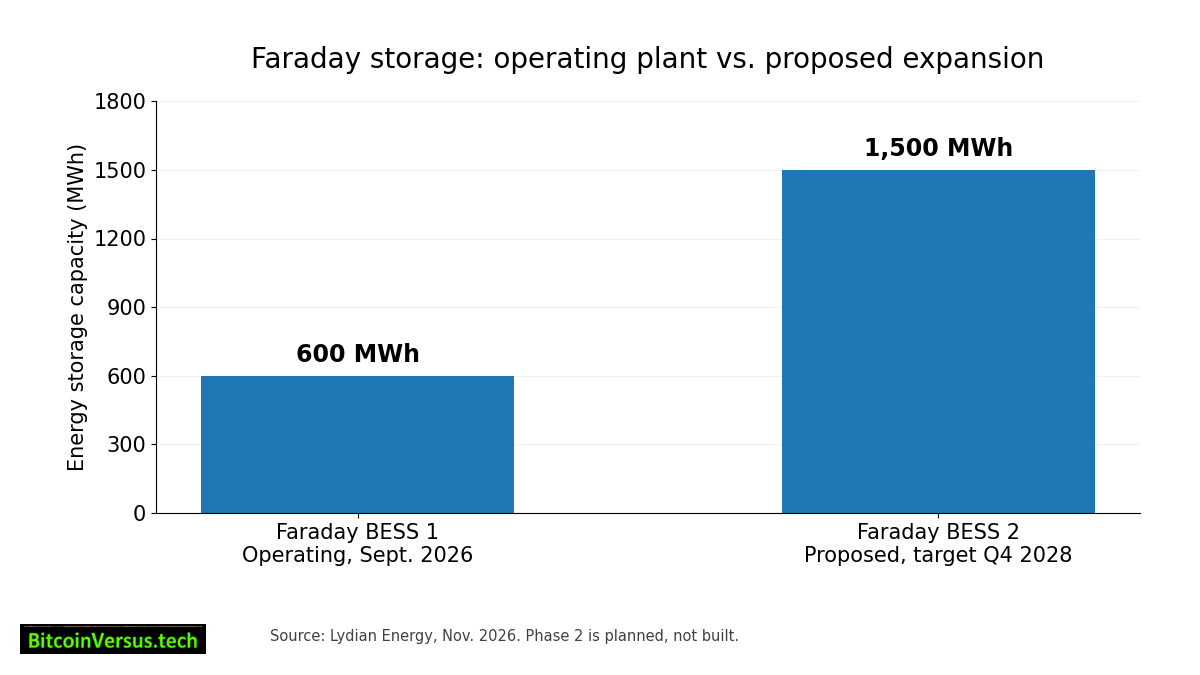
Lydian is developing Faraday BESS 2, an additional phase rated at up to 375 MW / 1,500 MWh, with a targeted fourth-quarter 2028 service date. At the stated four-hour duration, the proposed phase would hold 2.5 times the energy of the operating plant. Neither a published target nor the capacity chart establishes that the expansion has been constructed.
An earlier February 2026 financing release characterized Phase 1 as 150 MW / 733 MWh, versus 150 MW / 600 MWh of contracted storage in the later operating statement. Available releases do not reconcile gross capacity, usable capacity, contractual ratings or possible design changes. Both numbers should be presented with their original definitions rather than treated as identical measurements.
Educational context: Greenwood Solutions discusses LFP battery safety and thermal-runaway protection. Not a Faraday project video.
What matters for the electricity system
BitcoinVersus.tech previously examined national battery deployment, the largest operating U.S. storage facilities, and new transmission investment. Faraday demonstrates a practical grid strategy: add flexible capacity beside existing power infrastructure to help manage changing demand and generation.
The operational evidence is a commissioned battery, not a guarantee of cheaper power or uninterrupted data-center service. Long-term value depends on the dispatch schedule, charging cost, round-trip losses, degradation, interconnection constraints and sustained availability.
Primary sources
- Lydian Energy, November 2026 operating announcement
- Rocky Mountain Power, 2023 Utah Public Service Commission testimony
- Lydian Energy, February 2026 financing statement
- Energy-Storage.News, November 2026 secondary reporting
Cover disclosure: Original editorial illustration of a Utah battery facility and solar array; not a photograph of the Faraday installation. The featured image uses the approved BitcoinVersus.tech watermark asset.


Leave a Reply