
MIT engineers have developed a dry, stretchy polymer that transmits ultrasound without the wet gel traditionally placed between a probe and the skin. In research announced November 19, 2026, the team maintained clear images for approximately nine days in a laboratory tissue model and demonstrated a wearable device during exercise. The advance addresses a practical obstacle to continuous imaging: conventional water-rich coupling materials eventually dry out.
The distinction matters. The nine-day endurance result came from a synthetic phantom, not nine continuous days of imaging on a patient. Shorter human demonstrations showed that the material could function during running and cycling. The peer-reviewed study in Science describes a new interface material, not an approved, commercially available medical monitor.
Why ultrasound normally needs gel
Ultrasound depends on sending high-frequency pressure waves through a medium and recording echoes. Air gaps between a transducer and the body reflect much of the acoustic energy. Gel fills microscopic spaces, improving coupling and allowing tissue images to form. The challenge for a wearable patch is keeping that acoustic bridge intact while skin stretches, sweats and moves for hours or days.
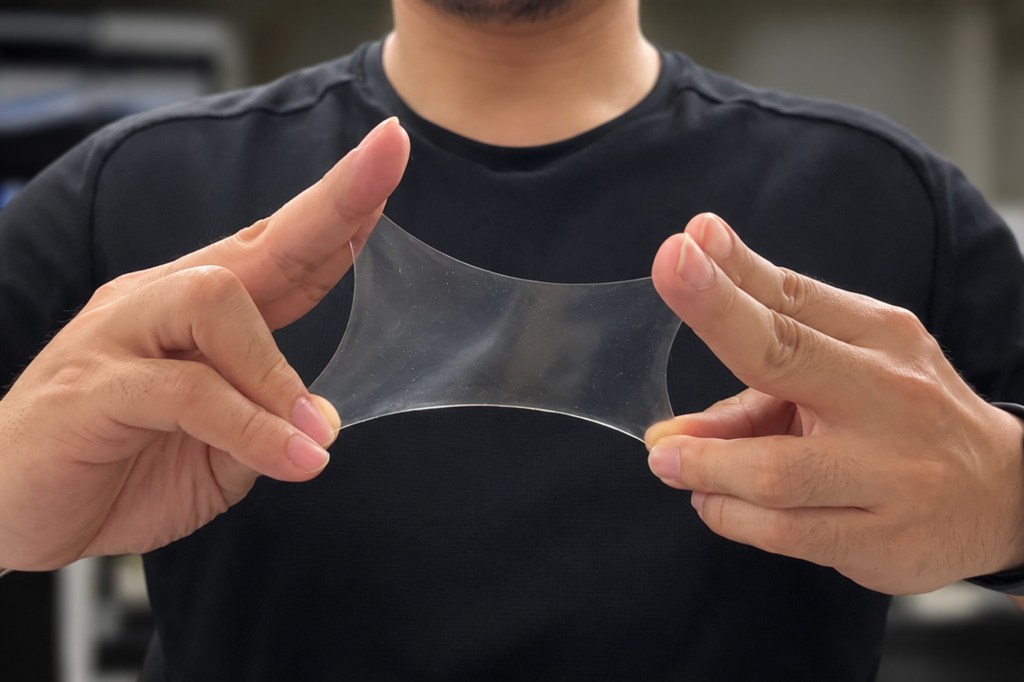
Ordinary rubbers do not automatically solve the problem. Their polymer chains can become entangled, dissipating sound energy as heat. Instead, the MIT and Singapore-MIT Alliance for Research and Technology team engineered molecules resembling bottlebrushes: a long backbone with side chains protruding outward. Side chains inhibit tangling and permit more mobile molecular motion at ultrasound frequencies. A second, loosely connected bottlebrush network reinforces the first network so the resulting solid remains soft but can be handled and stretched.
Three experiments, three different time scales
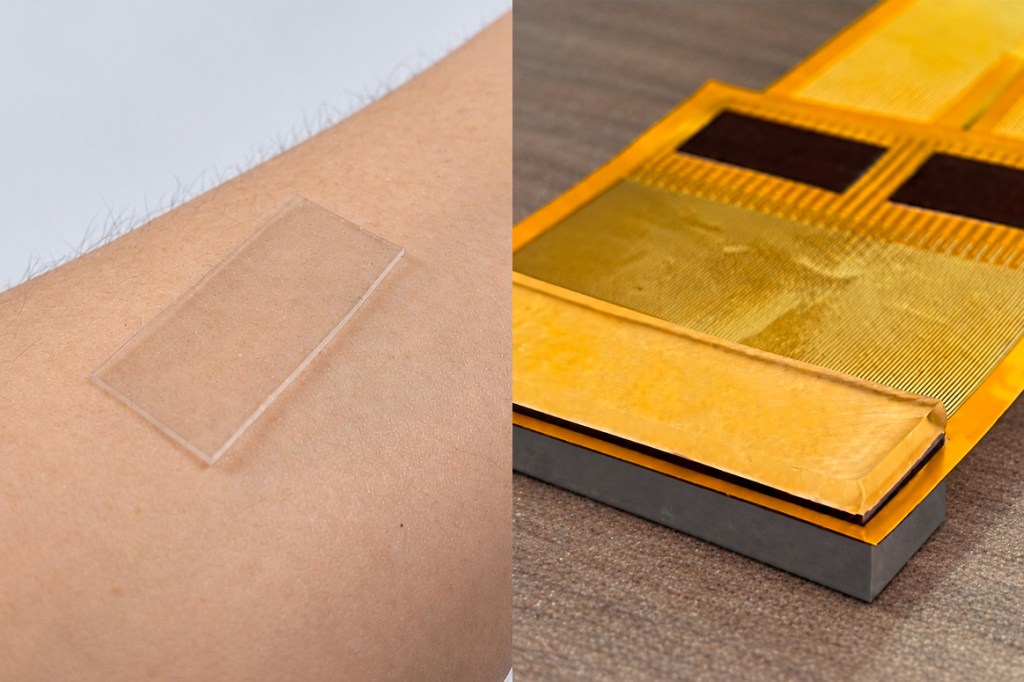
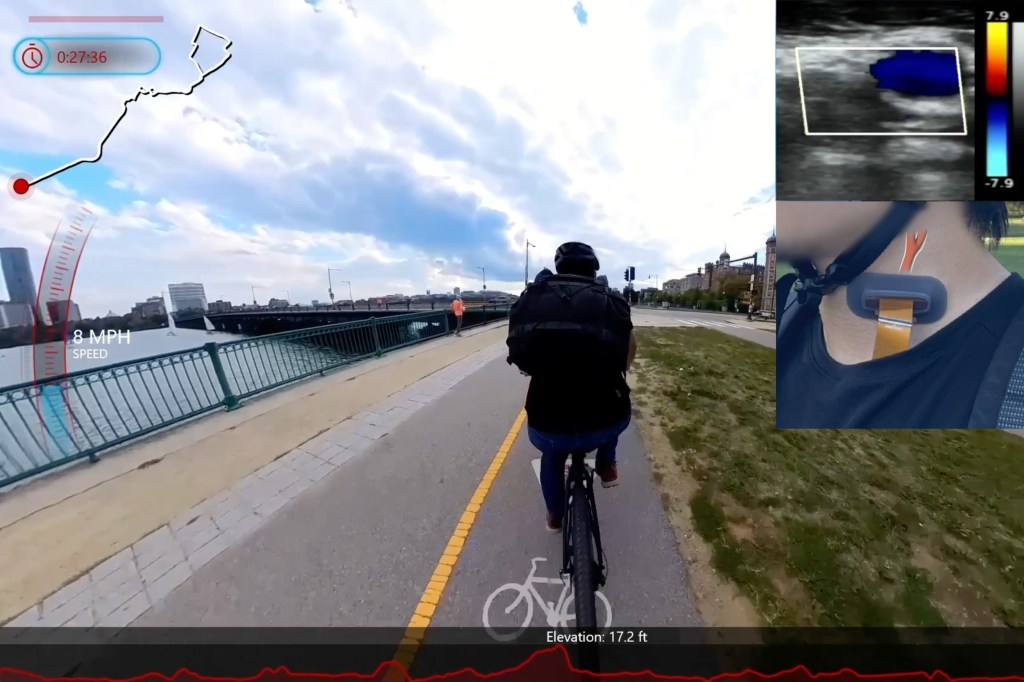
First, the researchers tested credit-card-sized samples on a tissue-mimicking phantom. Images remained clear for roughly nine days. Second, a volunteer ran for 10 minutes wearing both the new material and conventional silicone rubber. The comparator became saturated with sweat; the new material dispersed moisture more effectively. Third, a volunteer rode a bicycle for 30 minutes wearing a small neck-mounted ultrasound device, which continued imaging blood flow through changing terrain.
A materials breakthrough, not a complete wearable
The device still used external electronics to display or record images. The announcement did not establish a wireless, battery-powered patch that can monitor patients independently for nine days. Long-term adhesive performance on diverse skin types, infection control, manufacturing consistency, diagnostic accuracy and regulatory review all remain open questions. A stable acoustic interface is an enabling component rather than a finished clinical system.
Where longer-lasting interfaces could matter
Continuous, noninvasive monitoring could eventually help researchers examine blood-flow changes during activity or evaluate certain conditions beyond scheduled scans. That promise sits alongside other wearable technologies previously examined by BitcoinVersus.Tech: a light-based stress-sensing ring, an Apple-linked health AI study, a wearable robot-training interface, and a shape-responsive polymer. Each tackles a different sensing, reliability or materials constraint.
The most consequential finding is not that ultrasound gel has disappeared from hospitals. It is that researchers have demonstrated a dry, low-loss coupling layer whose acoustic performance persisted in a prolonged model test. Better manufacturing and controlled human trials will determine whether the concept can move beyond research prototypes.
Primary sources: MIT News, November 19, 2026; “Interpenetrating Bottle-Brush Elastomer for Low-Loss Soft Ultrasonic Interfaces,” Science. MIT images are original press photographs credited to the researchers; the featured cover is a separate editorial illustration. The Associated Press video concerns earlier related work, not the November experiment.
We volunteer daily to ensure the credibility of the information on this platform is Verifiably True. If you would like to support to help further secure the integrity of our research initiative, please scan the QR code below.



Leave a Reply