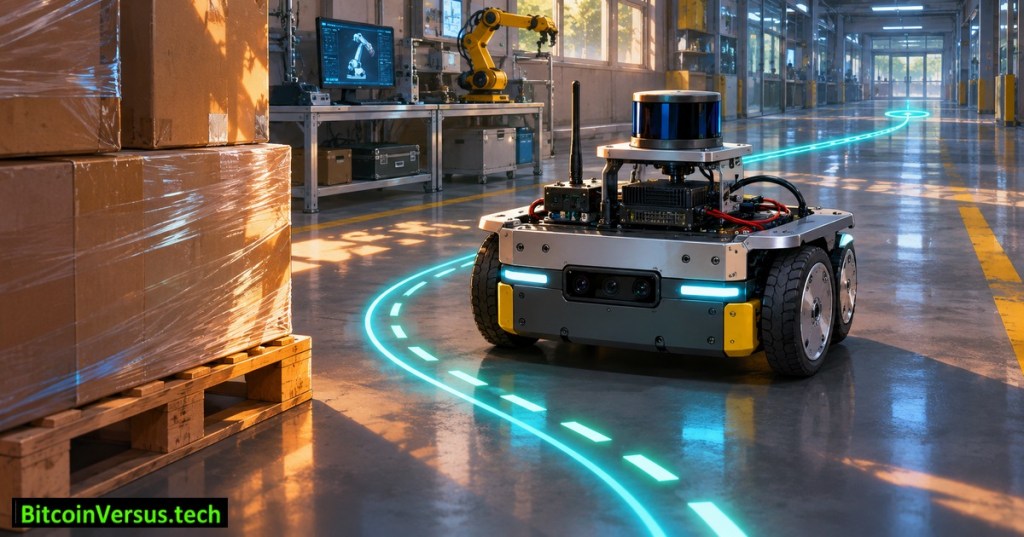
OSREC.017 answers a practical question: after a mobile robot calculates a route, how does it avoid an obstacle while obeying its speed and turning limits? A global path identifies where to go; a local controller selects the next feasible motion. The distinction builds on OSREC.016 on A* search and OSREC.015 on costmaps.
From a map route to a motion command
The Dynamic Window Approach (DWA) was described by Dieter Fox, Wolfram Burgard, and Sebastian Thrun in a 1997 robotics paper. Rather than testing arbitrary turns, the controller considers candidate linear and angular velocities the robot can physically reach over a short interval. It predicts motion, rejects dangerous candidates, and selects one based on goals and clearance. The original approach includes the ability to stop before collision, under its stated model assumptions.
Modern ROS 2 Nav2 provides a related DWB controller. Its trajectory generator samples motion possibilities, while configurable critics score obstacle proximity, global-path alignment, distance to the goal, and oscillation. DWB is an implementation family, not a claim that the original 1997 controller and every Nav2 release behave identically.
A numerical dynamic-window example
Suppose a robot currently moves at 0.40 m/s. Its illustrative maximum acceleration and braking magnitude are each 0.50 m/s², and the next control interval is 0.20 s. Ignoring other velocity limits, reachable forward speeds range from 0.30 to 0.50 m/s, calculated as 0.40 ± (0.50 × 0.20). Angular velocities have their own limits. A controller evaluates multiple reachable speed-and-turn combinations instead of commanding a physically impossible instantaneous jump.
Consider a candidate at 0.50 m/s. With constant 0.50 m/s² braking, ideal stopping distance is v² ÷ (2a) = 0.25 m. An obstacle only 0.20 m ahead leaves inadequate ideal braking distance, even before sensor latency, footprint, and uncertainty margins. The candidate should not be treated as safe. Actual collision checking requires a predicted path and configured robot geometry, not a single one-dimensional equation.
How a controller selects a trajectory
For each sampled command, simulate its short-term path through a local costmap. Discard collisions and unsuitable trajectories. Score the remaining paths according to navigation priorities, then command a selected velocity and repeat at the next control cycle. Nav2’s DWB documentation names the relevant velocity samples, acceleration parameters, simulation horizon, and critic plugins.
A simulation-only inspection lab
Open an approved ROS 2/Gazebo laboratory with a static obstacle placed beside a planned aisle route. Observe the global path and local predicted trajectories in RViz. Record the configured velocity limits, prediction horizon, obstacle footprint, and critic scores. Compare runs with a clear aisle and a blocked aisle; do not infer safety from a single successful run.
controller_server:
  ros__parameters:
    controller_plugins: ["FollowPath"]
    FollowPath:
      plugin: "dwb_core::DWBLocalPlanner"
The abbreviated YAML identifies the controller plugin; it is not a complete deployment configuration. Use the documentation appropriate to the installed ROS distribution and robot platform. Compare against OSREC.013 on state estimation because poor localization can invalidate a perfectly calculated local trajectory.
Trade-offs and knowledge check
Small velocity-sampling sets reduce computation but may overlook suitable turns; large sets cost more processing time. Short prediction horizons can miss emerging hazards, while aggressive clearance weights may stop progress in narrow aisles. DWA also cannot replace independent emergency stopping or validated functional safety. Review OSREC.012 on safety filters for a complementary method.
Question: At 0.40 m/s, with 0.50 m/s² acceleration over 0.20 seconds, what is the highest newly reachable forward speed before speed caps? Answer: 0.50 m/s. Takeaway: A drivable route is only the beginning; local navigation must respect motion limits, obstacle geometry, and uncertainty.
Editor’s note: Numerical values are illustrative, not a certified robot configuration. Research dates and Nav2 behavior come from cited primary documentation. Two independent demonstration videos have public listings, but player functionality and mobile playback require separate browser verification. The anime-style featured illustration is conceptual editorial artwork.
We volunteer daily to ensure the credibility of the information on this platform is Verifiably True. If you would like to support to help further secure the integrity of our research initiative, please scan the QR code below.



Leave a Reply