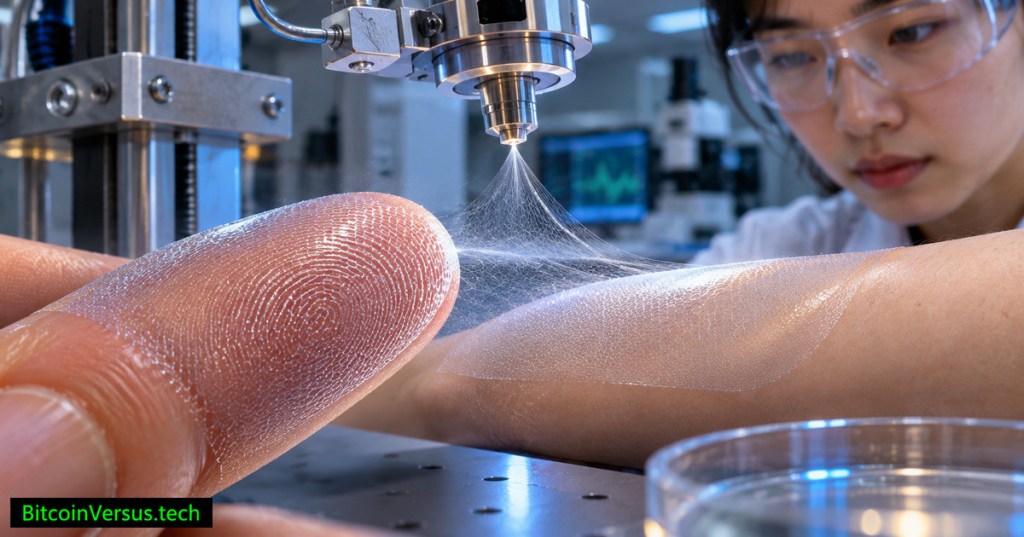
Researchers at the University of Tokyo have reported a way to fabricate electrical sensors directly onto curved human skin, rather than building a flat electrode first and transferring it later. Electrospinning deposits a breathable network of conductive nanofibres that can follow even the ridges of a fingertip. The peer-reviewed work appeared in Nature Communications on November 16, 2026; the university announced the findings November 19.
Research context: University of Tokyo professor Takao Someya discusses electronic skin in a 2022 lecture, before the current nanomesh study.
Why build the sensor on skin?
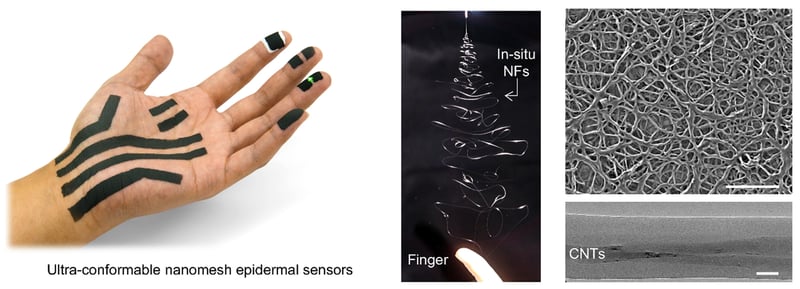
Conventional flexible electrodes are frequently fabricated on planar sheets. Moving them onto an irregular surface can introduce wrinkles, gaps or peeling, weakening electrical contact. Xiaoping Liang and colleagues instead produced fibres combining carbon nanotubes and an ethylene-vinyl alcohol copolymer. A modified electrospinning instrument creates intrinsically conductive nanofibres less than one micrometre wide, assembling a porous sensor network directly on the skin.
The open mesh permits water vapour and heat to pass through. Its flexibility is particularly useful near fingerprints, knuckles and other highly curved surfaces where a thin plastic sheet may buckle. The investigators evaluated conductivity, stability, breathability and biological compatibility in controlled tests. Those results are promising, but they are not a replacement for clinical trials or long-term consumer safety certification.
How did it perform?
The authors demonstrated several sensing applications: surface electromyography to record muscle-related signals, electrodermal activity sensing at a fingertip, and a multilayer capacitive pressure sensor. For gesture recognition, three pairs of electrodes collected forearm muscle signals. A windowed transformer encoder decoded the recordings, yielding 97.8% average prediction accuracy for the gestures evaluated by the research team. Such accuracy is specific to the reported experimental conditions; it does not establish performance across every user, motion pattern or everyday setting.
Process context: IMDEA Materials Institute explains electrospinning in a March 2026 technical video. The segment does not show the Tokyo group’s exact fabrication apparatus.
Why the advance matters
Conformal, breathable electrodes could eventually support rehabilitation monitoring, gesture-controlled electronics and physiological measurements without bulky adhesive assemblies. Related technology includes MIT’s dry ultrasound wearable film, USC’s optical stress ring, UCLA’s wearable robotic interface, and Microchip’s robotic touch electronics. Each solves a different sensing problem.
Open questions remain about repeatable deposition on diverse skin surfaces, removal and reapplication, production throughput, sweat and motion interference, and validation beyond a controlled lab. No commercial availability, medical approval or lifetime rating follows from the reported results. The contribution is primarily a fabrication method that reduces the mechanical mismatch between electronic sensors and the body’s curved surfaces.
Primary research: Liang et al., Nature Communications (2026); University of Tokyo, November 19 release.
We volunteer daily to ensure the credibility of the information on this platform is Verifiably True. If you would like to support to help further secure the integrity of our research initiative, please scan the QR code below.



Leave a Reply