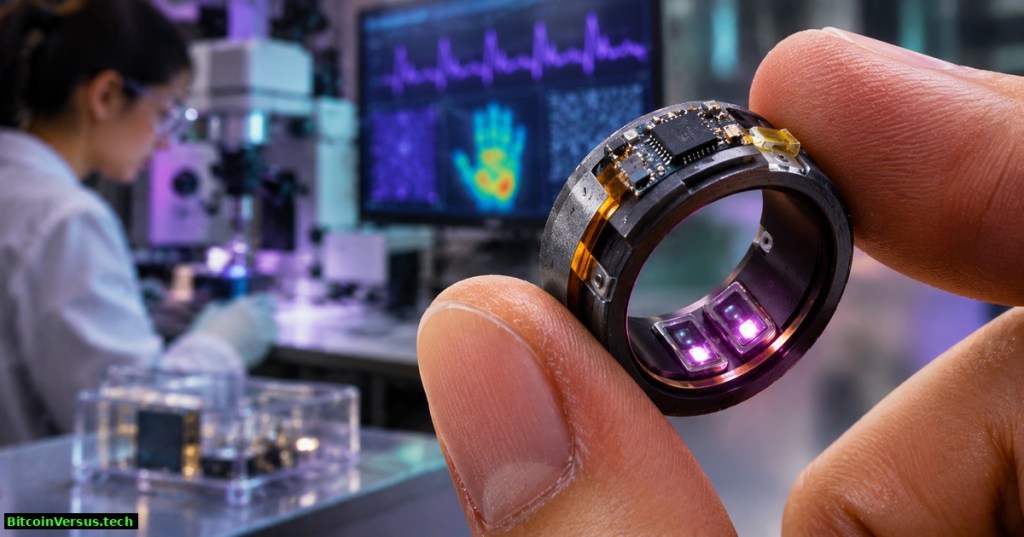
A University of Southern California research team has developed a smart ring that measures stress-related sweat responses with light rather than skin-contact electrodes. In a laboratory study published in Science Advances on November 13, 2026, the optical ring achieved 92.3% accuracy at distinguishing experimentally induced stress from relaxation, compared with 77.95% for the electrode-based reference sensor.
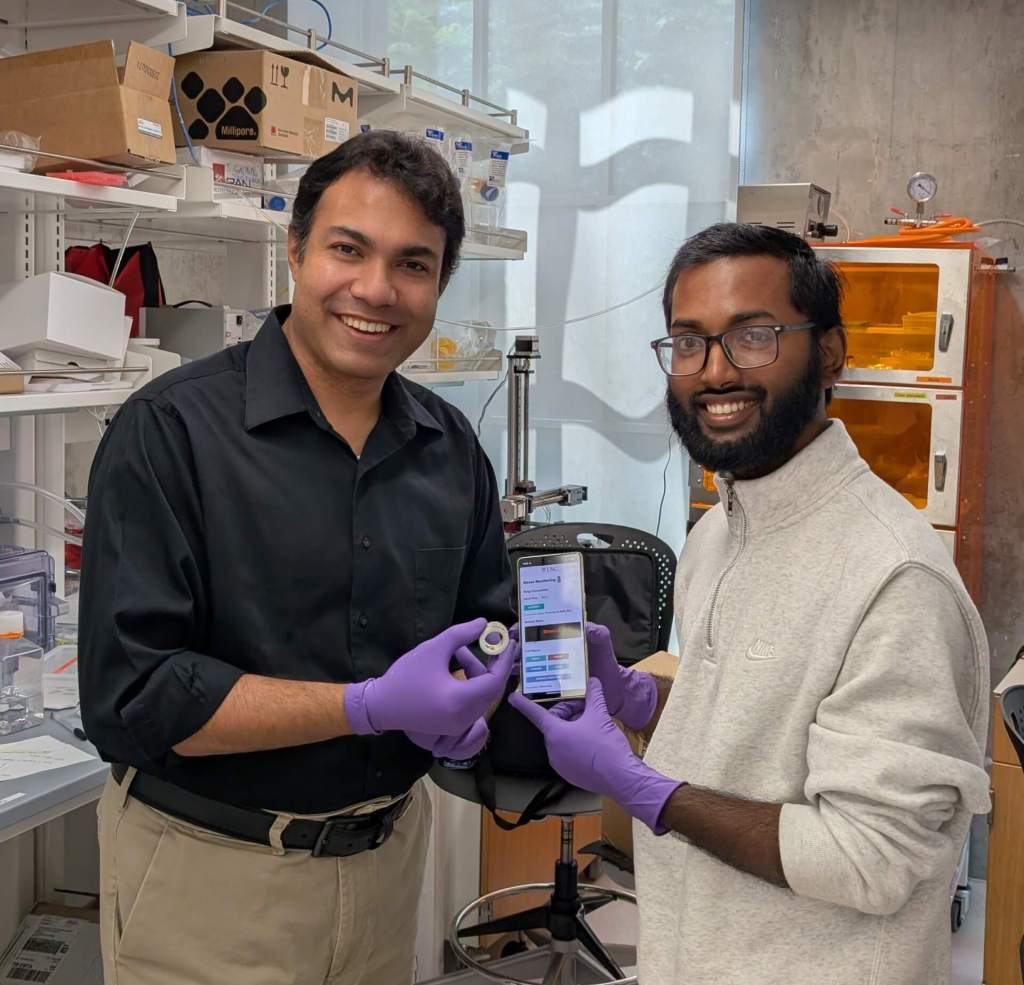
USC announced the work on November 18. Led by assistant professor Yasser Khan and doctoral researcher Md Farhad Hassan, the project addresses a familiar weakness of electrodermal activity sensors: their readings depend on consistent electrical contact with skin, sometimes through conductive gel that can dry out during extended wear.
USC’s 2025 interview with Yasser Khan about future wearable technologies. The university video predates the 2026 ring study and is included as background, not as demonstration footage of the new prototype.
How infrared light detects sweat
The method, called optodermal activity, measures changes in reflected near-infrared light associated with sweat gland activity below the skin. One LED operates at 960 nanometers and responds to water-related changes. A second LED at 1,250 nanometers serves as a reference, allowing the device to compare signals rather than relying on a single reflection measurement.
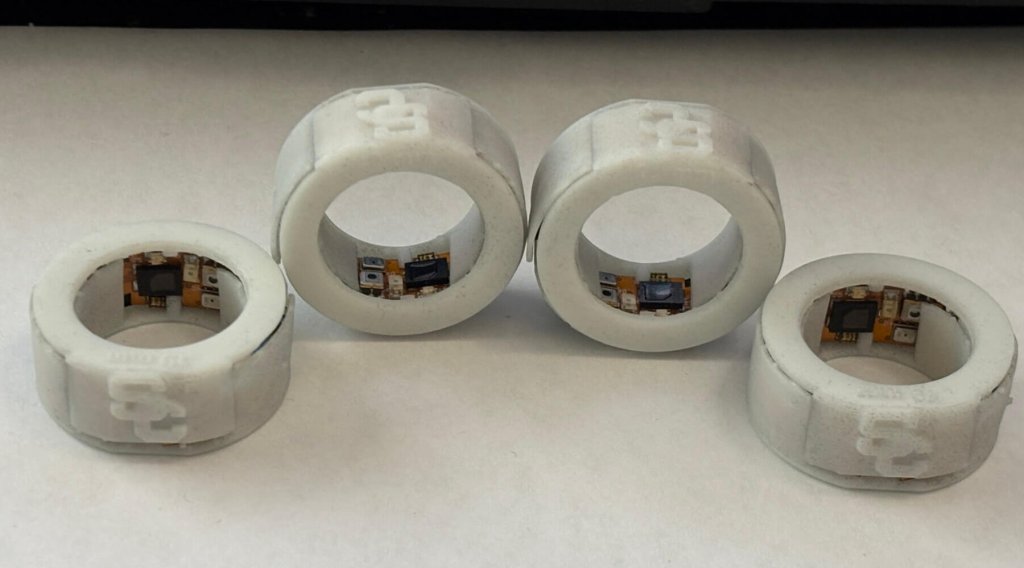
The ring also extracts photoplethysmography signals for heart rate and related variability. Temperature and acceleration sensors help distinguish sympathetic stress responses from exercise, heat and motion. A compact microcontroller runs a neural-network model locally, reducing reliance on sending continuous raw measurements to remote servers. Local analysis offers privacy advantages, although device security and data handling would still matter in a commercial product.
The laboratory comparison
The short-duration classification experiment involved six participants. Researchers alternated relaxation and cold-water stress tests, then added walking and cycling tasks to investigate movement-related and heat-related signals. The study compared classifications made from the optical ring with those obtained using a commercial electrodermal sensor, which measures skin conductance through electrodes.
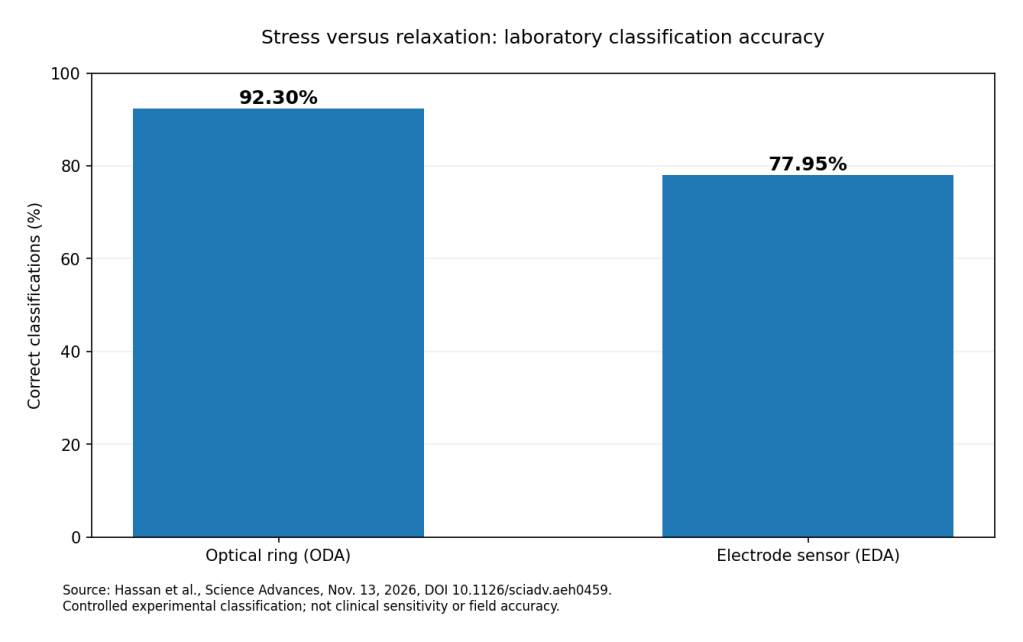
Binary classification accuracy was 92.3% for the optical system versus 77.95% for the electrode system. The result measures correct labels under the study’s controlled protocol, not medical diagnosis, accuracy across all populations or reliable detection of a person’s feelings in daily life. The study also reported stronger performance for the optical approach when classifying four experimental conditions.
The tougher test lasted 12 hours
In a separate long-duration evaluation involving two participants, the optical approach retained 79.55% stress classification accuracy after extended use, while the electrode method dropped to 57.35%. Researchers attributed the reference sensor’s decline partly to drying conductive gel and unstable electrode contact. Small study groups and highly structured tasks limit how broadly the findings can be generalized.
What commercialization would require
Khan’s team plans a yearlong study with 40 participants in an office setting. The researchers also acknowledge interference from surface perspiration and the need to investigate a wider variety of cognitive and social stressors. USC says a patent application is pending and commercialization remains a possibility, not an announced product launch.
The engineering direction builds on growing interest in personal electronics, including our reporting on consumer AI rings, Apple’s health AI research, specialized wearable processors and experimental motion sensors. Success in everyday wear would require independent validation, robust calibration across people and devices, acceptable battery life and clear privacy controls.
For now, USC has demonstrated a promising sensing technique and measured a meaningful performance improvement in limited tests. A prototype that works in the laboratory is an important starting point, but not yet a proven replacement for clinical monitoring or consumer health assessment.
Sources and research
- Hassan and colleagues, Science Advances, November 13, 2026, DOI: 10.1126/sciadv.aeh0459
- Open-access research article, experimental methods and results
- USC Viterbi announcement, November 18, 2026
- USC Khan Lab research and publications
Editor’s Note: We volunteer daily to ensure the credibility of the information on our platform is Verifiably True. If you would like to support our work and the integrity of our research initiatives, scan the QR code below to donate 5,000 sats.

For mobile scanning, open the article on another display and scan the QR code with a Bitcoin wallet. Verify receiving address 3C9o19EH5HSiwEPyCTmEKzxhNCbo2X6TTb before sending.
BitcoinVersus.Tech publishes technology, science and finance journalism for informational purposes and does not provide medical diagnosis, treatment advice or individual health recommendations.


Leave a Reply