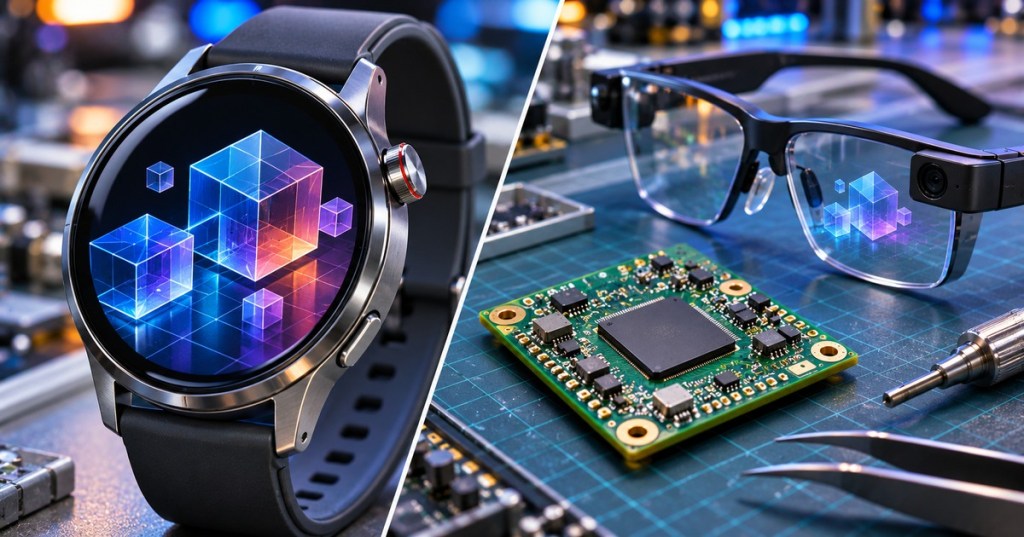
Shanghai chip-design company VeriSilicon announced GLTiny on October 29, 2026, a lighter 3D graphics programming system for smartwatches, smart glasses and other battery-constrained devices. The announcement targets a practical hardware problem: sophisticated animation needs graphics processing, but wearable systems have much less memory, battery capacity and CPU headroom than phones or PCs.
GLTiny is software and a driver model for VeriSilicon’s Nano OpenGL ES GPU intellectual property, not a newly released consumer smartwatch or an independently benchmarked chip. Its configurable functions are intended to reduce driver memory consumption and CPU overhead. VeriSilicon did not publish comparable megabytes, frame rates or watt-hour results, so claims of specific performance gains remain unverified.
Why native glTF support matters
GLTiny accepts standard Khronos glTF 3D models and supports lighting, skeletal skinning, morph targets and animated clip playback. A watchface designer could use those features to animate a mechanical dial, for example, without building a complete custom rendering engine. The same pipeline could support small 3D interfaces in future smart glasses. Those are design possibilities, not announced production deployments.
The company also describes combining GLTiny with its existing VGLite driver, rendering 2.5D vector elements and 3D objects in the same frame. This builds on the firm’s April 2025 GCNano3DVG GPU IP, which already offered separate pipelines for hybrid wearable graphics. Importantly, GLTiny expands the software stack rather than proving that every Nano GPU now performs identically.
The next technical test
Smaller graphics stacks matter as chipmakers put more functions into edge devices. Ceva’s scalable NPU portfolio addresses related compute constraints, while BrainChip’s development kit puts a different low-power accelerator into developers’ hands. Graphics efficiency and AI efficiency are different workloads, as our CPU, GPU and NPU explainer details.
Next, developers need public driver availability, supported Nano GPU configurations, reproducible memory and frame-rate benchmarks, and shipping-device evidence. More advanced effects do not automatically deliver longer battery life. As the mobile ray-tracing ecosystem also evolves, wearable GPU software will be judged by visual quality per milliwatt, not marketing claims alone.
BitcoinVersus.Tech
BitcoinVersus.Tech Editor’s Note: We volunteer daily to ensure the credibility of the information on this platform is Verifiably True. If you would like to support our work and help further secure the integrity of our research initiatives, please scan the QR code below to donate 5,000 sats. For best results, scan the QR code from a laptop or larger screen.

Bitcoin address: 3C9o19EH5HSiwEPyCTmEKzxhNCbo2X6TTb. On a phone, open the QR image on another screen or copy and verify the address in your wallet before sending.
BitcoinVersus.tech is not a financial advisor. This media platform reports on financial subjects purely for informational purposes.


Leave a Reply