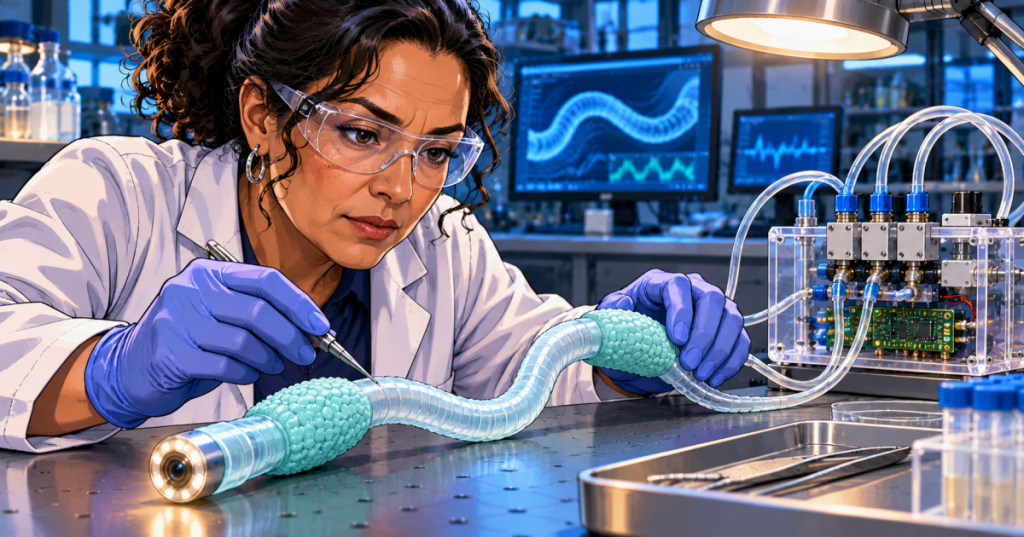
CAMBRIDGE, Mass. — Engineers at MIT and UT Southwestern reported a snake-inspired soft robotic endoscope on October 28, 2026, designed to travel through the small intestine while carrying a camera, drug sprayer and biopsy tools. Named BIOSENTER, the device advanced approximately 6.5 feet through an animal intestine in preclinical tests; it has not been demonstrated in human patients.
The research, published in Science Robotics, addresses a difficult clinical target: the human small intestine extends roughly 20–25 feet and is harder to reach than the stomach or colon. The new system could eventually assist diagnosis or treatment of bleeding, lesions and other intestinal conditions.
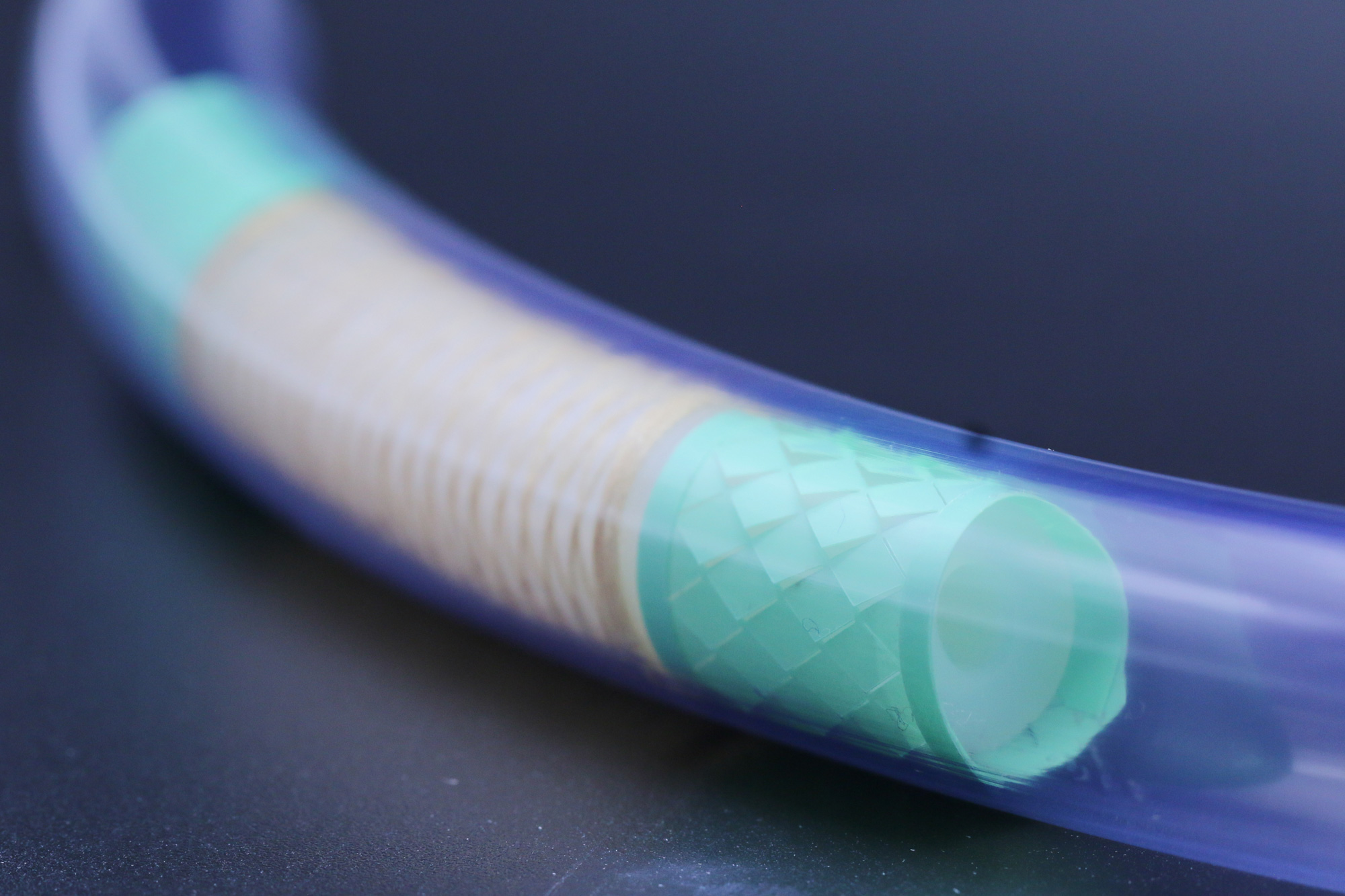
Actual BIOSENTER prototype with snake-scale-inspired gripping sleeves. Photograph courtesy of the researchers via MIT News, October 28, 2026.
How the Soft Robot Crawls
Instead of using rigid wheels, BIOSENTER inflates four pneumatic chambers in different combinations to extend and bend its tubular body. Expandable balloons at its head and tail alternately anchor the machine, creating a controlled inching movement.
Kirigami-inspired sleeves on the balloons form raised gripping features when expanded, helping the robot gain traction against slippery tissue. This design aims to move without excessive stretching of the intestinal wall, but clinical safety has not yet been established.
MIT News’ original BIOSENTER demonstration video, linked from the university’s October 28 research announcement.
A Tool Carrier, Not an Autonomous Surgeon
The prototype’s central passage accommodates imaging, a fluid sprayer and small tissue clips. In animal experiments, researchers demonstrated these functions along with locomotion. The system remains tethered to external pneumatic and electronic controls, and a human operator guides it with a controller.
That distinguishes it from a capsule camera that merely travels with digestive motion. It also differs from conventional double-balloon enteroscopy, in which clinicians repeatedly inflate and deflate balloons while advancing instruments by hand.
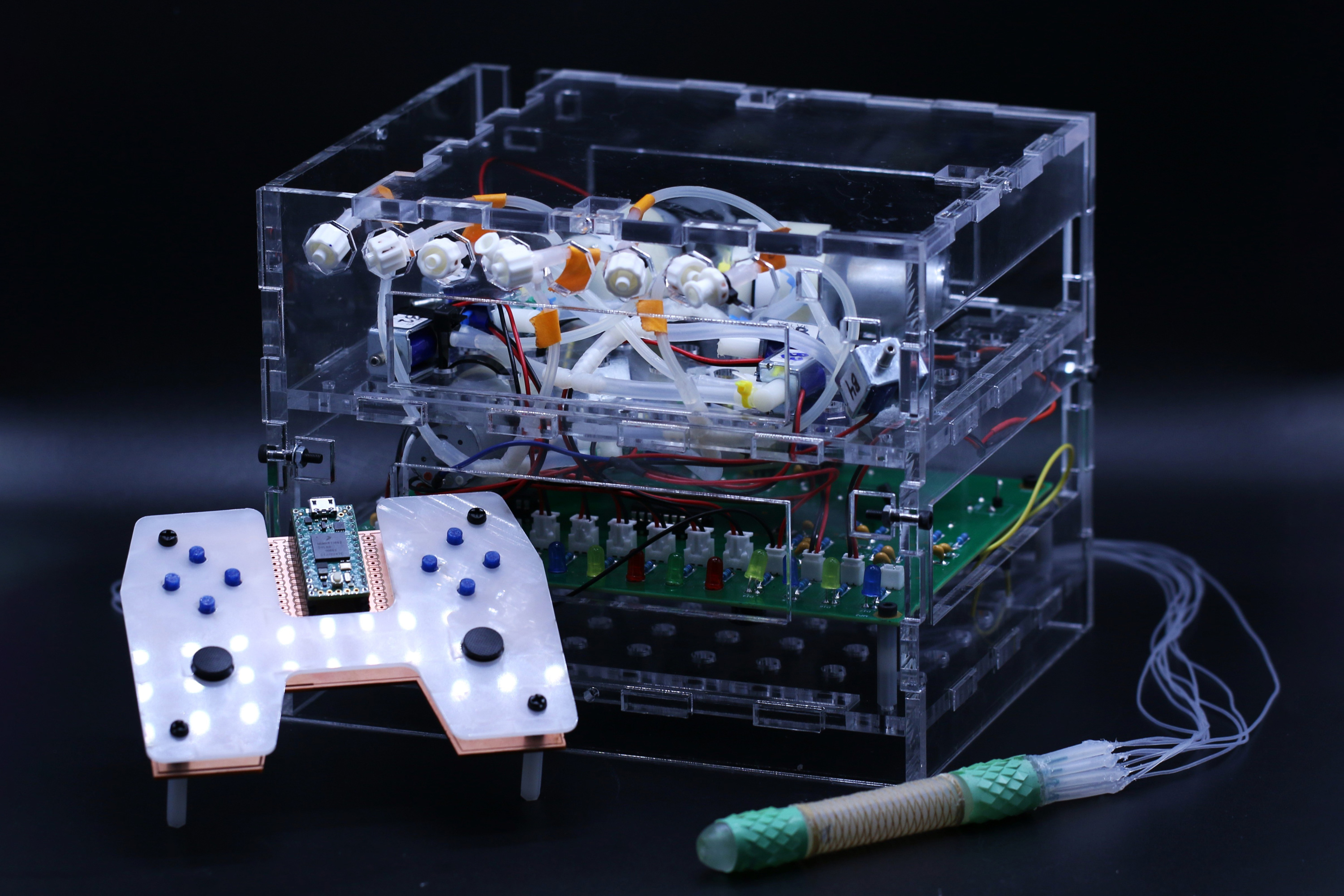
Actual pneumatic controller, hand-operated interface and robotic tube. Photograph courtesy of the researchers via MIT News.
What Needs to Happen Next
BitcoinVersus.Tech has covered medical microbots, robots in surgical environments, MIT’s deformable sensing hardware and robotic drug manufacturing. BIOSENTER adds a separate frontier: controlled movement through delicate internal anatomy.
Researchers are improving navigation and exploring additional tasks. Before clinical adoption, they must establish safe operation, reliable intervention and performance in human studies. The 6.5-foot animal result should not be confused with traversing an entire human intestine.
Support BitcoinVersus.Tech
We volunteer daily to ensure the credibility of the information on this platform is Verifiably True. Please scan the original QR code below to donate 5,000 sats if you would like to support our independent reporting. For best results, open this page on a laptop or larger screen.

On mobile, display the QR code on another screen to scan it with a Bitcoin wallet; alternatively, use a wallet’s saved-image QR-scanning feature if available. Bitcoin donation address: 3C9o19EH5HSiwEPyCTmEKzxhNCbo2X6TTb.
BitcoinVersus.tech is not a financial advisor. This media platform reports on financial subjects purely for informational purposes.


Leave a Reply