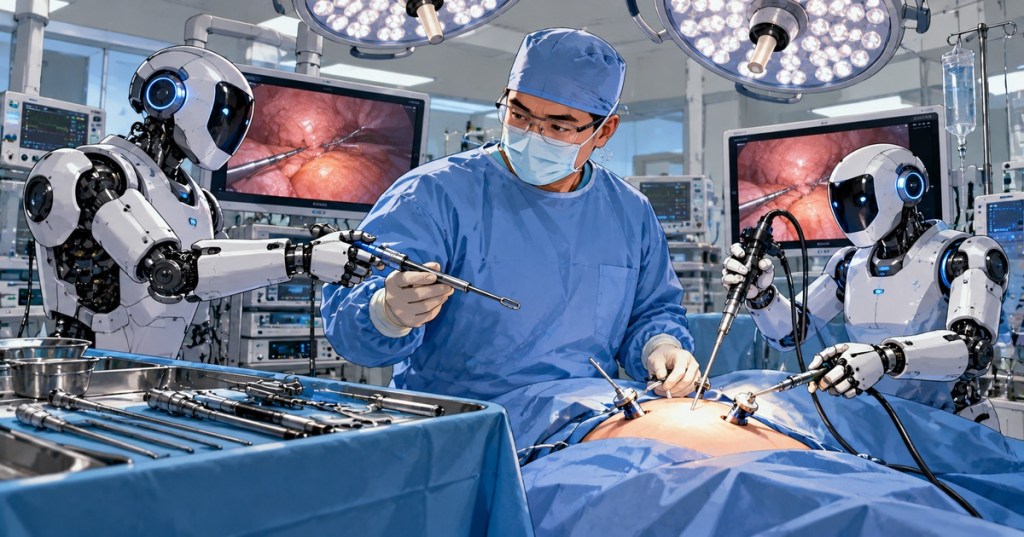
Samsung Medical Center says humanoid robots are moving closer to becoming practical assistants in the operating room.
In an official update published October 16, the Seoul hospital detailed a September 16 public demonstration in which two humanoid robots worked alongside a surgeon in a simulated surgical environment. The robots were tested on tasks including passing and retrieving instruments, operating an endoscope, retracting tissue, responding to voice commands and stopping or recovering safely.
The system is being developed through the ORchestra consortium, which includes Samsung Medical Center, Rainbow Robotics, AIDIN ROBOTICS, Seoul National University, the National Cancer Center and other partners. Rainbow Robotics described one robot acting like an operating-room nurse while the second handled assistant-surgeon duties such as holding a laparoscope and retracting tissue.
Why the humanoid form matters
The positive engineering idea is compatibility. Operating rooms, tools and workflows are already designed around human bodies. A humanoid assistant can potentially work inside that environment without requiring hospitals to rebuild the room around a purpose-built machine.
That could matter most where staffing is limited. Samsung Medical Center says the long-term goal is to support repetitive and physically demanding operating-room work and help fill gaps during night, emergency and essential-care procedures. The project is still in validation, however. It has not reached routine clinical use, and commercialization would require further performance testing, preclinical studies, usability work, clinical trials and medical-device approval.
Healthcare robotics is broadening
The project fits a wider shift toward physical AI in healthcare. BitcoinVersus.Tech recently covered Hurotics raising 25 billion won for wearable robots, a tongue-controlled exoskeleton that helps restore hand function, and Intel’s physical-AI push.
The important distinction is that this is assistance, not a claim that surgeons are being replaced. The current system is designed around human direction, shared roles and existing surgical workflows. If the research succeeds, the benefit may be less about fully autonomous surgery and more about giving medical teams another reliable pair of hands.
BitcoinVersus.Tech Editor’s Note:
We volunteer daily to ensure the credibility of the information on this platform is Verifiably True. If you would like to support to help further secure the integrity of our research initiatives, please donate using the QR code provided

For best QR-code scanning results, please scan this donation code from a desktop or larger screen. Mobile screens may prevent camera recognition.


Leave a Reply