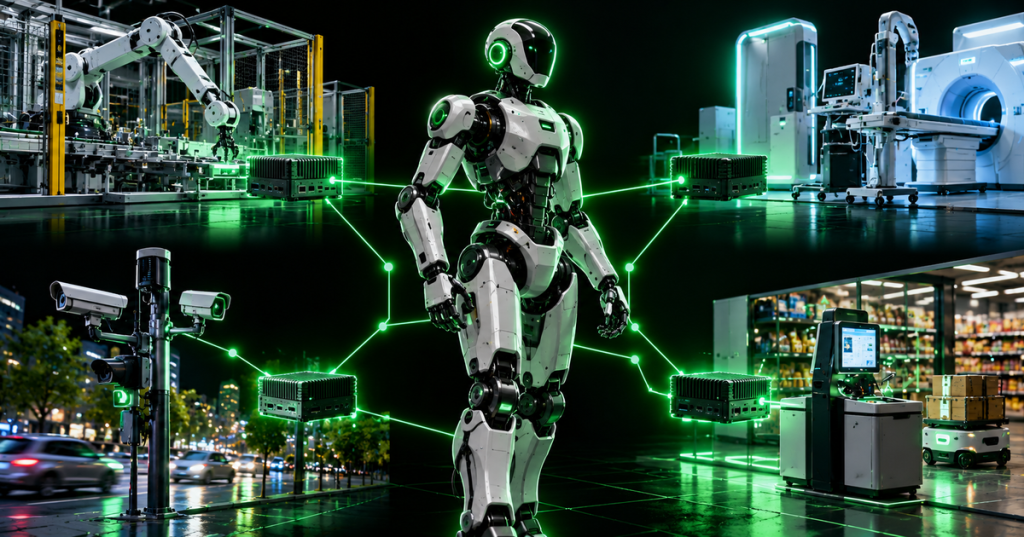
Intel is taking physical AI beyond the prototype stage at Web Summit 2026, where it plans to demonstrate robotics and edge-computing systems built to sense, reason and act locally across manufacturing, healthcare, retail and smart-city environments.
In its October 15 announcement, Intel said its Lisbon demonstrations will focus on the infrastructure beneath physical AI: local sensing, edge inference, real-time control and open software. The company is positioning the event around a practical question—how developers move robots and autonomous systems from convincing demonstrations into reliable production deployments.
The official Web Summit schedule lists Intel sessions on scaling AI pilots, cognitive cities and the engineering trade-offs involved in putting robots to work. That emphasis matches a broader shift BitcoinVersus.Tech has tracked through AMD’s physical-AI work at ROSCon, robot gyms becoming training-data factories and TDK’s PositionSense rollout.
Intel’s core pitch is that physical AI depends on more than accelerator performance. Latency, power draw, sensor integration, deterministic control and the cost of running inference continuously at the edge can determine whether a robot works economically outside a lab.
Web Summit runs November 9–12 in Lisbon. Intel’s presence suggests the next competition in physical AI will be less about isolated robot demos and more about which hardware-and-software stacks can operate reliably, efficiently and at scale.
BitcoinVersus.Tech Editor’s Note:
We volunteer daily to ensure the credibility of the information on this platform is Verifiably True. If you would like to support to help further secure the integrity of our research initiatives, please donate using the QR code provided

For best QR-code scanning results, please scan this donation code from a desktop or larger screen. Mobile screens may prevent camera recognition.


Leave a Reply