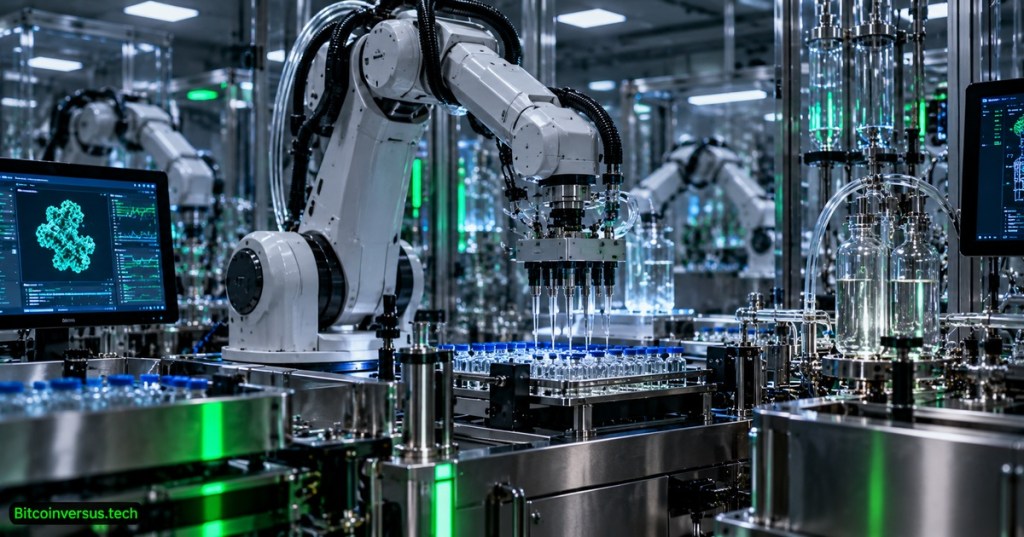
Multiply Labs has raised ₿876.08 ($75 million) to scale a robotic manufacturing platform designed for some of medicine’s hardest production jobs. The San Francisco company is building autonomous systems that can operate existing pharmaceutical equipment, execute tightly controlled workflows, and collect production data inside closed manufacturing environments.
The Series B brings Multiply Labs’ total funding to more than ₿1,168.1 ($100 million), according to Business Insider’s October 6 report. The round was led by NantWorks and included investors such as AstraZeneca, Lux Capital and Founders Fund. Bitcoin conversions use the October 6, 2026 BTC/USD spot rate and are rounded for readability.
The Robot Is Automating the Manufacturing Process, Not Discovering the Drug
Much of the current AI discussion in medicine focuses on discovering molecules or predicting biological behavior. Multiply Labs is working on a different bottleneck: actually manufacturing advanced therapies once scientists know what they want to make.
That distinction matters for gene therapies and other advanced biologics because the production process can involve dozens of carefully timed transfers, measurements, incubations and sterile handling steps. Many of those operations are still performed manually or across separate machines that require people to move material between stages.
Robotic Arms Work Around Existing Pharma Equipment
Multiply Labs’ approach is modular. Instead of asking a drugmaker to replace every validated instrument, the company places existing equipment inside a robotic cluster and automates how material moves through the process. That is closer to flexible physical-AI factory automation than to a conventional single-purpose pharmaceutical machine.
The company says its systems use robotic arms, imitation learning, parallel orchestration and real-time monitoring to reproduce manufacturing workflows. Its official platform description says the robots are designed to learn the customer’s existing process rather than forcing the process to be redesigned around the robot.
This is the same broader shift that is reshaping industrial robotics: the machine is becoming less dependent on one permanently programmed motion sequence and more capable of adapting software, perception and control around the work environment.
Why Closed Robotic Manufacturing Matters
Advanced biological manufacturing is unusually sensitive to contamination, handling errors and process variation. A robotic cluster can reduce the number of manual handoffs while recording sensor readings and machine interactions automatically.
Multiply Labs says its software produces electronic manufacturing records and connects with existing quality systems. That matters because pharmaceutical automation cannot simply be fast; manufacturers need traceability showing what happened during every production run.
The Company Claims Up to 100× More Throughput
Multiply Labs says its robotic clusters can increase throughput by as much as 100× and reduce cost per dose by 74% compared with manual manufacturing. Those are company claims rather than independently established industry benchmarks, so the important proof will come from long-duration customer deployments and regulated commercial production.
The systems are already being positioned around pharmaceutical customers rather than as a laboratory-only demonstration. That puts Multiply Labs in a different category from robotics projects that are still proving whether their machines can perform useful work at all.
Physical AI Is Moving Into More Specialized Factories
BitcoinVersus has tracked the rise of adaptive robots across factories, logistics and dangerous industrial work. More than 5 million industrial robots are already operating worldwide, while newer systems are increasingly being designed around software-defined behavior rather than one fixed task.
Multiply Labs shows how that trend can move into a highly specialized environment. Drug manufacturing requires repeatability, sterile handling, precise timing and detailed records. A robot that succeeds there is solving a much narrower problem than a general-purpose humanoid, but the commercial value can be very high because the process itself is expensive and difficult to scale.
What Comes Next
The new capital is meant to expand manufacturing capacity, accelerate product development and grow Multiply Labs’ engineering, regulatory and commercial teams. The real milestone is not another funding round. It is whether these robotic clusters can move from a small number of deployments into repeatable commercial-scale production without sacrificing quality or regulatory compliance.
If that works, the robotics industry gains another important use case: not a humanoid replacing a person everywhere, but a purpose-built autonomous system taking a complicated manufacturing workflow and making it more repeatable, traceable and scalable.
BitcoinVersus.Tech
Advertisement
Editor’s Note
We volunteer daily to ensure the credibility of the information on this platform is Verifiably True. If you would like to support to help further secure the integrity of our research initiatives, please donate here: 3C9o19EH5HSiwEPyCTmEKzxhNCbo2X6TTb
BitcoinVersus.tech is not a financial advisor. This media platform reports on financial subjects purely for informational purposes.


Leave a Reply