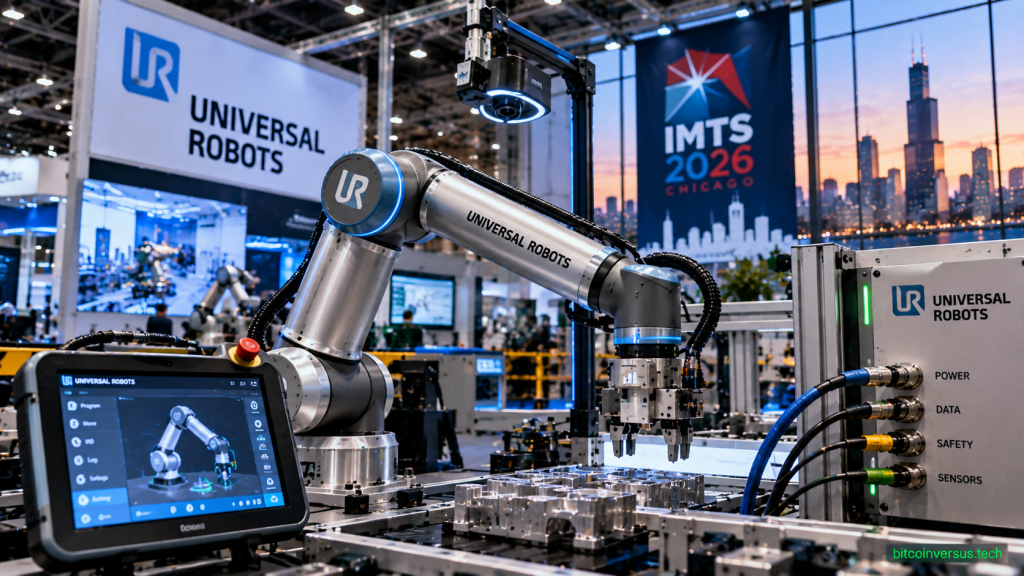
Universal Robots has launched Gen 7, a redesigned collaborative-robot platform built to make physical-AI applications easier to deploy on factory floors.
In the company’s September 14 announcement at IMTS 2026 in Chicago, Universal Robots introduced the g-Series, CB7 Core controller, TP7 Core teach pendant, SP7 Smart Panel and PolyScope X as one unified platform. A same-day X post highlighted one of the more practical hardware changes: power, data, safety and sensor links moving directly into the tool flange.
Gen 7 moves more integration into the robot itself
Traditional industrial robot deployments can require external cabling, separate vision hardware, extra controllers and custom wiring around each end effector. Universal Robots says Gen 7 is designed to collapse more of that infrastructure into the robot platform itself.
The new g-Series brings ethernet, high-power connections and configurable I/O closer to the tool, while the CB7 Core controller provides more onboard compute and a smaller physical footprint. PolyScope X ties the hardware together with open APIs and an SDK intended to support AI applications directly on the platform.
Physical AI is becoming a factory integration problem
Independent IMTS coverage describes Gen 7 as a complete system upgrade rather than a single new arm. The platform is built around the idea that deploying AI in manufacturing requires better integration between robot hardware, sensing, software and operator interfaces.
That broader software shift is already visible across the robotics ecosystem. BitcoinVersus.Tech recently covered Intrinsic open-sourcing its industrial robotics stack, NVIDIA bringing AI agents into Isaac ROS 5.0, and Qualcomm moving deeper into robotics through PickNik. Gen 7 attacks the same problem from the machine side by making the robot itself easier to connect to vision, tools and AI software.
The controller and teach pendant are part of the redesign
Universal Robots is also changing how technicians and integrators interact with the machine. The TP7 Core teach pendant adds a more modern interface for programming and setup, while the SP7 Smart Panel can be mounted closer to the application for two-hand robot maneuvering and faster adjustment.
The company says the new architecture is intended to simplify installation while preserving the collaborative-robot workflow that made its earlier generations popular with smaller manufacturers and systems integrators.
Why Gen 7 matters
Industrial AI does not become useful simply because a model can recognize objects or plan a motion. The robot still needs reliable power, networking, safety, sensing, controls and software interfaces that can survive production conditions.
Gen 7 is Universal Robots’ attempt to make those layers feel like one platform instead of a collection of add-ons. If that approach works, physical-AI deployments could become less about rebuilding the same integration stack for every cell and more about deploying reusable automation patterns across factories.
BitcoinVersus.Tech
Advertisement: See the BitcoinVersus.Tech X post below for the current Bitaxe mining-hardware promotion.
BitcoinVersus.Tech Editor’s Note:
We volunteer daily to ensure the credibility of the information on this platform is Verifiably True. If you would like to support to help further secure the integrity of our research initiatives, please donate here: 3C9o19EH5HSiwEPyCTmEKzxhNCbo2X6TTb
BitcoinVersus.tech is not a financial advisor. This media platform reports on financial subjects purely for informational purposes.


Leave a Reply