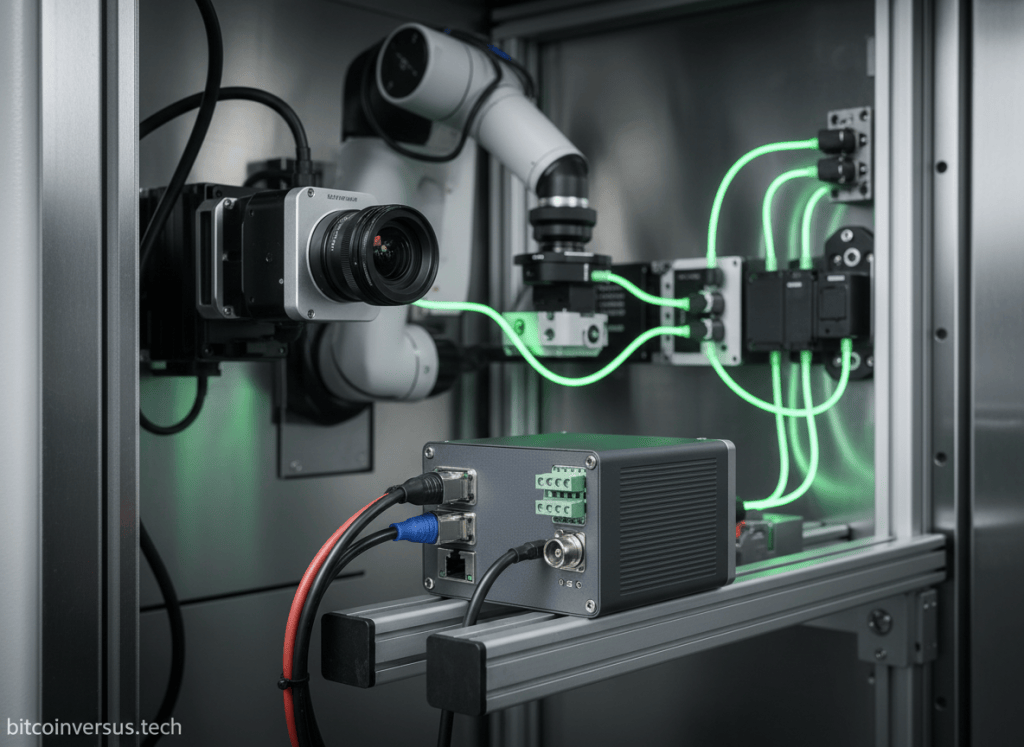
Seeed Studio has launched a fanless industrial edge-AI computer built around Rockchip’s RK3576, combining a 6 TOPS neural processor with RS-485, CAN FD, digital I/O, dual Gigabit Ethernet and wide-voltage power for local AI inference on factory and field equipment.
The company announced the reComputer Industrial RK3576 in a September 24 post, positioning it for industrial automation, machine vision, intelligent equipment and distributed AIoT deployments where data needs to be processed close to the machine rather than sent continuously to the cloud.
Seeed’s official product page describes a fanless Rockchip RK3576 system with a 6-TOPS NPU, native industrial I/O, wide-voltage DC input, hardware watchdog support and multiple mounting options for production environments.
Edge AI moves inference beside the machine
The key design choice is locality. Instead of pushing every camera frame, sensor reading or control event to a remote cloud service, the RK3576 can run supported AI workloads directly at the edge.
That matters in environments where latency, bandwidth, privacy or intermittent connectivity make cloud-only inference impractical. A machine-vision camera on a production line can detect an event locally, trigger an output and continue operating even if the upstream network is degraded.
BitcoinVersus.tech recently covered a similar efficiency trend in Ambarella’s low-power physical-AI processor, where useful perception workloads move closer to cameras and machines instead of relying exclusively on centralized compute.
Industrial I/O is what separates this from a desktop AI box
The RK3576 platform is not only an AI accelerator in a rugged enclosure. Its industrial value comes from the interfaces around the processor.
Seeed lists dual RS-485 connections, CAN FD, digital input/output, dual Gigabit Ethernet with one PoE-capable interface, a 9-to-36-volt DC input, DIN-rail or wall mounting and passive cooling. The system is specified for operation from 0°C to 60°C.
Those ports let the computer sit between traditional industrial equipment and newer AI workloads. RS-485 can connect meters, sensors and controllers already deployed in the field, while Ethernet can link cameras, supervisory systems and upstream networks.
BitcoinVersus.tech’s Modbus RTU over RS-485 guide shows why that matters: a large amount of industrial equipment still communicates through simple serial field networks that remain useful precisely because they are predictable and robust.
The RK3576 balances CPU, NPU and media processing
The underlying RK3576 combines four Arm Cortex-A72 performance cores with four Cortex-A53 efficiency cores, a Mali GPU and the 6-TOPS neural-processing unit.
Hackster’s independent coverage of Seeed’s RK3576 platform describes the same eight-core architecture and 6-TOPS NPU, noting that the chip is designed for computer-vision and other edge-AI workloads.
The platform also supports high-resolution video decode and encode, which is useful for machine vision because the system can ingest and process camera feeds without dedicating the entire CPU to media handling.
One-click deployment lowers the integration barrier
Seeed is pairing the hardware with reComputer AI Lab, its model-deployment layer for converting and launching supported AI workloads on the device.
That software layer matters because edge AI often fails at the deployment step rather than the model step. A prototype may work on a developer workstation but require driver changes, model conversion, accelerator-specific runtimes and operating-system configuration before it can run reliably on industrial hardware.
Industrial AI needs hardware that can live beside the equipment
A factory-floor AI computer has different requirements from a desktop workstation. It needs stable power behavior, industrial mounting, long unattended operation, field I/O, network redundancy and thermal management that does not depend on exposed fans.
That is why fanless enclosures and DIN-rail mounting matter even though they sound less exciting than TOPS figures. The computer has to survive as part of the control cabinet, not only perform well on a benchmark.
The broader direction is visible in Universal Robots’ Gen 7 platform, where factory robotics is becoming more software-defined and more dependent on local perception, networking and compute at the machine level.
Cloud AI is not disappearing — the edge is taking the time-critical jobs
Systems like the reComputer Industrial RK3576 do not replace data centers. They divide the workload differently.
Large model training, fleet analytics and centralized data storage still belong in cloud or data-center infrastructure. The edge computer handles the part that benefits from immediacy: vision inference, local alarms, protocol translation, sensor fusion and machine control.
That division may become one of the defining architectures of industrial AI. Central systems learn from large datasets while ruggedized local computers make second-by-second decisions beside the equipment generating the data.
BitcoinVersus.Tech
Advertisement
BitcoinVersus.Tech Editor’s Note:
We volunteer daily to ensure the credibility of the information on this platform is Verifiably True. If you would like to support to help further secure the integrity of our research initiatives, please donate here: 3C9o19EH5HSiwEPyCTmEKzxhNCbo2X6TTb
BitcoinVersus.tech is not a financial advisor. This media platform reports on financial subjects purely for informational purposes.


Leave a Reply