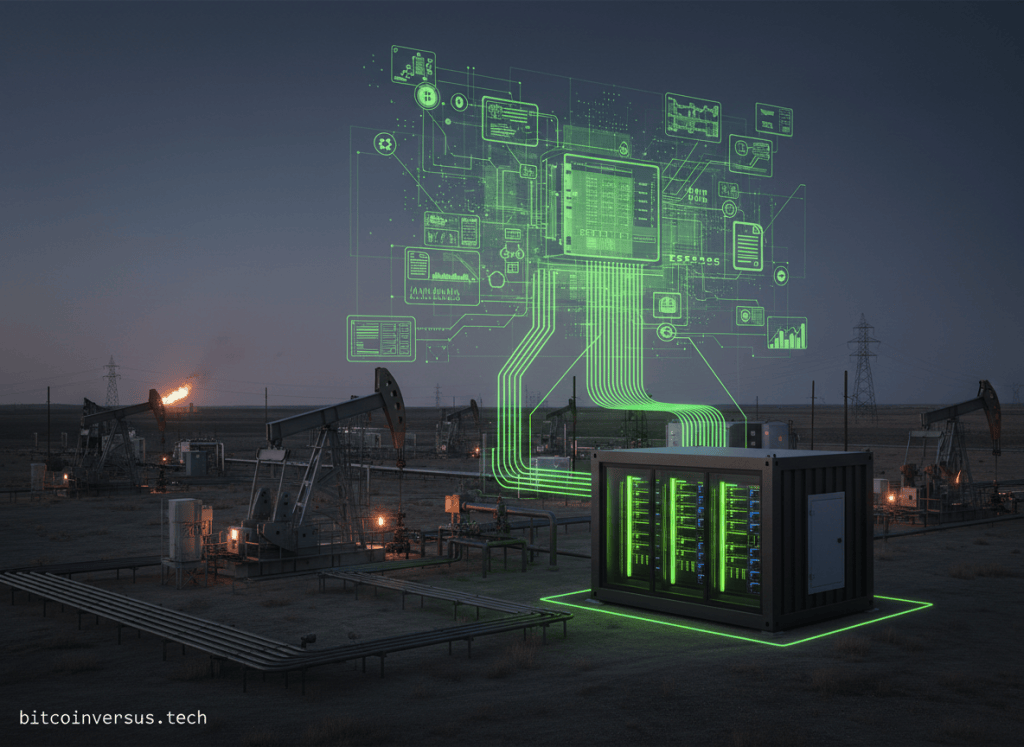
Battalion Oil is investing directly in oil-and-gas-specific artificial intelligence, backing Collide Industrial Technologies and preparing to unify more than 100 terabytes of well files, land records, contracts, production history and field data inside a single AI-native operating environment.
The September partnership is more than a software subscription. Battalion made an equity investment in Collide, became a Strategic Partner with product-advisory rights and says it will deploy Collide’s operations system across its upstream business. Financial terms were not disclosed.
Collide co-founder and CEO Collin McLelland described the deployment in a September 9 post, saying Battalion has roughly 100 terabytes of well files and that the first step is to ingest land and title documents, midstream contracts, production data and surface-facilities information before layering petroleum-engineering agents on top.
Battalion is trying to turn legacy oilfield data into an operating system
According to Battalion’s September 8 announcement, Collide’s platform is designed specifically for upstream, midstream and oilfield-service workflows rather than as a general-purpose chatbot layered over company documents.
The system, including Collide’s Riggs work environment, is intended to connect PDFs, spreadsheets and legacy databases into a common business model that oilfield-specific agents can query and act on. Planned use cases include gas-marketing reconciliation, field-invoice review, power-usage analysis, hedging support and well-failure diagnostics.
A Stock Titan review of the deal notes that the rollout begins with more than 100 terabytes of records and that Riggs is expected to reach Battalion production engineers around the first 90 days of deployment.
This is a data-infrastructure problem before it is an AI problem
Oil and gas companies often have decades of operating history split across file servers, spreadsheets, GIS systems, land databases, maintenance platforms and engineering applications. The AI layer is only useful if those records can be normalized, connected and retrieved with enough context to support a real field decision.
That is why Battalion’s 100-terabyte figure matters. The investment is not mainly about buying access to a language model. It is about building a data layer that can connect a well’s production history with lease obligations, power usage, invoices, facilities information and engineering analysis.
The same infrastructure-first logic appears elsewhere in energy. BitcoinVersus.tech recently covered how Kazakhstan is pairing oil-field gas with on-site compute infrastructure, where generators, networking, controls and data systems become part of the value chain around the well.
AI agents are replacing some legacy software integrations
Collide’s engineering pitch is that AI agents can sit across multiple legacy systems instead of forcing an operator to replace every old application first. An agent can retrieve data from different sources, apply domain logic and return an auditable answer or workflow to the engineer.
That does not eliminate traditional oilfield software. It changes the integration layer. Instead of requiring every system to present the same interface, an AI-native layer can potentially translate between document stores, production databases, mapping systems and operational applications while keeping the human operator in review.
Battalion is also looking at a West Texas data center
The most interesting line in Battalion’s announcement sits outside the software deployment. The company says it is exploring a large-scale data center on company-owned surface acreage in West Texas, using existing power, water and natural-gas infrastructure.
That creates a second technology pathway for an oil producer: use AI internally to improve field operations while also evaluating whether energy and land assets can support external compute infrastructure.
BitcoinVersus.tech has already tracked that convergence in West Texas. Sterling Digital recently brought compute online using West Texas gas, showing how energy infrastructure can be paired directly with high-density computing loads.
The same model is spreading beyond Bitcoin mining. xAI’s Memphis data-center expansion demonstrated how natural-gas generation can become part of the power stack for large AI systems.
Oil companies increasingly own assets that AI infrastructure needs
Oil and gas producers control more than hydrocarbons. Many also control large land positions, power connections, water access, roads, communications infrastructure and fuel supply—exactly the physical inputs that large computing sites struggle to secure quickly.
Battalion’s Collide investment shows the digital side of that transition. Its West Texas data-center review shows the physical side. One uses oilfield data to improve the energy business; the other asks whether the energy business itself can become infrastructure for computing.
The investment amount remains undisclosed, so the immediate metric to watch is deployment rather than valuation: whether Riggs reaches production engineers on schedule, whether operators actually use the agents in daily workflows, and whether Battalion advances the proposed West Texas data-center project beyond exploration.
BitcoinVersus.Tech
Advertisement
BitcoinVersus.Tech Editor’s Note:
We volunteer daily to ensure the credibility of the information on this platform is Verifiably True. If you would like to support to help further secure the integrity of our research initiatives, please donate here: 3C9o19EH5HSiwEPyCTmEKzxhNCbo2X6TTb
BitcoinVersus.tech is not a financial advisor. This media platform reports on financial subjects purely for informational purposes.


Leave a Reply