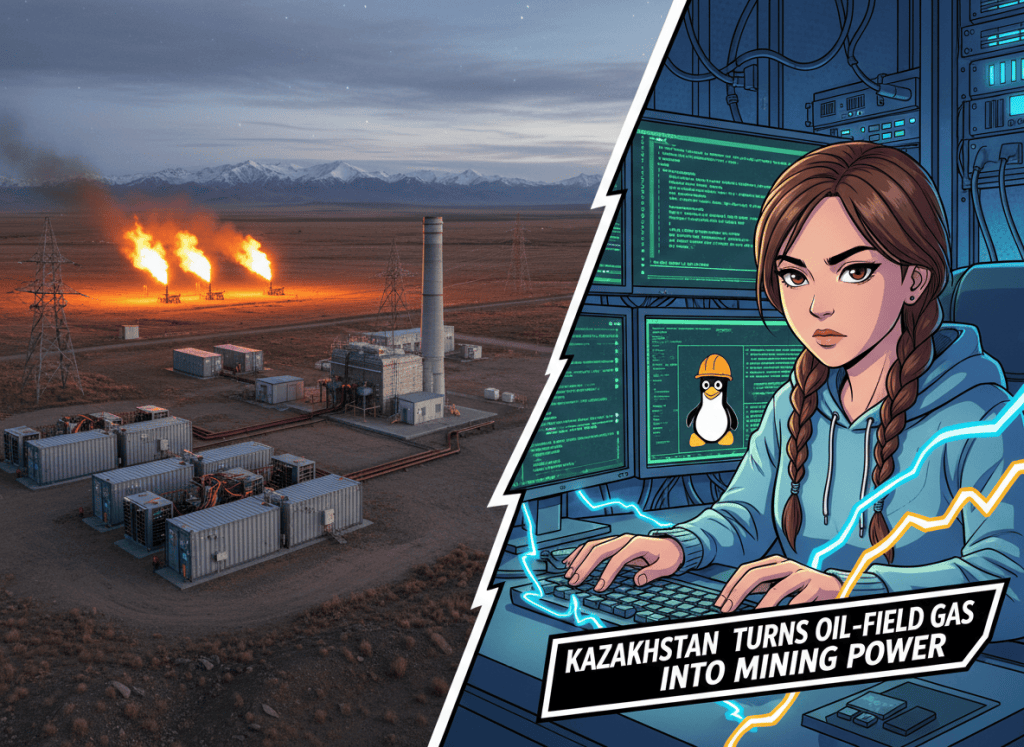
Kazakhstan is moving to connect two industrial systems that normally sit far apart: oil-field associated gas and high-density cryptocurrency mining. The government is developing a framework that would let miners install autonomous power plants at oil and gas fields, converting gas that can otherwise be flared into electricity for mining centers.
The proposal is especially relevant to Bitcoin mining infrastructure because it shifts the load away from Kazakhstan’s public grid and toward behind-the-meter generation located beside the fuel source. That turns gas conditioning, generator efficiency, electrical distribution, cooling, networking and ASIC uptime into one integrated site-engineering problem.
Oil-field gas becomes mining power
Euronews reported September 25 that Kazakhstan is allowing miners to use excess associated petroleum gas from oil fields to generate electricity at their own power plants. The country’s Ministry of Energy says roughly 40 to 60 oil fields currently flare associated gas.
The policy direction is also reflected in Kazakhstan’s government action plan. On September 15, the government instructed the Ministry of Energy and Ministry of Artificial Intelligence and Digital Development to work out mechanisms for using gas and coal generation to power mining centers.
Interfax-Kazakhstan reported that Deputy Minister Gizzat Baitursynov described a mechanism allowing miners to generate power from associated petroleum gas directly at oil fields. The model is intended to create autonomous generation rather than simply adding another large 24/7 load to the national grid.
A 100,000-cubic-meter gas stream can support industrial scale
The engineering numbers make the concept more than a small pilot. Industry participants cited by Euronews estimate that an oil field producing 100,000 cubic meters of associated gas per day could support roughly 13 to 15 MW of generation, assuming a gas-piston system produces about 3 to 3.5 MWh from each 1,000 cubic meters of gas.
That sits squarely inside the range of an industrial mining site. The same report places a typical industrial mining farm around 5 to 20 MW, with large facilities exceeding 50 MW. Kazakhstan reportedly flared roughly 300 to 340 million cubic meters of associated petroleum gas in 2024, which industry estimates say could have produced approximately 1.2 to 1.3 TWh of electricity.
The real hardware is bigger than the ASIC
For miners, cheap fuel does not automatically mean cheap Bitcoin. A remote oil-field deployment needs gas treatment, gas-piston generators, switchgear, transformers, protection systems, distribution, communications and a mining load capable of operating continuously. Cooling also matters, particularly where water availability is limited.
Industry participants told Euronews that large operators generally look for fields capable of at least 5 MW because the project must absorb the cost of infrastructure and equipment maintenance. Building a new power station was estimated at roughly €1.7 million to €2.2 million per MW and could take more than three years, which helps explain the emphasis on specialized engineering partners.
That is the same infrastructure-first logic visible across BitcoinVersus.tech’s Bitcoin mining coverage: ASIC specifications matter, but the economics of a fleet are ultimately tied to delivered energy cost, uptime, heat rejection and the electrical plant feeding the machines.
Kazakhstan is trying a different mining model
Kazakhstan’s earlier mining boom put substantial pressure on an aging electrical system. The government responded with restrictions, licensing rules and an electricity-auction system tied to surplus generation. The oil-field model takes a different approach by pairing compute directly with stranded or underused energy.
It also gives oil producers another outlet for associated gas. Instead of treating the gas only as a disposal problem, an operator can potentially sell it as fuel while a mining company finances generation and compute infrastructure near the field.
For Bitcoin miners, the development is worth watching because it resembles other stranded-energy mining deployments but at potentially meaningful industrial scale. The key question will be how Kazakhstan’s final rules handle permits, generation ownership, mining licenses, taxation and the transfer of mined digital assets under its broader strategic-mining framework.
BitcoinVersus.Tech Editor’s Note:
Support BitcoinVersus.tech with Bitcoin: 3C9o19EH5HSiwEPyCTmEKzxhNCbo2X6TTb
Follow BitcoinVersus.tech on X: https://x.com/BitcoinVersus
BitcoinVersus.tech is not a financial advisor. This media platform reports on financial subjects purely for informational purposes.


Leave a Reply