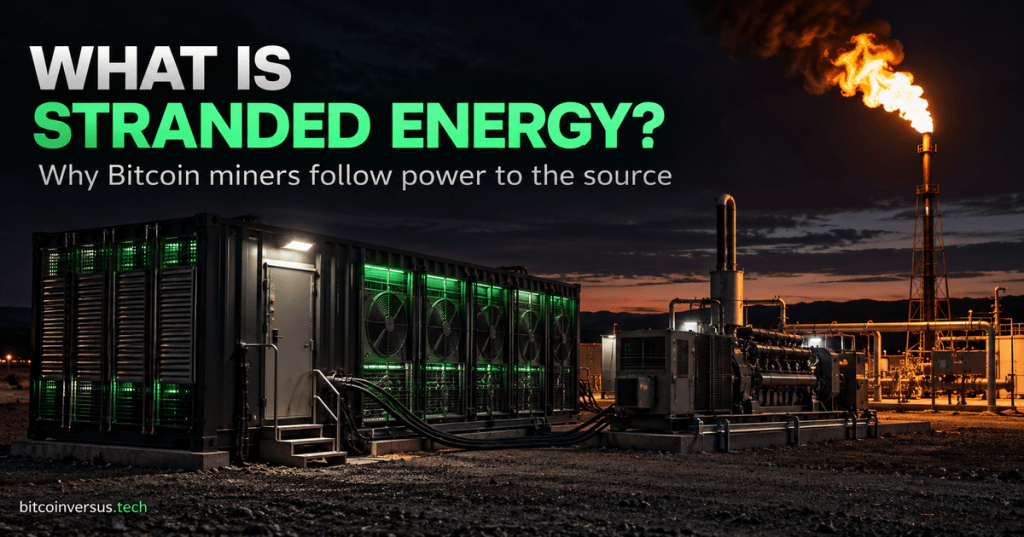
Stranded energy is usable energy that exists in the wrong place, at the wrong time, or without an economical path to a buyer. The power itself may be perfectly good. The problem is that transmission lines, pipelines, local demand, storage, or market access are missing or constrained.
Bitcoin mining is unusually compatible with this kind of energy because mining machines can move to the power source instead of requiring the power source to move to a city, factory, or traditional data center. That location flexibility is why miners keep appearing beside oil fields, remote hydro plants, renewable projects, and other energy systems with surplus output.
Stranded does not mean free
Stranded energy is often described as “wasted” power, but the two ideas are not identical. Energy can be stranded even if it still has some local use or future market value. What makes it stranded is the inability to sell or transport all of it economically under current conditions.
A remote generator may have fuel but no transmission line. A hydro plant may be able to produce more electricity than the nearby community can consume. A wind or solar project can be curtailed when the grid is congested. An oil well can produce associated natural gas before pipeline takeaway capacity is available. In each case, the resource exists before the market connection does.
Flare gas is the easiest example to visualize
Oil production can bring natural gas to the surface along with crude oil. When there is no economical pipeline or other way to move that gas to market, operators may flare it rather than sell it. The U.S. Energy Information Administration explains that venting and flaring can occur because of infrastructure constraints, maintenance, safety conditions, and limited takeaway capacity. Its 2023 estimate put reported U.S. venting and flaring at roughly 0.5% of gross gas withdrawals, down sharply from the 2018 peak. EIA explains why gas is vented or flared here.
The scale is still enormous globally. The World Bank’s 2026 Global Gas Flaring Tracker estimates that 167 billion cubic meters of associated gas were flared in 2025, with an estimated value of about $54 billion. The World Bank’s latest tracker describes limited market infrastructure as one of the main structural reasons routine flaring persists.
That creates a straightforward engineering opportunity: route part of the gas into a generator, convert it into electricity, and place a modular computing load beside the generator. Bitcoin mining is one of the loads that can absorb that power without needing a fiber-heavy customer market nearby.
BitcoinVersus.Tech has covered the same model in practice, including Sterling Digital’s first Bitcoin output from West Texas gas and Kazakhstan projects designed to turn oil-field gas into mining power.
Why Bitcoin mining fits stranded power better than many loads
Most electricity customers care deeply about location. A factory needs workers, roads, suppliers, and shipping. A conventional cloud data center needs dense fiber connectivity and strict uptime. A residential neighborhood obviously cannot relocate every time a new energy source becomes available.
Bitcoin mining is different. A container full of ASIC miners mainly needs electricity, cooling, networking sufficient to communicate with the mining pool, and technicians who can reach the site. The computation can happen almost anywhere because the workload does not need to sit next to the end user.
Mining is also interruptible. A miner can reduce load when electricity becomes more valuable elsewhere, then resume when surplus power returns. That does not mean every mining operation is automatically helpful to a grid or energy producer, but it gives operators a level of flexibility that many industrial loads cannot match.
Stranded renewable energy works the same basic way
The concept is not limited to natural gas. A renewable project can become partially stranded when generation is available but transmission capacity or local demand is not. Hydroelectric plants can face seasonal surpluses. Wind and solar projects can be curtailed when the grid cannot accept their full output.
A flexible computing load can sit near that generation and buy energy during periods when another buyer is unavailable. In that sense, the miner is not creating the electricity resource; it is creating a buyer that can travel to the resource.
The economics depend on more than the electricity price
Cheap energy alone does not make a stranded-energy project profitable. The miner still has to pay for generators, transformers, switchgear, containers, cooling, networking, maintenance, fuel treatment, site access, permits, labor, and ASIC hardware. Low uptime can erase the advantage of a low headline power price.
The quality of the energy matters too. Gas flow can vary. Remote hydro can be seasonal. Curtailment windows can be unpredictable. A mining fleet therefore needs an operating model that can tolerate changing power availability without destroying equipment or creating excessive restart labor.
Stranded energy can stop being stranded
This is one of the most important caveats. If a new pipeline, transmission line, industrial customer, battery project, or local market appears, the energy may suddenly have a more valuable buyer. A mining project that only works because nobody else can use the energy must be designed around that possibility.
That is also why the concept overlaps with, but is not identical to, behind-the-meter power. Behind-the-meter describes where generation sits relative to the utility meter. Stranded energy describes a market and infrastructure problem: useful energy exists, but its path to an economical buyer is constrained.
The simple mental model
Think of stranded energy as power without a practical customer. Bitcoin mining can turn that equation around by moving a customer to the power.
That does not make every stranded-energy mining project efficient, profitable, or environmentally beneficial. The counterfactual matters: what would have happened to the energy without the mining load? The hardware, emissions profile, reliability, local rules, and future market value of the energy all still matter.
But the basic reason miners keep showing up in unusual places is simple. Bitcoin turns electricity into a globally marketable digital output, so the mine does not need to wait for the traditional customer to arrive. In many projects, the compute can go where the electrons already are.
BitcoinVersus.Tech
Advertisement
Editor’s Note
We volunteer daily to ensure the credibility of the information on this platform is Verifiably True. If you would like to support our research and publishing work, please donate here: 3C9o19EH5HSiwEPyCTmEKzxhNCbo2X6TTb
BitcoinVersus.tech is not a financial advisor. Content is provided for informational purposes.


Leave a Reply