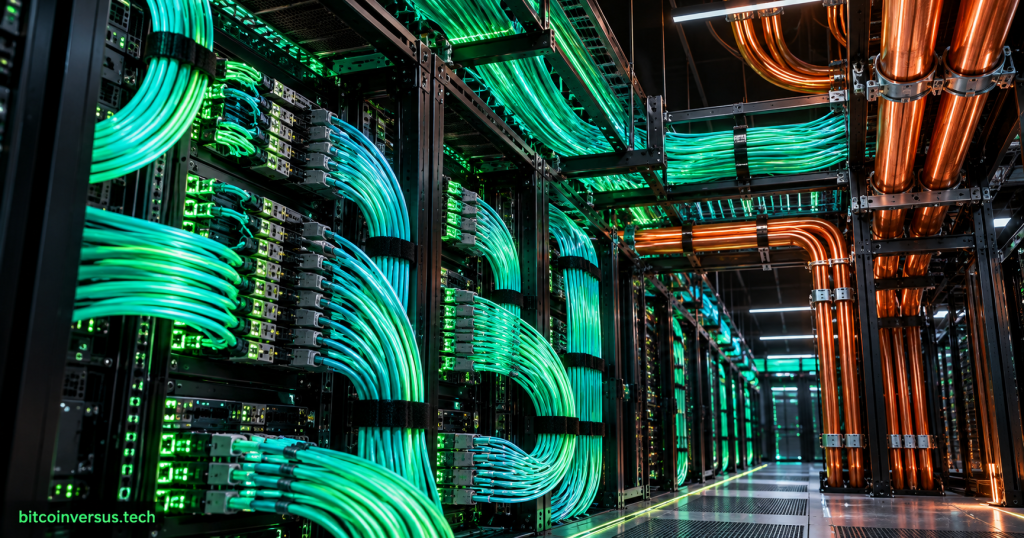
Data center cabling used to be easy to overlook. Servers, switches, chillers, UPS systems, and generators got most of the attention while copper and fiber quietly connected everything together.
AI is changing that hierarchy. As accelerator clusters grow larger and links move toward 800G, 1.6T, and eventually higher speeds, the physical network is becoming denser, harder to install, more sensitive to loss and heat, and more expensive to build incorrectly. At the same time, the power side of the facility is consuming more conductor material as rack density climbs.
The result is simple: cabling is becoming more valuable because the data center cannot scale without it, and more expensive because both the materials and the engineering requirements are moving upward at the same time.
The Data Center Is Becoming a Wiring Machine
AI racks create more connections in less space. More GPUs mean more links between accelerators, switches, storage, management networks, and adjacent racks. Scale-out fabrics push those connections across rows, rooms, buildings, and campuses.
Corning’s recent AI connectivity portfolio shows how quickly that density problem is evolving. Its newest micro cable is designed to place up to 50% more fiber into the same duct, while its multicore fiber packs four optical cores into one standard-sized strand. Corning says the multicore approach can reduce connector count by up to 75%, cable mass by up to 70%, and installation time by up to 60%.
That is not a cosmetic improvement. Pathway space, bend radius, connector access, labeling, tray fill, and serviceability are becoming design constraints. BitcoinVersus.Tech’s Data Center Cabling Fundamentals 101 explains the basics, but AI infrastructure is pushing those fundamentals into a much higher-density operating environment.
Copper Still Matters, and It Is Getting More Expensive
Fiber may be taking more of the high-speed data path, but copper is not disappearing. It remains critical for rack power, busways, branch circuits, grounding, short-reach interconnects, transformers, switchgear, and the grid infrastructure that feeds the campus.
That matters because copper has become more expensive. Recent market reporting described copper reaching record levels as tariff uncertainty collided with growing demand from AI data centers, electrical infrastructure, and grid expansion. Even when the conductor is only one part of a cable assembly, a sustained rise in copper cost works its way through power-cable pricing, connectors, busbars, and distribution equipment.
One recent X post summarized the physical chain neatly: AI needs data centers, data centers need power, power needs grids, and grids need transformers, cables, and conductors.
Bandwidth Makes Every Cable More Important
Higher link speeds raise the cost of mistakes. At lower speeds, a marginal cable route or dirty connector might create an intermittent problem. At 800G and 1.6T, insertion loss, reflections, connector cleanliness, bend radius, polarity, lane mapping, and thermal conditions become much less forgiving.
BitcoinVersus.Tech recently covered how 1.6T Ethernet is moving closer to deployment. That transition increases pressure on the passive layer because the network must move more data through the same rack face, cable tray, and building pathways without turning maintenance into a physical maze.
The density numbers are already extreme. BitcoinVersus.Tech also reported on Molex packing up to 3,456 fibers into 1RU. Once thousands of fibers can occupy a rack unit, cable management becomes part of system architecture rather than housekeeping.
The Technician Becomes More Valuable Too
As cabling gets denser, the labor becomes more specialized. Technicians increasingly need to understand fiber inspection and cleaning, polarity, loss budgets, OTDR traces, light-level testing, high-density connector systems, copper certification, grounding, labeling, pathway management, and documentation.
That skill has direct economic value. A rack full of expensive accelerators can sit idle because of one bad trunk, a contaminated fiber end face, a mislabeled patch, a damaged connector, or a power-cable problem. The cost of the cable itself may be small compared with the compute attached to it, but the cable can still determine whether that compute is usable.
This is why installation quality matters more as data centers grow. Dense cabling that is badly routed can obstruct airflow, complicate liquid-cooling service, increase troubleshooting time, violate bend-radius limits, and make future upgrades slower. A clean physical layer makes every later layer easier to operate.
Fiber Is Moving Closer to the Chip
The next step makes cabling even more central. Co-packaged optics and near-packaged optics move optical connections closer to switches and accelerators, reducing how far very high-speed electrical signals have to travel. That can improve bandwidth density and power efficiency, but it also turns fiber routing, connector precision, and serviceability into part of the compute platform itself.
In other words, the cable is no longer simply the thing between two boxes. Increasingly, the optical path is becoming part of the box.
Cabling Is Becoming Strategic Infrastructure
The AI buildout is exposing an old truth about infrastructure: the least glamorous layer can still become the bottleneck. GPUs cannot exchange data without fiber. Racks cannot run without copper and busway. Buildings cannot scale without pathways. Technicians cannot troubleshoot what was never labeled, tested, or documented correctly.
As data centers grow from buildings into campuses and from campuses into distributed AI networks, cabling increasingly determines how quickly capacity can be installed, how efficiently it can run, and how easily it can be repaired or expanded.
That makes the future of the data center surprisingly physical. More AI means more silicon, but it also means more glass, more copper, more connectors, more trays, more testing, and more people who know exactly how to put all of it together.
BitcoinVersus.Tech
Advertisement
Editor’s Note:
We volunteer daily to ensure the credibility of the information on this platform is Verifiably True. If you would like to support our research initiatives, please donate here: 3C9o19EH5HSiwEPyCTmEKzxhNCbo2X6TTb
BitcoinVersus.tech is not a financial advisor. This media platform reports on financial subjects purely for informational purposes.


Leave a Reply