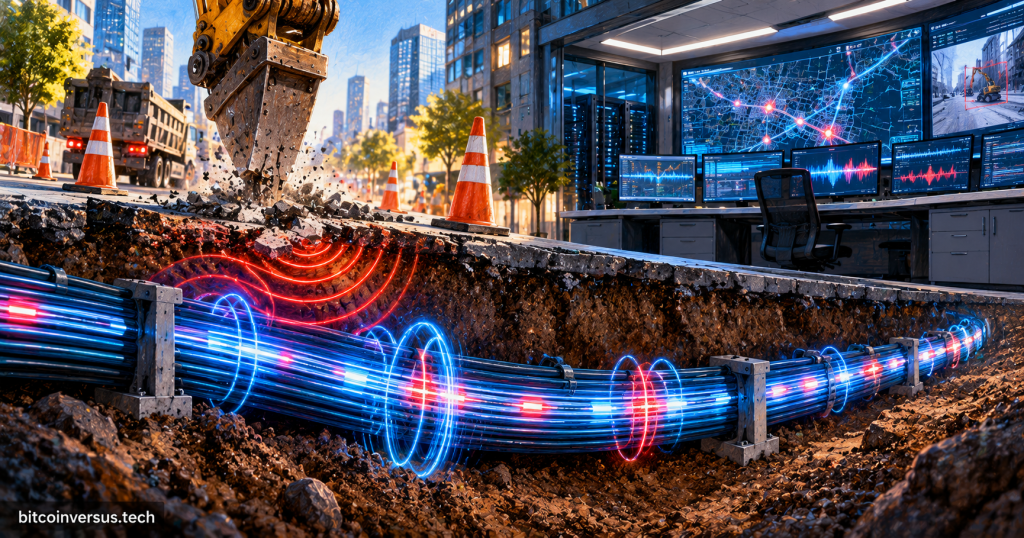
Fiber networks are starting to do more than move data. Comcast is turning sections of its fiber plant into a real-time sensing system that can detect physical activity around buried routes before that activity becomes an outage.
In its September 29 announcement, Comcast said its fiber sensing platform analyzes vibrations traveling through fiber to identify and locate activity around the network. The system can distinguish events such as construction equipment operating near a buried line from ordinary background activity like a subway train passing nearby.
That matters because Comcast operates more than 430,000 miles of fiber. At that scale, even a small reduction in accidental cuts, delayed fault detection, or unnecessary field investigation can translate into a major reliability improvement.
Data Center Dynamics highlighted the deployment in a September 30 X post, describing Comcast’s move to use fiber itself as a real-time monitoring layer.
The Fiber Becomes the Sensor
The most interesting part of the system is that Comcast does not need to install a conventional vibration sensor every few feet along a buried route. The optical fiber already in the ground becomes part of the sensing platform.
Changes caused by nearby physical activity can be analyzed to determine where something is happening and what kind of event it may be. Construction machinery near a buried route can produce a different signature from normal traffic or rail movement, allowing the network operations team to prioritize the events that actually threaten the cable.
That adds another dimension to the physical network. BitcoinVersus.Tech recently examined why fiber and copper cabling are becoming more valuable infrastructure as data centers and AI networks scale. Comcast’s deployment shows that the fiber itself can also become an observability tool.
A Fiber Cut Is Usually a Physical Event First
Many network failures begin outside the network stack. An excavator hits a conduit. A pole is damaged. Construction begins too close to a buried route. A wildfire, vehicle accident, or act of vandalism affects the physical path before software ever sees packet loss.
Traditional network monitoring is very good at recognizing that connectivity has degraded. Fiber sensing tries to move detection earlier in the chain by recognizing the physical event that could cause the degradation before service is lost.
Independent coverage from Data Center Dynamics confirms that Comcast is using the technology to identify activity around fiber routes in real time and give operations teams earlier warning of potential damage.
Network Operations Moves Closer to Physical Reality
Modern network operations centers already consume telemetry from routers, switches, optical systems, power equipment, and environmental sensors. Fiber sensing adds another data source: the physical environment surrounding the cable itself.
That can change field response. Instead of waiting for an alarm that says a link is down, an operator could receive an alert that heavy equipment is active near a critical fiber segment and investigate before service is interrupted.
The same idea becomes more important as backbone links carry more traffic. BitcoinVersus.Tech has covered the move toward 1.6T Ethernet, where fewer physical paths can carry extraordinary amounts of data. The faster and denser the network becomes, the more expensive an avoidable physical interruption becomes operationally.
AI Could Turn Fiber Alerts Into Automated Response
Comcast says it is exploring how the sensing layer could be combined with AI, data, and automated systems. One future example described by the company is automatically dispatching a drone to inspect network damage, vandalism, wildfires, or accidents after the fiber detects suspicious activity.
That creates a possible closed loop: the fiber detects a physical event, software classifies it, an automated system gathers visual information, and a field team receives a more precise diagnosis before arriving on site.
For large distributed networks, that kind of automation matters because the fiber path may span cities, highways, rail corridors, campuses, and remote infrastructure. The challenge is no longer just knowing that something failed. It is knowing exactly where, why, and what should happen next.
Distributed AI Infrastructure Makes Fiber Reliability More Important
AI infrastructure is also becoming more geographically distributed. Compute clusters, storage systems, edge sites, and data centers increasingly depend on high-capacity links between facilities.
BitcoinVersus.Tech recently covered how WhiteFiber linked two data centers into a 136 Tbps distributed GPU supercluster. Architectures like that make the physical integrity of the inter-site fiber part of the compute system itself.
A severed fiber is no longer just a telecom problem if it separates two halves of an AI cluster, interrupts storage access, or forces traffic onto a constrained backup path. Physical network intelligence therefore becomes part of application reliability.
The Network Is Starting to Observe Its Own Environment
Comcast’s deployment illustrates a broader change in infrastructure engineering. Networks are becoming more instrumented, more automated, and more aware of the physical systems around them.
Fiber started as the medium that carried the signal. Now the same strand can help operators understand what is happening around the route carrying that signal.
That makes a buried cable something more than a passive connection between two endpoints. At scale, it becomes part communications link, part environmental sensor, and potentially part of an automated response system.
Editor’s Note
We volunteer daily to ensure the credibility of the information on this platform is Verifiably True. If you would like to support our research initiatives, please donate here: 3C9o19EH5HSiwEPyCTmEKzxhNCbo2X6TTb
BitcoinVersus.tech is not a financial advisor. This media platform reports on financial subjects purely for informational purposes.


Leave a Reply